
How a Rookie Mistake, a Troubled Youth Program, and a Flawed Investigation Collided Inside the Wakulla County Sheriff’s Office
What began as a simple mistake in 2021 spiraled into a full CID interrogation three years later, fueled by a troubled Explorer Program and a complaint with no clear path into the agency. This case reveals how process, timing, and culture inside WCSO can transform missteps into something much larger without a definitive timeline.
CITIZENS STORIES AND SUBMISSIONS2026
Ida B. Wells
6/28/202611 min read
Scroll down for blog update: 07/01/2026
Some stories arrive in fragments. A memo. A parent’s letter. A disciplinary form that doesn’t match the timeline. A deputy who admits her mistake but insists the process that followed was not just flawed, but fundamentally broken.
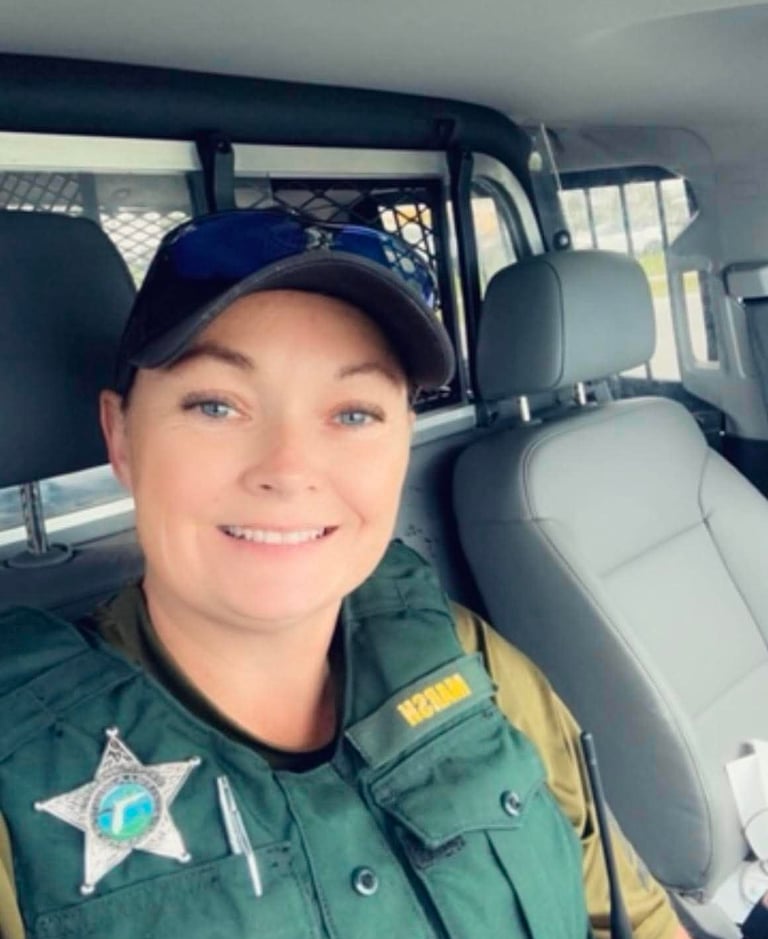
The story of former Deputy Marsh is one of those cases. It is not a simple tale of innocence or guilt. It is a story about timing, judgment, leadership, and the way an agency can mishandle a problem until it becomes something much larger than it ever needed to be.
A Deputy’s Beginning
When Deputy Marsh joined the Wakulla County Sheriff’s Office in 2020, she was like many new deputies. Eager. Green. Learning the ropes. Her early evaluations show a young deputy who arrived early, kept a clean uniform, asked questions, and tried to do things the right way. Any corrective criticism by supervisors was not outside of the normal course of business.
Supervisors described her as adaptable, dependable, and willing to volunteer for extra duties. Over the next few years she became a School Resource Officer, worked at multiple schools, and eventually stepped into a leadership role with the Sheriff’s Explorer Program.
Parents saw her as steady. Kids saw her as approachable. Supervisors saw her as reliable.
Nothing in her file suggested she was on a path toward termination.
The 2021 Mistake
In early 2021, Deputy Marsh made a mistake she has never denied. She ran a name and shared confidential information with a man she knew, S. B. She was young, new to the job, and entangled in a personal situation she should have stepped away from.
She admits this. She owns it. She calls it a bad judgment call.
What is striking is what happened next.
Nothing.
No complaint was filed. No investigation was opened. No discipline was issued. No supervisor documented concern.
The agency simply moved on.
The Explorer Program Begins to Crack
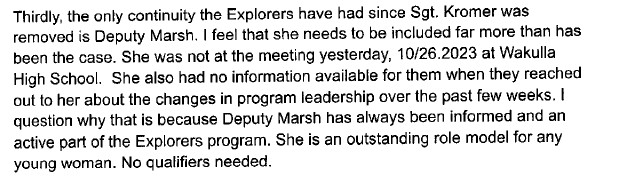
Fast forward to 2023. The Explorer Program, once a bright spot for the Sheriff’s Office, was suddenly unstable. Leadership changed abruptly. Parents were confused. Cadets were upset. One parent wrote a detailed letter to Sheriff Miller describing the chaos and praising only one person for providing continuity.
That person was Deputy Marsh
The parent wrote that she was the only steady presence the kids had left. She was the one they trusted. She was the one who showed up. She was the one who kept the program from falling apart.
Sheriff Miller acknowledged this and placed her in a leadership role. But according Deputy Marsh, being a newer deputy in a tight‑knit agency made this a double‑edged sword. She often felt resistance from peers when trying to schedule training or raise concerns.
When I sat down with her and reviewed the parent’s letter during our interview, I wrote a note to myself in the margin: “this was our trigger.” It was not something from inside the agency. It was my own observation. The timing, the tension, the sudden instability in the Explorer Program. It all pointed to this moment as the spark that set everything else in motion.
A Deputy Planning Her Future
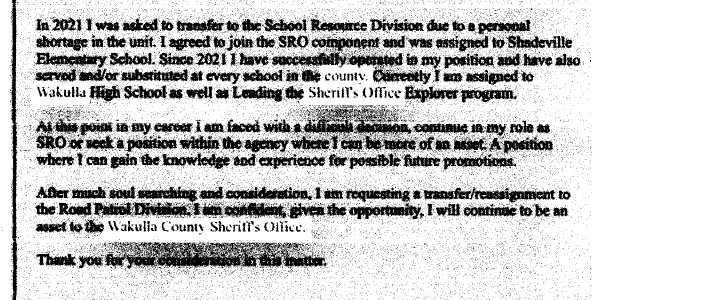
In April 2024, Deputy Marsh submitted a formal memo requesting a transfer back to Road Patrol. The memo is calm, professional, and forward‑looking. She explains her experience, her desire to grow, and her commitment to the agency. Beneath that professionalism, she was also seeking relief from the mounting pressure of managing the Explorer Program. Rather than escalate internal tensions, she attempted to transition quietly.
There is no hint of trouble. No hint of discipline. No hint of an investigation.
She believed she had a future at WCSO.
What Was Happening Behind the Scenes
While Deputy Marsh was on vacation with a colleague, (Major Dale Evans who would later file suit against the county himself) and his family, a memo was filed with WCSO. Not a formal complaint. Not a sworn statement. A memo indicating that she had looked up a woman’s car tag in 2021.
It was now 2024.
A case file was assembled during her vacation. When she returned, it was waiting for her.
June 2024: The Past Comes Back
Three years after the 2021 incident, Deputy Marsh was suddenly called into the Criminal Investigations Division. She walked in expecting to assist with a case. Instead, she found herself being questioned about her own actions from years earlier.
According to the investigative file, a mutual acquaintance of both Marsh and the purported victim, R. T., had loaned his iPad to his five‑year‑old daughter during her shared parenting time in 2024. That acquaintance, S. B., had been in a heated custody dispute with R. T. back in 2021. During that time, Marsh had been a supportive ear to S. B. and even served as a character witness in the custody matter.
In 2024, while the child used the iPad, R. T. accessed the device, discovered old messages from 2021, and later provided screenshots to WCSO nearly three years after the actual incident. Those screenshots became the basis of the new investigation.
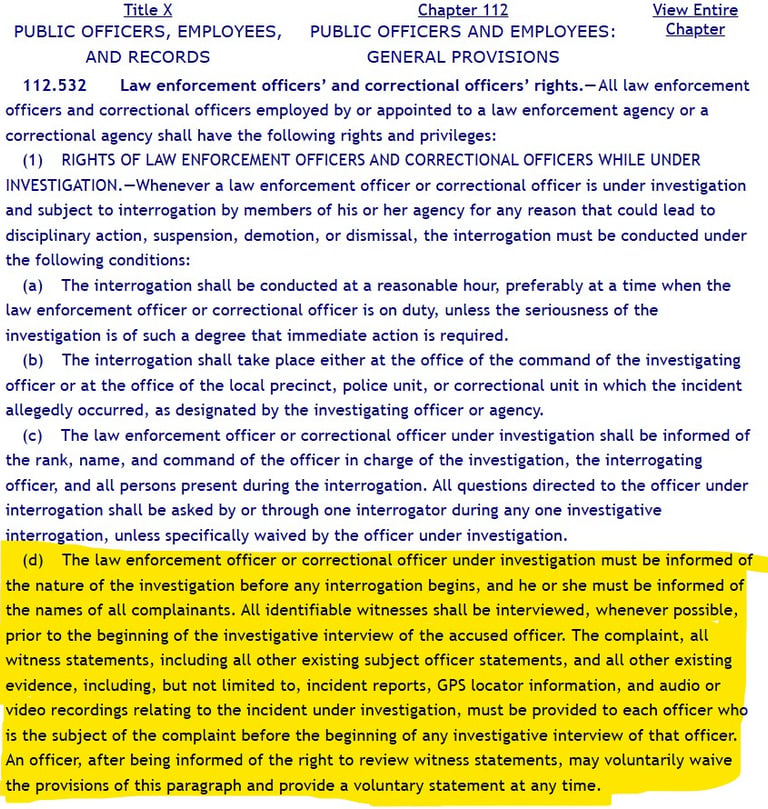
When Marsh arrived at CID, she was not told she was the subject of the investigation until after questioning began. She was not given the complaint. She was not given witness statements. She was not given evidence. She was not given the names of complainants.
Florida law requires all of that before an interrogation. The investigation had already violated the Law Enforcement Officers Bill of Rights before it even started.
The Incident Report That Raised More Questions Than Answers
Detective O.’s report is long, detailed, and emotional. It includes screenshots provided by R. T. and her fiancé, K. G. It includes their recollections of seeing Deputy Marsh in public places. It includes their interpretations of her presence. It includes their feelings about her.
None of these recollections were reported at the time they allegedly occurred.
The complainant stated she did not report it in 2021 because she believed WCSO “looked out for their own.”
What the report does not include is the one thing any prudent investigator would consider essential.
A single interview with S. B.
The man who owned the iPad. The man who received the confidential information. The man whose device contained the screenshots.
He was never interviewed.
This is not a small oversight. It is a foundational failure and is required in the statute for Law Enforcement Officers’ and Correctional Officers’ rights.
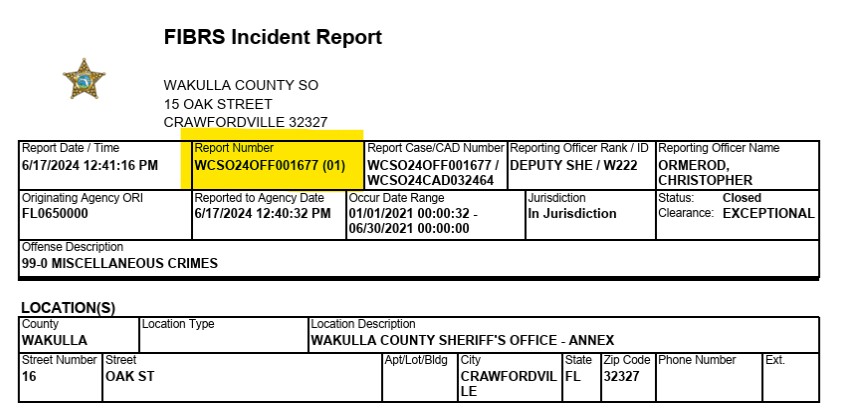
Author Note: If you would like to request the full report from WCSO, the reference number below is provided for your convenience. Redacting the entire document would render it unusable, so the essential details and relevant handling of the case are summarized here. Deputy Marsh fully admits the original violation; however, the central questions about how and why the incident was resurrected three years later remain critical to understanding this investigation.
The iPad Access
According to investigative interviews, R. T. accessed S. B.’s iPad using a password obtained from the child and reviewed private messages without his knowledge. She then saved screenshots to her own device before returning the iPad.
The information she extracted was from 2021. She accessed the device in 2024.
This raises natural questions about:
• Consent
• Chain of custody
• Authenticity
• Context
• How the screenshots were selected
• Why they surfaced three years later
These are not accusations. They are questions any reasonable investigator would ask.
The TAR Report That Never Appears
Any allegation involving misuse of FCIC or NCIC should be verified through a TAR audit. A TAR report is an automatic, permanent log that records:
• Who ran a query
• When it was run
• What terminal was used
• What type of query was performed
• The purpose code
If Deputy Marsh ran R. T.’s information in 2021, there would be a TAR entry documenting the exact date, time, and terminal used.
The incident report does not reference any specific TAR verification. The interview audio references a partial TAR report. The public records provided to Marsh do not include one.
Does it exist in its entirety or only partial? Was it reviewed at the time of the incident or subsequent to? Is there a standard TAR review process at WCSO? Or is it only pulled when a problem arises?
This is a significant gap in the investigative record.
The Stalking Allegations
The report claims that Marsh “stalked” R. T. and K. G. in 2021. Yet:
• No contemporaneous complaints were filed
• No videos or photos were taken
• No one called dispatch
• The report does not show that a vehicle number was ever provided
• No one filed a report at the time
• No one identified her by name
• No one even knew who she was
R. T. claimed she recognized Marsh from a “witness list” in her custody case with S. B. Witness lists do not contain photographs. Meanwhile, according to the report, Marsh did not even know who K. G. was until 2024. The idea that a deputy was stalking someone in 2021, yet no one thought to take out a phone, call 911, or report it until 2024, strains credibility.
Even if someone distrusted WCSO, FDLE existed in 2021.
The Detective’s Contradictions
During the recorded interview, Detective Ormerod. acknowledged that the statute of limitations had expired. In the same breath, he said it was up to the State Attorney’s Office. If the statute of limitations had passed, why was a criminal investigation conducted at all? Why wait for the ASA to say it was administrative? Why not begin with an administrative review? The contradiction raises questions about the purpose of the investigation.
The Suspicious Messages
In August 2024, Marsh received anonymous messages referencing her confidential investigation. She reported them immediately. Internal Affairs responded: “It is really odd to know that someone has infiltrated your confidential investigation.”
They asked her to allow them to review her phone. They insisted they would not use anything on her phone against her.
Her attorney advised her to decline.
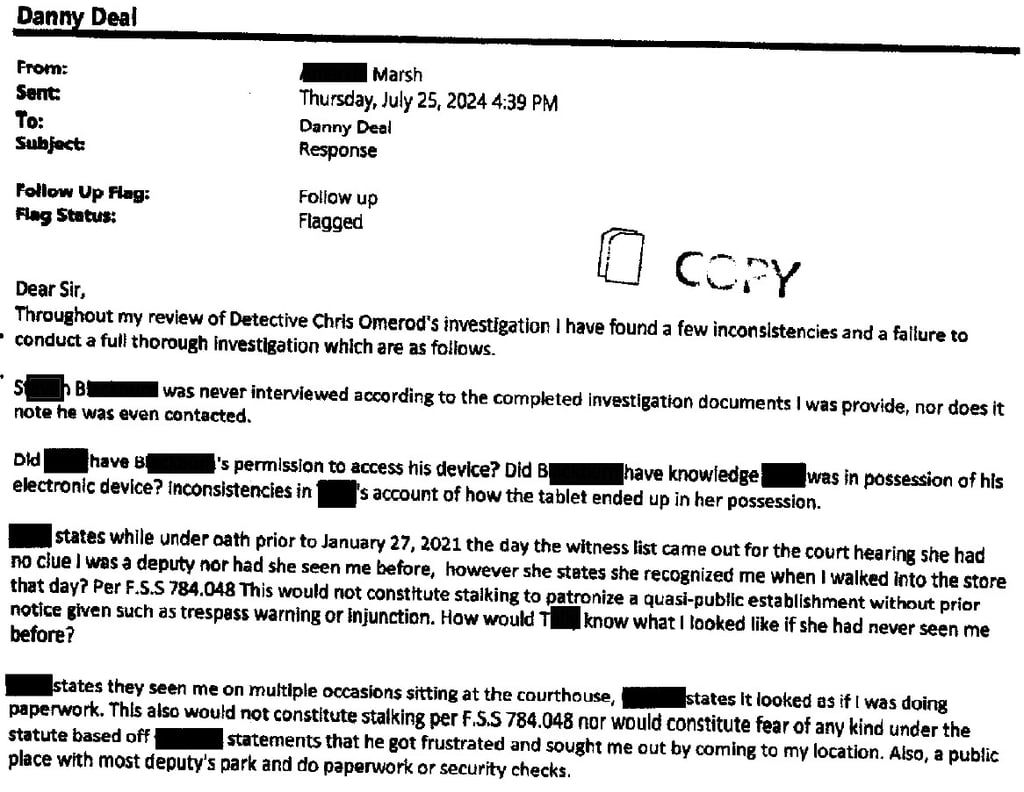
Marsh’s Rebuttal
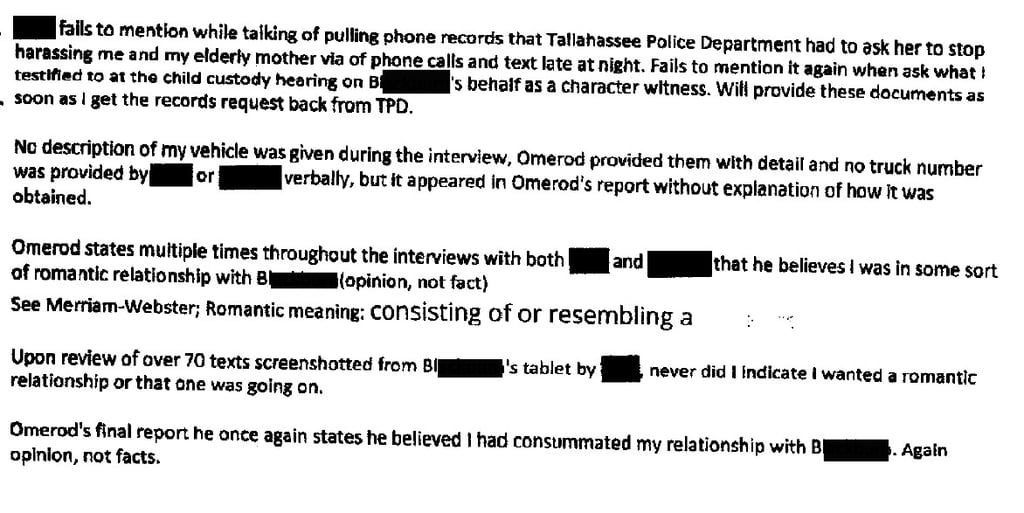
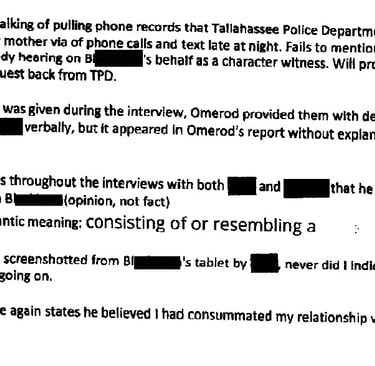
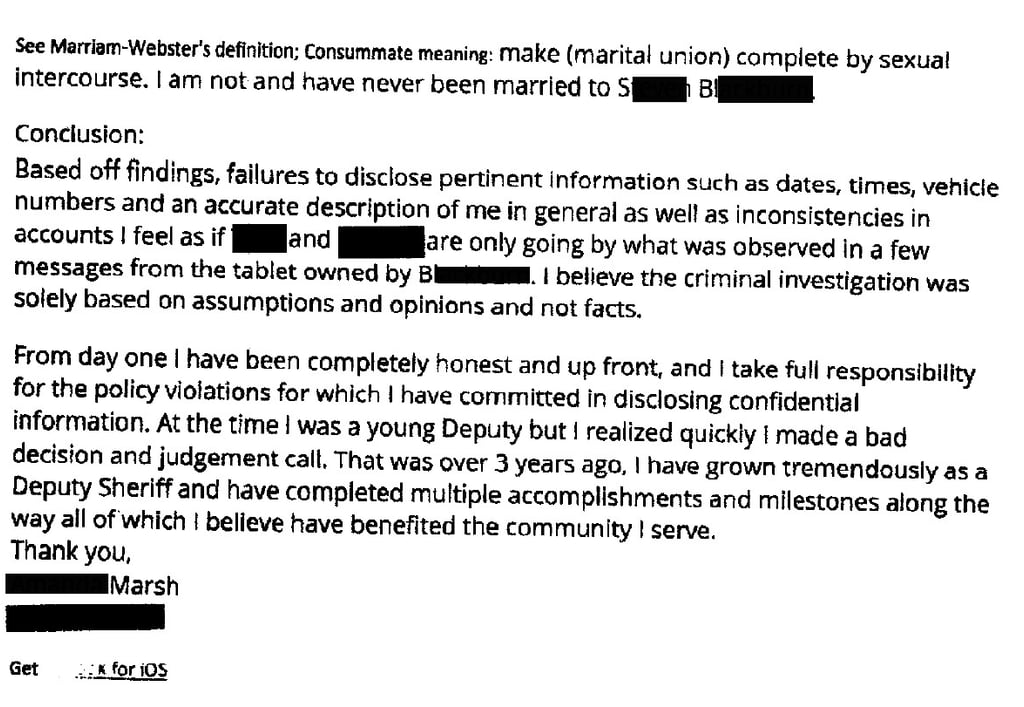
On July 25, 2024, Marsh submitted a written rebuttal to Internal Affairs. It is calm, factual, and grounded in statute. She points out inconsistencies in R. T.’s statements. She questions how R. T. could recognize her if she had never seen her before. She cites the stalking statute and explains why the allegations do not meet the legal definition. She highlights that the detective repeatedly inserted personal opinions about her relationship with S. B.
She ends with something rare in these cases:
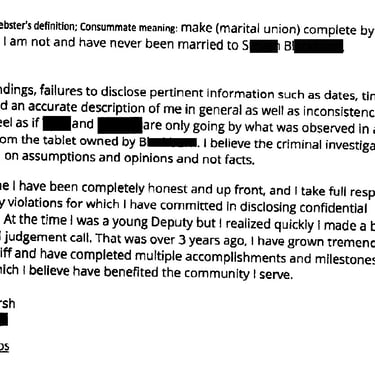
“I take full responsibility for the policy violations for which I have committed in disclosing confidential information.”
There is no evidence that Internal Affairs ever addressed her rebuttal.
The Termination That Was Already Decided
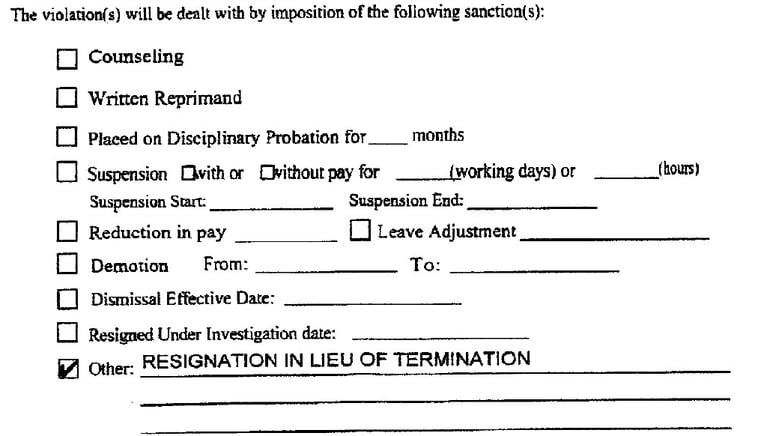
On September 13, 2024, Deputy Marsh was handed a disciplinary form that said “Dismissal, effective 9/17/24.” She refused to sign it.
Three days later, HR delivered a termination notice. She was told she could request a name‑clearing hearing, but the timeline was tight and the outcome was already clear.
On September 18, she signed a form that said “Resignation in lieu of termination.”
This was not a voluntary resignation. It was a forced exit.
The Path of the Complaint
One detail remains especially unclear.
The path the complaint took into the agency is unclear. The incident was originally reported to Tiffany Spears, a detective with WCSO who was not a witness to the events, which raises questions about how and why a three‑year‑old incident suddenly resurfaced. The original complaint did not seem to follow the same process any other citizen would have to follow.
This is not an accusation. It is a question of timing, process, and transparency.
What the Documents Show
What Deputy Marsh did wrong in 2021
• She disclosed confidential information
• She became entangled in a personal situation
• She exercised poor judgment
What WCSO did wrong in 2024
• Violated multiple LEOBR requirements
• Opened an investigation three years too late
• Failed to interview the key witness
• Pressured her to surrender her phone
• Ignored her written rebuttal
• Pre‑decided termination
• Used a report filled with opinion
• Omitted solid TAR verification
What the timing suggests
• The Explorer Program was unstable
• Parents were complaining
• Deputy Marsh was the only continuity
• She referred a parent directly to the Sheriff
• The Sheriff promoted her into leadership
• Internal resentment grew
• The old 2021 incident suddenly resurfaced
The timing is not proof of retaliation, but it is impossible to ignore.
The Story Behind the Story
This is not a story about a perfect deputy. It is not a story about a perfect agency. It is a story about what happens when a mistake is ignored until it becomes useful.
If WCSO had addressed the 2021 violation in 2021, this story would not exist. Instead, the agency waited three years, then used the old mistake as the foundation for a new criminal investigation that violated multiple legal protections.
The result was predictable. The process was flawed. The outcome was predetermined.
And a deputy who had spent four years serving schools, children, and the community was pushed out in a way that raises serious questions about fairness, transparency, and leadership.
A Pattern Bigger Than One Case
The story of Marsh does not stand alone. It sits beside other cases in Wakulla County where investigations skirted procedure, where complaints were mishandled, and where both citizens and deputies were left without answers. Different facts. Different people. The same structural weaknesses. And a flavor for “going back three years to dig up dirt”. See the Dale Evans story here.
A culture where process bends. A culture where timing is political. A culture where accountability is inconsistent. A culture where both citizens and deputies pay the price.
Where This Leaves Wakulla County
The deputies deserve a fair process, timely discipline, and termination when warranted. The Explorer Program deserves stability. And the Sheriff’s Office deserves scrutiny when its internal processes fail.
This story is not over. It is only a part of a larger conversation about accountability, culture, and the future of civic institutions in Wakulla County.
07/01/2026 Blog Update – Clarification on Interview Type & LEOBR Applicability
After reviewing the reader’s comment and taking a closer look at the statute, Wakulla Reports is adding the following clarification to ensure accuracy:
Florida’s Law Enforcement Officers’ Bill of Rights (F.S. 112.532) applies whenever an officer is under investigation and subject to interrogation for any reason that could lead to disciplinary action, demotion, or dismissal. This means that even if an agency initially frames the interview as “criminal,” LEOBR protections may still apply if the matter ultimately results in administrative consequences - which this case did.
At this time, Wakulla Reports does not have the full audio or transcript of Deputy Marsh’s interview. We agree that this information would be helpful for determining the exact nature of the interrogation. Please see the report ID above and request the records if you would like more information. While we do grab as many public records as we can, we cannot do it all and it takes community involvement just like the below comment.
While Deputy Marsh openly admits the original policy violation, the questions raised in this report focus on process, timing, and consistency - including why a criminal investigation was initiated despite the statute of limitations having expired, and why key procedural steps were omitted or unclear.
We appreciate the reader’s insight, and this update has been added to ensure the blog reflects the most accurate interpretation of the law based on the information currently available to us. Comments and records are welcome even if private. Private messages can be sent to wakullareports@gmail.com
Follow Us on Social
Facebook brings you bite-sized written content, sticky-note facts, and rolling updates you can share and discuss.
NEW! TikTok You can now follow Wakulla Reports on TikTok for quick updates and BOCC video clips.
YouTube is updated less often but does still exist for historical value and for longer videos as necessary.
Prefer to browse at your own pace?
Bookmark our website and visit anytime for fresh posts, resources, and real-life examples from right here in Wakulla County.
© 2026. All rights reserved.
Sign Up for Updates!
By submitting my information below I agree to receiving emails from Wakulla Reports.