Memo 2 from the homeowner surrounded on three sides by Raker’s Crossing. This is a follow-up to his first memo about the 191-home development, which you can read here.
WHERE THINGS STAND: On Oct. 28, the county board denied my appeal and said I filed it too late. I filed on day one of a 30-day window. Now my attorney is asking a judge to look at it. The deadline to file is Nov. 27, so it goes in this week. Yes, attorneys are involved now.
Who made the call?
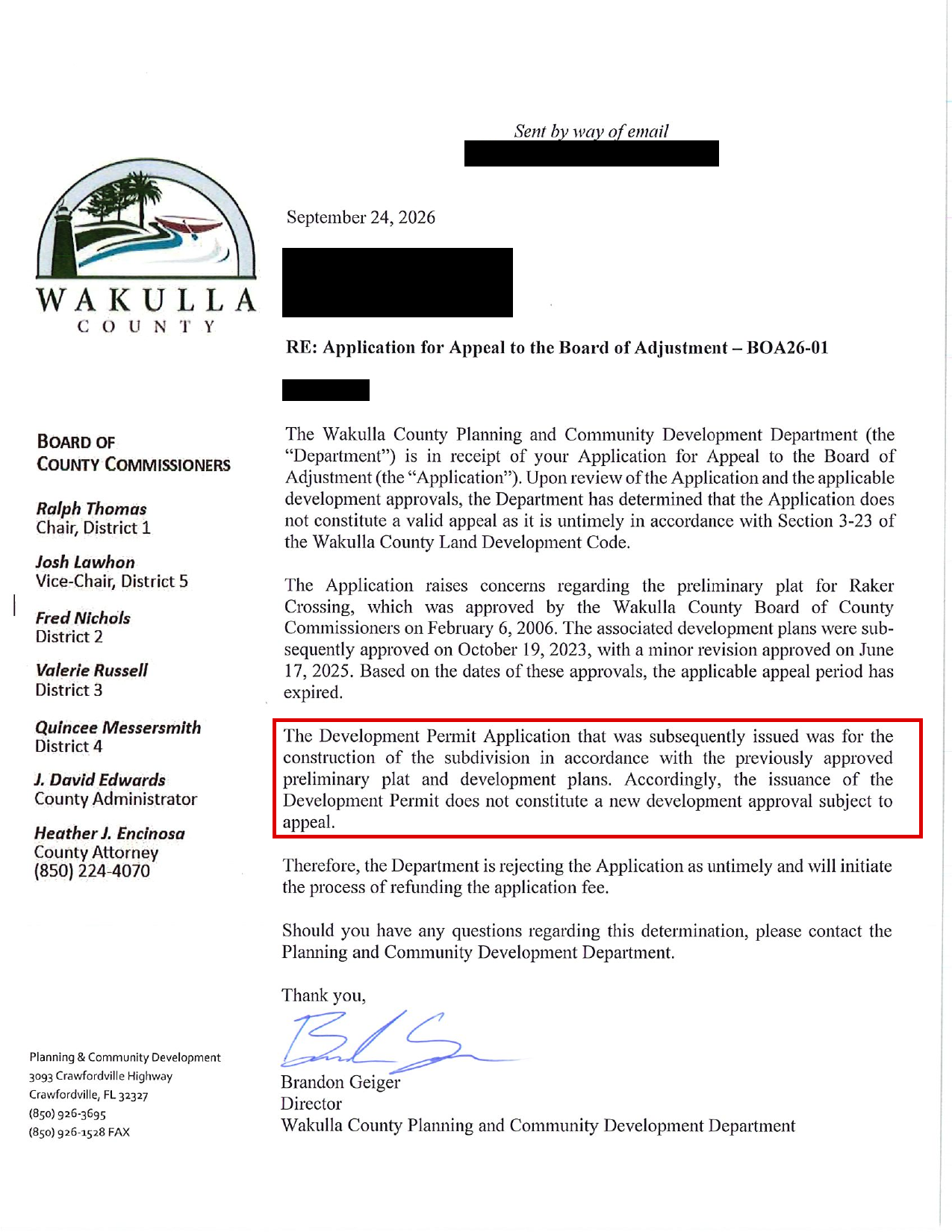
The county’s letter says the board “upheld the Planning Director’s determination” that my appeal was late.
That’s a strange way to put it. The rules say the board decides if an appeal is late, not the Planning Director. Staff doesn’t get to make the call and have the board rubber-stamp it. So why word it that way? As this heads to court, it makes you wonder if someone is already picking who gets thrown under the bus later.
The letter also ignored every other problem I raised. That’s fine. They aren’t going away.
There is no such thing as a “renewal”
The county called the 2026 development permit for Raker’s Crossing (the permit to start building roads and pipes) a “renewal” of the 2023 permit. Here’s why that word matters. If it’s a renewal, the county can keep using studies from 2004. If it’s a new permit, it needs new studies.
The 2023 permit had expired. The county’s own website says “expired.” And there is no such thing as renewing an expired permit. There’s no renewal form and no renewal process in the county code. The only place the word “renew” shows up is a box the developer typed into.
At the hearing, the county’s second attorney (yes, they needed two) asked if my position was that renewals don’t exist. I said, “Yes sir. If there is such a thing, show me where in the code or the statutes it exists.” He had nothing to point to.
So they invented a renewal. When I called that out, they switched stories and said the permit just let construction start “based on prior approvals.” But those approvals had expired. You can’t start building on an expired permit.
It gets worse: the original approval expired too
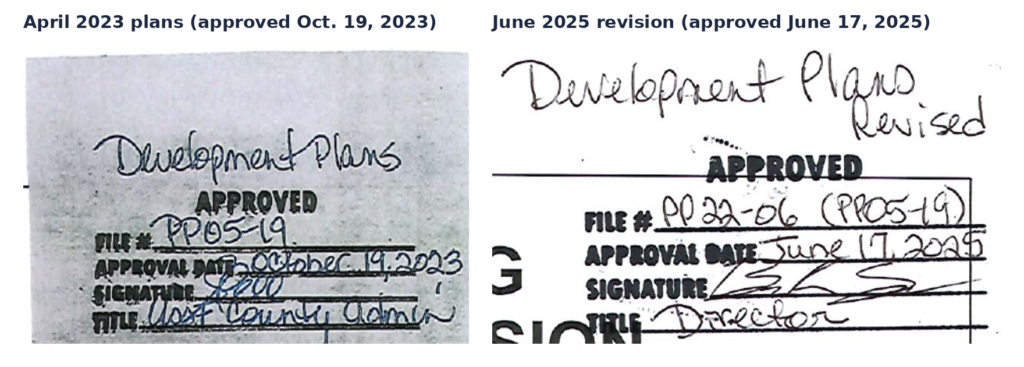
The county first approved this subdivision’s layout (the preliminary plat) back in 2006. County code says that approval dies if the developer doesn’t file a final plan within 18 months. They never did. That means it expired around 2007, and the developer should have had to start over.
At the hearing, the Planning Director said under oath that the old approvals, including the concurrency checks, don’t expire. He said it five times. Watch for yourself in the hearing video at 32:13, 1:12:15, 1:26:30, 1:30:20 and 1:31:40: https://www.youtube.com/watch?v=e8yaCngykfk
At 1:31:40, the attorney asks him straight out if the 2006 approval expires. He says, “In this instance it does not.” That’s just wrong. Read the code above.
Why that matters: 2004 paperwork
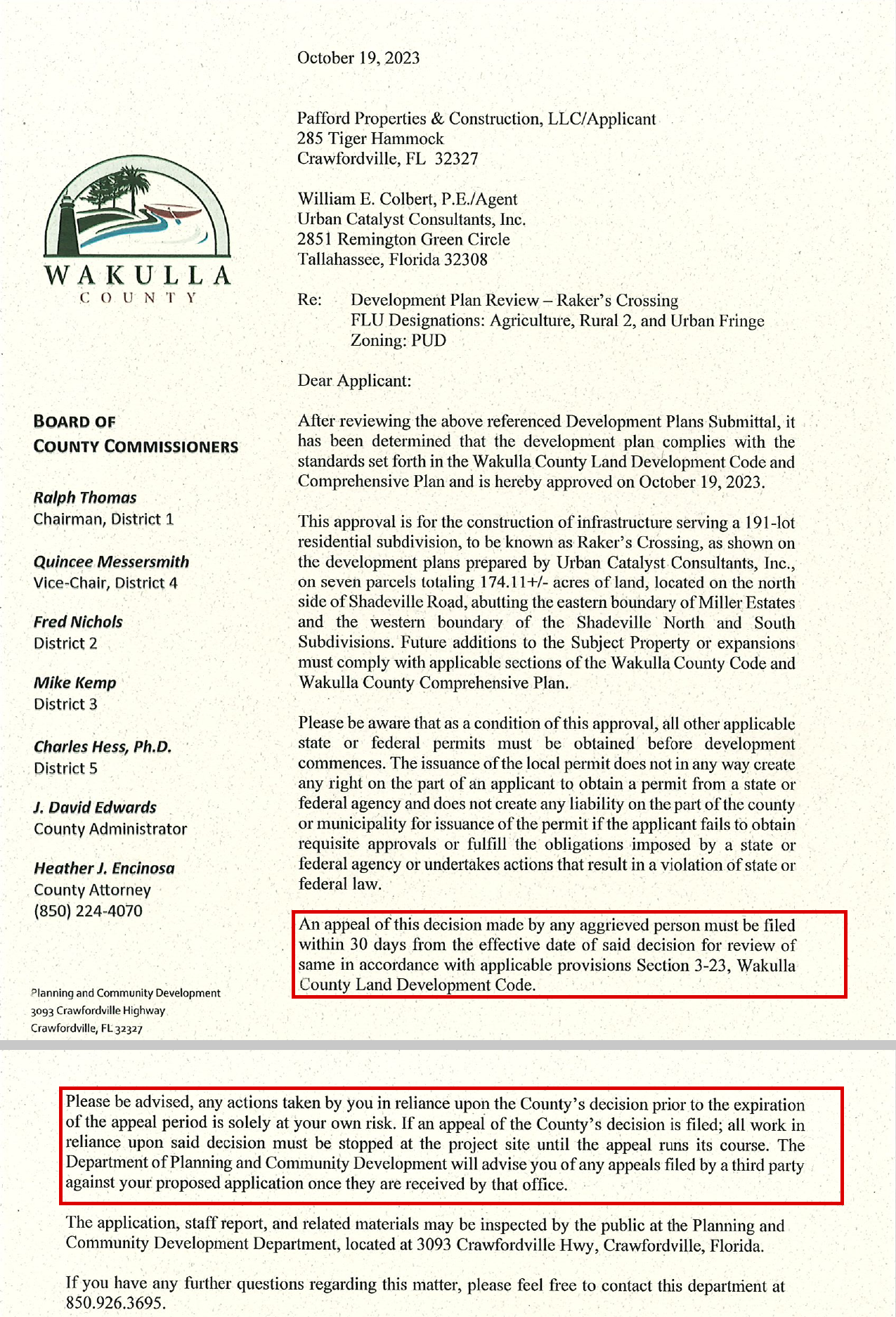
Before the county allows new homes, it has to check that roads, water, sewer, schools, parks, trash service and drainage can handle them. That check is called “concurrency.” The county’s own plan says it has to be done “with each application.” And it says that approval expires when the permit expires.
So when the old approvals expired, the old checks expired with them.
What did the county use instead? Water, sewer and traffic letters from 2004. The only recent study is for drainage, from 2023. Twenty-year-old letters stapled to the file are not a review.
What happens next
My attorney is asking a judge to review the board’s decision. Here’s how it works:
The judge gets the hearing record and what I presented.
Both attorneys file written arguments.
The judge decides if the board followed the law. The commissioners won’t be there.
If the board didn’t, we likely get a brand-new hearing, and I can bring in the new evidence, like the expired 2006 approval.
If they invent a new reason to rule against me, we go back to court. If the first judge rules against me, I still have one more court to try.
Why I’m doing this
First, it’s my home. My water is already bad. Talquin is putting in new wells, but that’s just to keep up with the people already here. Talquin’s own technicians told me the problem is the pipe I’m on, and new wells won’t fix it. A real concurrency check is supposed to catch that. A 2004 letter doesn’t.
Second, look around. Wakulla Gardens has water that looks like mud. You can’t get through the lights on Crawfordville Highway in one try. This project would add about 400 cars, most headed to Tallahassee, and about 100 more kids to schools that already say they’re full.
Somebody has to say how absurd this is. The commission won’t, and for some reason staff is working overtime to ignore the code or invent their way around it. So someone has to ask why. Why go to all this trouble to avoid following the rules that protect the county and the people who already live here?
Thank you to everyone who has supported me, and especially to those who took off work to come to a hearing in the middle of the day. If we get another hearing, I hope it’s held after work hours so more people can show up and be heard.
A note from Wakulla Reports: The memo below was written by Richard Blake, the homeowner whose property borders Raker’s Crossing on three sides. It is addressed to the public and appears in his own words, edited only for grammar. We have agreed to publish his series so residents can follow the issue and so there is a record of the series of events. All Raker’s Crossing coverage can be found in the link at the top of this page.
First, I want to personally say thank you to all the people who have been following the Raker’s Crossing saga and have offered kind words of support, and especially to those who showed up to the hearing in the middle of the day to support me.
I think it’s important for me to personally explain why I am doing what I am doing. First off, my property is surrounded on three sides by this new development, and I think we have all seen the impact irresponsible development has had on adjoining homeowners, much less on those completely surrounded by it. I have a responsibility to do everything I can to ensure this one is done correctly so that it doesn’t negatively impact me, whether that’s from runoff, flooding, stinky water or other issues. This all started with me simply investigating what was going on around my home. However, once I started looking into the permitting process, it took me down a rabbit hole that exposed issues that were simply unbelievable to me, including two-decade-old water, sewer and traffic studies that were used as part of the new permit process. And there are many more issues as well.
Many times, citizens and residents bring very valid concerns to the county and commissioners, and they are told over and over, “the law ties our hands,” or that “SB180” prevents them from doing this or that. However, in this case there are MANY laws and codes already on the books, in both the Wakulla Land Development Code and Florida Statutes, to protect homeowners, myself included, and they are flat out being ignored at best or purposely being circumvented at worst.
My goal is not to stop development. A complete moratorium is probably not a good thing; we all need jobs, and we all know that will never happen. My goal is to make sure development is done smartly and in accordance with the laws and codes already on the books.
I want to do a series that outlines these codes and laws one at a time, explaining what SHOULD have happened in this case and the absolute absurdity of the position the county has taken. The first issue I would like to address is a bit technical, but it’s the one the county has chosen to hang its hat on: timeliness.
At 8:06 a.m. this morning, I received the official denial letter rejecting my appeal. The SOLE reason given by the county was “untimely filed and therefore invalid,” and I will walk everyone through how patently absurd that is.
Under the Wakulla Land Development Code, you have 30 days from the date a decision is rendered to appeal an administrative decision. § 3-23(2): “Such appeal shall be taken within 30 days after the order, requirement or decision is rendered.” “Rendered” is the key term here, because it is actually defined by Florida law. You don’t get to interpret it and decide the meaning yourself; the meaning is defined in the law. Florida Statute § 163.3215(4)(h): “is not considered rendered or final until officially date-stamped by the city or county clerk.” So it has to be officially filed (rendered) before the 30-day clock starts.
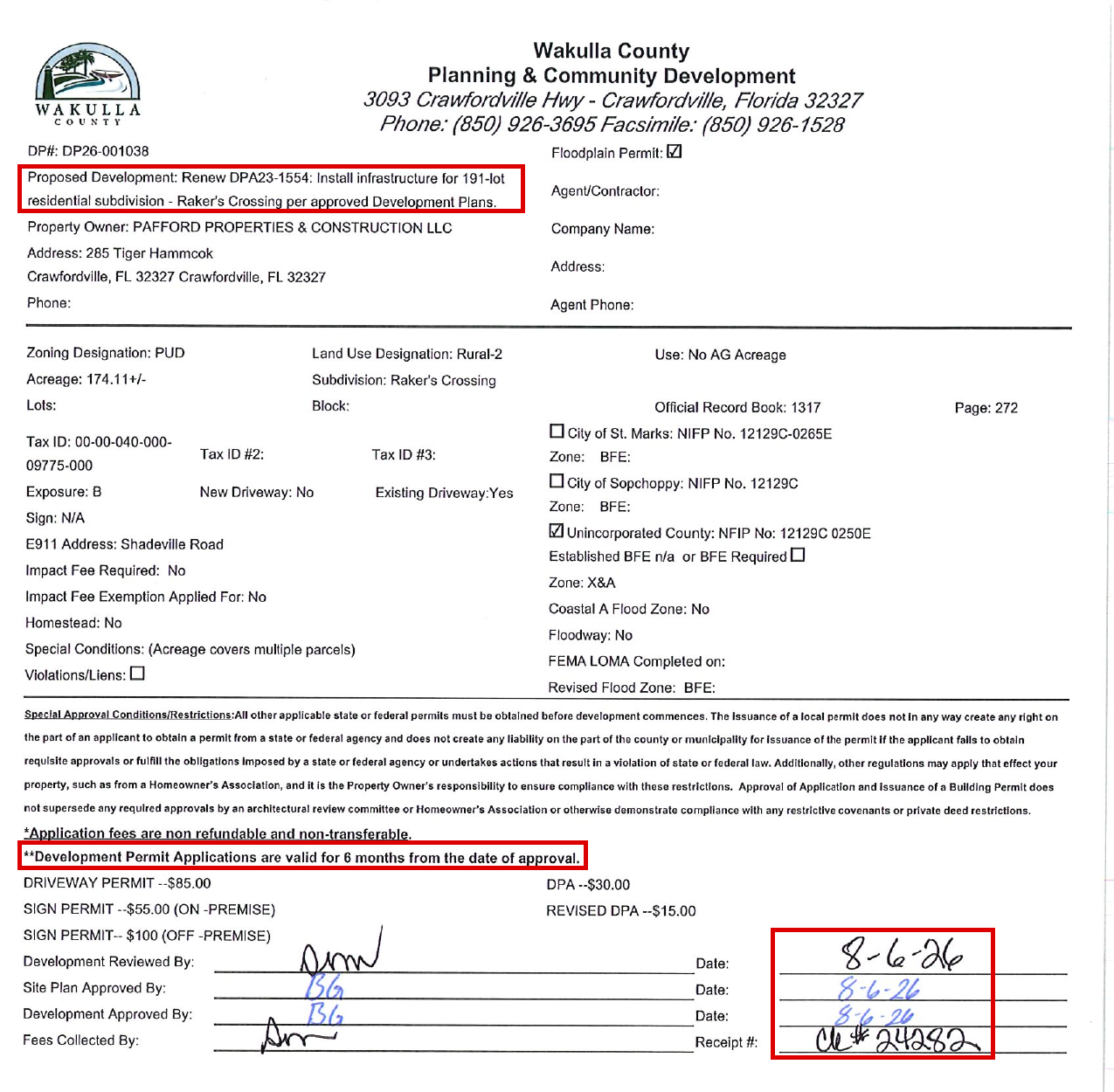
The image below is from a public records request I made. It’s not something I found on the internet. It is the product of a public records request to Wakulla County.
The document clearly shows the application was made on 8/6/2026, was Approved on 9/18/2026 and was Issued on 9/18/2026. You could consider either the Approved or the Issued date to be the date it was rendered or filed. It was also paid for on 9/18/2026, and I have the receipt for that as well. I made my appeal on 9/18/2026, the VERY SAME DAY the permit was approved and issued. You can see this in my receipt below. Yet the county has somehow determined my appeal was untimely, even though I appealed on day one of a 30-day clock.
Now, I don’t know about you, but I consider filing on the first day of a 30-day appeal window to be the opposite of untimely. I cannot figure out how anyone could come to that conclusion, much less put it in writing that my appeal was untimely. I would also assume this letter was reviewed by the county attorney, and somehow she concluded that filing an appeal on 9/18 of a permit issued on 9/18 is untimely.
There is a little more to the story. In the original letter they sent me, and during the hearing, they stated that the appeal period had expired for the original 2006 preliminary plat and the 2023 permit. But both the preliminary plat and the 2023 permit had EXPIRED. I have no reason to appeal either of those, and I very clearly outlined in my appeal that I was appealing the 2026 permit, which is the only unexpired, valid permit on the books.
That’s a long read, but it outlines just one of the many issues with this new development permit. I will post additional updates until I have gone through all the issues and the related laws and codes. Given how clear the code is, and that no interpretation is necessary (or, in most cases, even allowed), I was under the delusion that this was a slam dunk at the hearing. However, we now know that is NOT the case, and I want to make it very clear that this is NOT over. I am taking the initial steps to bring this to the next level, where hopefully the law will prevail and the necessary steps will be taken to ensure the development is done smartly and safely.
This post was written with AI assistance and reviewed word for word by a member of the Wakulla Reports team.
The county rejected a neighbor’s appeal as late and closed the file. He took it to the County Commission in public. Ten days later, the hearing was on the calendar. Here is what happened, what the county’s own file shows, and how to be there.
Catching Up
Last month we reported on Raker’s Crossing, a 191-home subdivision planned for about 174 acres on the north side of Shadeville Road. A homeowner whose land borders the site appealed the county’s August 2026 renewal of the project’s development permit. Here is what has happened since:
Sept. 18: The homeowner filed his appeal and paid the fee.
Sept. 24: The planning director rejected the appeal as late and said the file would be closed. The homeowner filed a second appeal the same day, challenging that rejection.
Oct. 5: He told the County Commission, during Citizens to be Heard, that the director had rejected the second appeal too and that the county’s permit portal listed both as denied. He asked the board to hear his appeal.
Oct. 15: The county posted a notice scheduling both appeals, BOA26-01 and BOA26-02, for a public hearing on Oct. 28. Read the notice here.
The County’s Side
The county’s reason for rejecting the appeal was timing. County code Sec. 3-23 allows 30 days to file an appeal. The county counted from Aug. 6, 2026, the date on the application for the permit renewal, DP26-1038, so by its count the window closed Sept. 5. The appeal was filed Sept. 18. In the Sept. 24 letter, the planning director treated the appeal as untimely and started a refund of the fee. The county’s own permit system, however, lists Sept. 18 as the date the permit was approved and issued, the same day the appeal was filed.
That is a real argument, and the board will have to weigh it. The homeowner’s answer is that whether an appeal is valid and on time is a question for the board, not for the staff member whose decision is being appealed.
What He Told the Board
On Oct. 5, the homeowner spoke for a little under four minutes. He walked the commissioners through both rejections and then laid out his reading of the code.
“There is no such thing in the land development code as an administrative denial.”
He said the decisions he was appealing were made by the planning director, so the appeal should go to the board.
“The appeal goes up. It does not go back to the person who made the call.”
He also told the board that no certificate of imminent peril had been issued. Under Sec. 3-23, as he described it, that certificate is what allows work to continue while an appeal is pending. He said work was continuing anyway. His request was simple: put the appeal on a Board of Adjustment agenda.
“The staff can make their case to you at the hearing, not in a letter to me, but to this board in public on the record the way the code was written.”
He handed the board a packet he described as receipts showing he had followed the process. The chair thanked him. No commissioner or staff member responded on the record. Ten days later, the hearing notice was posted.
Since the first post, we went back through the records the county released and checked them against the county code and state law. Here is what stands out.
A 2006 plat number on 2023 plans. The project’s preliminary plat, PP05-19, was approved Feb. 6, 2006. Under county code Sec. 7-21(2), as it read during the 2022 and 2023 review, a preliminary plat approval lapses if a final plat is not submitted within 18 months, and a new application has to be filed. For this project, 18 months would have run out in 2007. We did not find a final plat filing or an extension in the records released. Even so, the development plans approved Oct. 19, 2023 carry a county stamp reading “FILE # PP05-19.” The June 2025 revision is stamped “PP 22-06 (PP05-19),” the first time a 2022 plat number appears anywhere in the file.
To be fair to the county, the 18-month wording we have dates from 2015, and we have not seen the version that was in force in 2006. The records we have also do not show what PP22-06 is or whether it went through a public hearing.
STILL UNANSWERED: What kept the 2006 preliminary plat alive past 2007, and what is PP22-06?
The 2023 permit had expired. The 2023 development permit, DP23-1554, says on its face that it is valid for six months. The county’s permit portal shows it was issued June 3, 2025 and expired Dec. 3, 2025, more than eight months before the 2026 “renewal.” Florida law (s. 252.363) can extend a permit after a declared emergency, but only if the permit holder notifies the county in writing. We did not find such a notice in the records released. That does not prove none exists, but the record does not show why an expired permit was later “renewed.”
STILL UNANSWERED: Did the permit holder file a written emergency extension notice for DP23-1554?
The county was counting these homes in 2021. On Jan. 15, 2021, County Administrator David Edwards emailed the School Board the county’s sewer planning figures. “Rakers Crossing 191 Units” is on the list, among homes counted “based on current platted lots.” That was more than a year before the 2022 development plan review began. It is planning data, not a concurrency approval or a school capacity letter.
How to Be There
When: Wednesday, Oct. 28, 2026, at 1:00 p.m. This is a special meeting, on a weekday afternoon.
Who decides: The Board of County Commissioners, sitting as the Board of Adjustment.
Where: County Commission Chambers, 29 Arran Road, Crawfordville, west of the courthouse.
Can you speak? Yes. The notice says interested parties are invited to attend and present testimony.
Need an accommodation? Call the county administration office at (850) 926-0919 at least two days before the meeting.
What Happens Next
The board will hear from the homeowner and from staff, and it will decide two things: whether the appeal was filed in time, and if so, whether the permit renewal should stand. Either way, the decision will be made in public, on the record, which is what the homeowner asked for on Oct. 5.
We will be watching, and we will continue to follow the facts as they develop.
Correction, Nov. 24, 2026: An earlier version of this post said the 2023 permit’s six-month window would have ended around April 19, 2024, a date we calculated from its October 2023 approval. The county’s permit portal shows the permit was issued June 3, 2025 and expired Dec. 3, 2025. The earlier version also said the 2026 permit was approved Aug. 6, 2026. That is the date the county counted from; its permit system lists the approval and issue date as Sept. 18, 2026. The post has been updated.
· The County Attorney’s memo (Agenda pp. 413 to 422, updated September 2026) says the public’s right to use Lake Ellen requires one of two things: the lake is a public, navigable waterbody, or the dedication of Lake Ellen Drive includes a public right to use and access the lake (p. 413).
· The 1961 plat dedicates the streets as “public highways.” It does not mention the lake. The memo calls that language “lacking in clarity and description” (pp. 414, 421).
· The county has acted as if the lake is public at times, but the memo says the public’s use “would ideally need to be documented and described” to make that argument (p. 422).
· Navigable status turns on whether Lake Ellen was navigable in 1845. The state has not determined that (pp. 413, 415 to 418).
· The memo’s conclusion: neither question can be resolved “with any degree of certainty absent judicial review” (p. 413).
What the dedication actually says
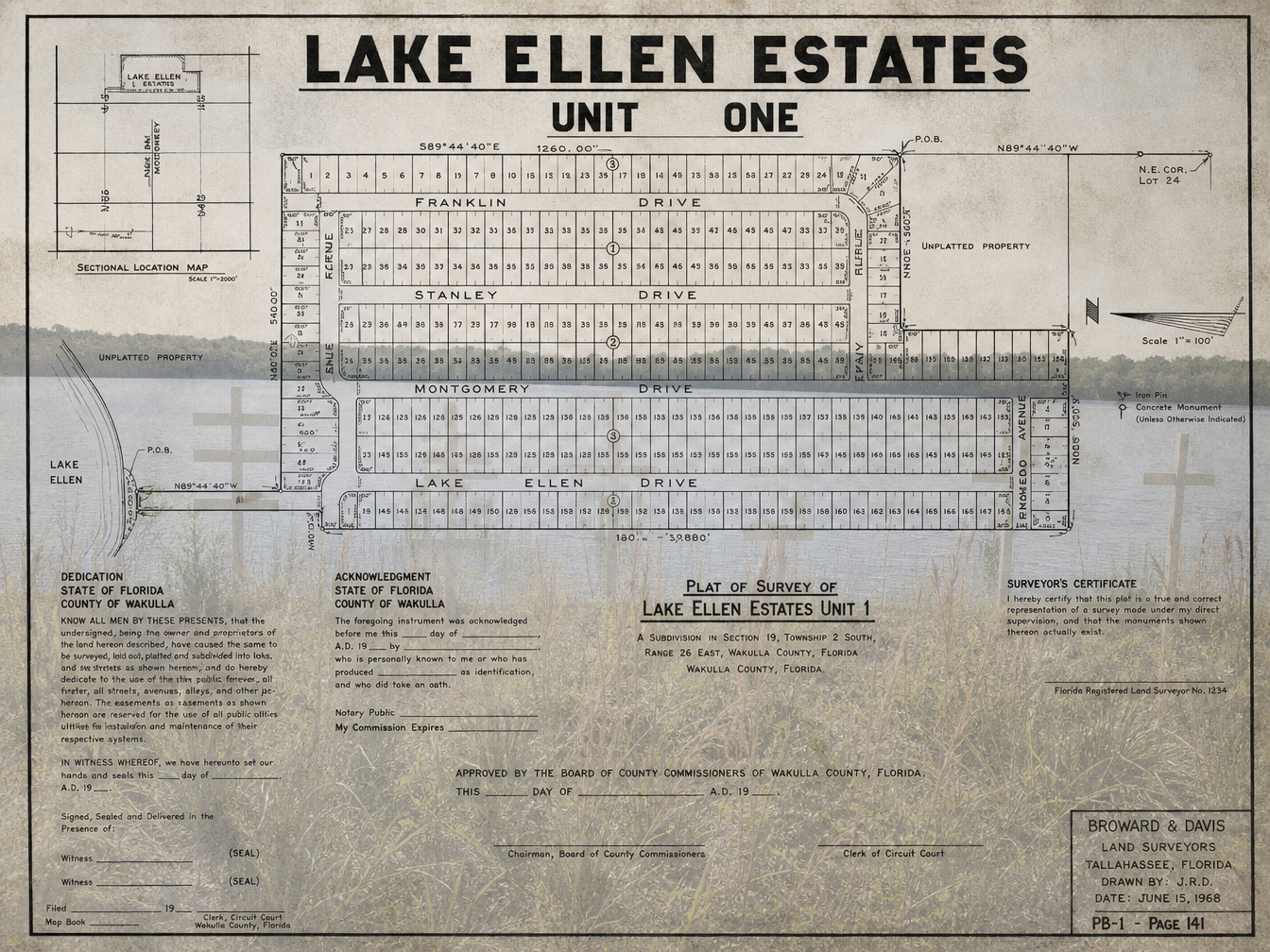
The subdivision, Lake Ellen Estates Unit One, was platted in 1961. The plat says the developer “does hereby dedicate to the perpetual use of the public as public highways the streets as shown hereon,” and reserves the right to take the streets back if the public abandons them or the law discontinues them (p. 414).
The plat drawing shows Lake Ellen Drive running “all the way up to the shores of Lake Ellen,” where it ends at a spot marked “Proposed Ramp.” The north end of the road serves no platted lots, and a recent survey shows the county’s right of way “extends all the way into the waters of Lake Ellen” (p. 414).
The memo says there are no separately recorded documents about the county’s right of way, so the question “largely involves interpreting the dedication language found on the Plat” (p. 420). It then calls the words “public highway” “lacking in clarity and description,” and asks four questions it does not answer (p. 421):
· Is the right of way only for vehicles going in and out?
· If so, for which properties, since no lots depend on this part of the road?
· Is it also meant to provide a public access point to the lake?
· Does the dedication include littoral rights to use the lake?
What the history of use shows
The memo’s record of how the county and the public have treated the lake points in more than one direction (p. 414).
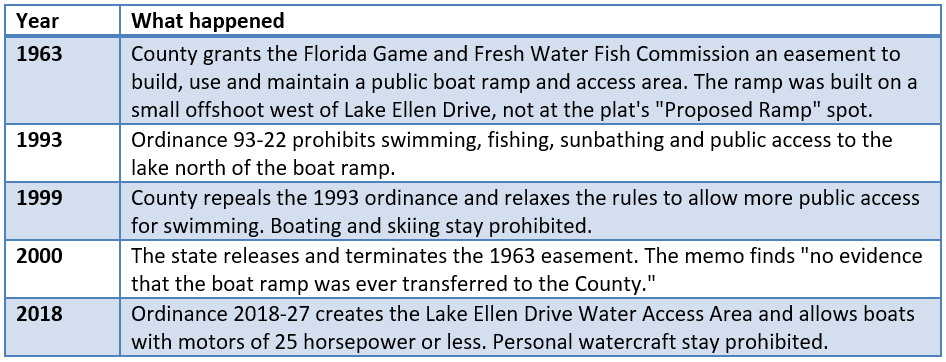
The memo says parts of this history help the county. It cites the public’s “apparent historical use” of the lake for “bathing, fishing, and boating,” and a ramp the state operated for years. It says the county’s own actions, the easement and two ordinances, “reflect that it understood Lake Ellen to be a public waterbody” (p. 422).
It also lists the limits. Public use alone making a lake navigable has “significant equitable appeal” but “limited judicial support” (p. 418). The court case behind the idea was a dissenting opinion decided before the main Florida navigability ruling (p. 417, footnote 2). And footnote 6 says the extent of the public’s use “would ideally need to be documented and described in order to properly craft the argument” (p. 422).
A 2018 reader letter on the ramp
A citizen sent Wakulla Reports a letter to the editor that ran in The Wakulla News, “Failure of vision at Lake Ellen” (August 2, 2018, page 4). It gives one lakefront property owner’s account of the ramp’s past. It is an opinion piece, not a county record, and the points below are the writer’s claims. Wakulla Reports has not confirmed them.
· The writer says the state wildlife agency “gave back to the county the Lake Ellen Boat Ramp” after a death at the lake, and that the county then closed the ramp and “over the following years opened and closed it multiple times.”
· The writer says the agency returned it because it “did not want the liability of having a boat ramp next to a swimming area.”
· The writer says four deaths have occurred at the lake, two of them after the commissioners reopened the ramp, and points to a Tallahassee Democrat clipping and a WCTV story as sources.
· The writer describes the 2018 ordinance as allowing swimming at county boat ramps, parks and facilities, and says he has spoken against the ramp and swimming area since the 1970s.
What the law says: navigable waters
Whether Lake Ellen is a public waterbody “held by the state … in trust for all the people” turns on whether it “was a navigable waterbody in 1845” (p. 417). Most of the memo’s legal analysis is about that one question.
The test
· Article X, Section 11 of the Florida Constitution says the state holds title to lands under navigable waters “in trust for all the people,” if those lands have not been sold off (p. 415).
· The date that counts is 1845, when Florida was admitted to the union. Only a water body “navigable in its natural state” then is state-owned (p. 415).
· Navigability “is based on the water body’s potential for commercial use in its ordinary and natural condition” (p. 416).
· The Florida Supreme Court has said the “capacity for navigation, not usage for that purpose, determines the navigable character” of the water (p. 416).
The limits
· Section 253.141(2) says navigable waters do not extend to lakes lying over areas “conveyed to private individuals” by the federal government or the state “without reservation of public rights” (p. 416).
· A “meandered” lake is one whose shoreline appears on an original government survey or plat. The Florida Supreme Court has said “nonmeandered lakes and ponds are not to be classified as navigable bodies of water,” though it also called the tests “at best broad guidelines” (p. 417).
· Of about 7,000 Florida waterbodies, only 200 are meandered. The memo says it is unknown whether Lake Ellen is meandered, or whether an original survey of the lake exists (p. 418).
What the state has said about Lake Ellen
· The Department of Environmental Protection said on at least two occasions that it was unable to determine whether Lake Ellen is state owned. In June 2017 it sent two letters saying it lacked enough information (pp. 415, 417).
· Lake Ellen has been included in the state’s water quality assessments, which “target publicly owned lakes” (p. 417).
· A November 15, 2017 internal DEP email says, “We know that Lake Ellen is non-sovereign,” but “neglects to explain the reasoning behind that conclusion” (p. 418). As of September 21, 2026, the county “has not been provided with a copy” of the determination behind it (p. 415, footnote 1).
The deeds
The memo says it “appears that at some point the submerged lands underlying Lake Ellen were conveyed into private ownership.” Deeds to property along the lake appear to include parts of the lake bottom (Official Records Book 1027, pp. 77 to 79). But that is “not dispositive,” because when the state conveys land under navigable water, the title passes “subject to the public easements and to the riparian rights allowed by law” (p. 418).
Note: Wakulla Reports posted a short video navigating the Wakulla County Property Appraiser’s website showing the lake being deeded to the bottom.
The public-use route
If the meander question cannot be answered, the memo says a court would have to review the lake’s capacity for navigation around 1845. The public’s historical use for boating, fishing and bathing “would likely support the County’s argument.” Evidence of actual use for commerce before 1845 “would be particularly compelling,” but even without it, the lake’s capacity to support navigation or commerce “is the critical issue” (p. 418).
How the pieces connect
The dedication argument depends on the navigability question. Florida case law says water rights come with a street easement “only when and at the points where the street … extends to a navigable body of water” (p. 419). Even if the lake is private, the memo says a government can hold littoral rights, which include access to the water, and “Governmental entities can be littoral owners” (p. 419).
The county’s argument is that the road is dedicated to the public, touches the water, and the plat does not reserve the ramp area for the developer. Ambiguities in a plat are “construed in favor of the public,” and there is a “strong presumption” that what a plat shows is dedicated to the public. The memo calls this “a compelling argument” (p. 421).
Then it adds a caution. These are “merely arguments that may be presented to a court,” and using a road dedication to give the public rights on a private lake “appears to be a somewhat novel one” (p. 422). The memo also notes the county “could itself presumably become a littoral owner by simply obtaining a fee interest abutting the Lake” (p. 422).
The memo’s own summary: neither question “is capable of being resolved with any degree of certainty absent judicial review” (p. 422).
What it could cost, and the questions for residents
This post is not about whether there should be public access to Lake Ellen. It is about what it takes to get that access legally, and what the county is willing to spend to get there.
Item 19 lists the budget impact of buying the property as the purchase price plus due diligence, legal fees, recording and closing costs (p. 343). It gives no figure for defending a lawsuit. Any purchase price, settlement, judgment or legal fee would be paid with county funds, which means taxpayers pay.
What the memo and legal references say, with the caution that this is not legal advice and we found no Florida case on these exact facts:
· Under the memo’s own test, sovereign status depends on whether the lake was navigable in 1845, not on who owns the parcels today (p. 415).
· The memo says the county’s theories are “merely arguments” and “somewhat novel,” and that neither question can be settled “absent judicial review” (p. 422).
· Inverse condemnation is a claim that government action took private property for a public use without compensation. A Florida county attorneys’ association paper lists the elements and says the government’s intent does not matter and physical occupation is not required (pp. 2 to 3).
· The same paper says sovereign immunity is not a defense to inverse condemnation, and that a successful plaintiff recovers attorney’s fees and costs (pp. 4 to 5).
· A Florida Bar Journal article says navigability is decided case by case in court, depends on historical evidence and expert witnesses, and calls that method “cost prohibitive.”
The memo says the deeds along the lake appear to include lake bottom (p. 418). If Lake Ellen is not navigable, the owners of that bottom could raise claims against the county if it buys the property and opens the area to the public. Whether such a claim would succeed depends on facts the packet does not give.
Questions for the Board and the County Attorney
1. Has the county assessed in writing the risk of inverse condemnation or trespass claims from owners of lake bottom if it buys the property and opens the area to the public?
2. If a court has to decide whether Lake Ellen is navigable, what is the budget, and who sets the limit?
3. Will the county formally request the 2017 state determination that it says it was never given (p. 415, footnote 1)?
4. If the county buys the property, does it plan to open the lake itself to the public, or only the parcel it owns?
5. If neighboring owners challenge the purchase, who pays to defend it?
Questions for residents
1. Are you willing to pay, through county funds, for a purchase, legal fees and possibly years of court review to settle whether Lake Ellen is navigable?
2. Would you support buying the whole 150-acre lake bottom to control access? The agenda packet has no cost estimate for that.
3. Should the Board set a spending limit before it chooses between continuing negotiations and closing the access area?
Sources
·Wakulla County Board of County Commissioners, October 5, 2026 Final Agenda packet, Item 19, County Attorney memorandum “Lake Ellen” (Nabors, Giblin & Nickerson, P.A.), packet pp. 413 to 422. Page cites in this post are to the packet’s page numbers.
·“Failure of vision at Lake Ellen,” Readers Write, The Wakulla News, August 2, 2018, p. 4 (opinion letter sent in by a citizen; author omitted).
·Florida Association of County Attorneys, Inverse Condemnation Avoidance and Defense (written materials, 2018), faca.fl-counties.com.
·The Florida Bar Journal, Sovereignty Lands in Florida: It’s All About Navigability (Part I), floridabar.org.
·October 5, 2026 Final Agenda packet, Item 19 request, p. 343 (budgetary impact).
A citizen who lives on Shadeville Road reached out to us earlier this month. He owns about 8.5 acres, and the new 174-acre Raker’s Crossing subdivision wraps around it. The project is planned for 191 homes. His land was left out of the subdivision, so the lots will ring his property. The plan shows four lots (173 through 176) lining his east side, another (177) at his northeast corner, and a long boundary running along his north line.
He isn’t trying to stop anyone from building on land they own. He has said that plainly, in writing, more than once. What he wants to know is whether the county checked that this project won’t send water onto his land, and whether roads, water, sewer and schools can handle 191 more households today. He has put those questions to the county in writing again and again. As you’ll see, most of them are still unanswered.
Where the Water Goes
The homeowner met with county Planning staff on September 9. By his account, staff told him the county “cannot allow the project to push water onto” his property. He asked them to show him where the plans make sure that happens. He says he never got a sheet number, a drainage basin map, or a calculation that answered it.
Here’s what worries him. He read the project’s grading sheets (C-105.1 and C-105.2), which put his land and the back edges of Lots 173 through 176 at roughly 16 to 17 feet of elevation. The new street, Katherine’s Loop, and its ditches sit at roughly 18 to 20 feet. The storm drains on that street sit higher than the back yards next to him. A 20-foot drainage easement between Lots 176 and 177 runs east toward the street. No easement or outfall is drawn onto his parcel. So where does water from those back yards go?
“‘We cannot push water on you’ is a rule,” he wrote. “It is not a grading plan.”
That same day he sent the Planning Director and Senior Planner a written request for five things:
• The runoff calculations at his property lines
• The drainage basin map for the lots next to him
• Any plan note or condition requiring those back yards to drain toward the street
• How the “pending renewal” would be processed, and whether he’d be notified before it was approved
• The state stormwater permit number
He asked the county to “say so in writing” if any of those didn’t exist.
STILL UNANSWERED: No written response to those five requests appears in anything the county has produced or in the correspondence we’ve reviewed. Nothing on record says whether the basin map, the property-line calculations, or the permit number exist.
The rules are on his side on paper. The county’s Comprehensive Plan says a new development can’t send off more stormwater than the land did before it was built, measured against a 25-year, 24-hour storm. State rules require reasonable assurance that a project won’t flood neighboring property. The regional water management district’s handbook says that if a project sends more water onto private land next door, concentrates it, or changes where it drains, the builder needs that landowner’s permission. He says he has not given it.
We went through the stormwater files ourselves. There’s a drainage basin map from October 2022 and computer modeling output from July 2023. We couldn’t find a narrative report, or any before-and-after runoff numbers measured at his property lines.
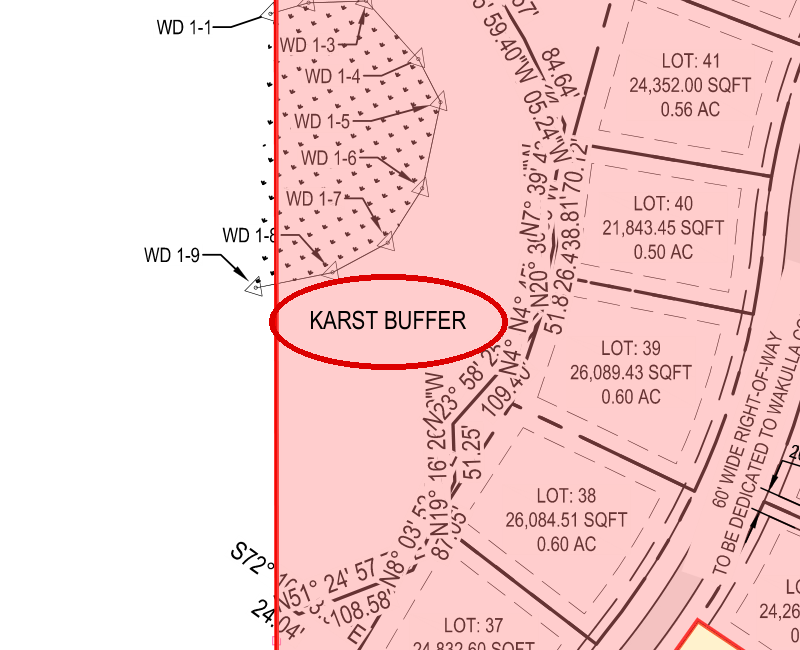
The county’s own reviewers flagged drainage problems along the way. In a May 2023 review letter, staff noted that one stormwater pond drains into a second pond “which has no outfall point,” and that both ponds overflow their banks in a 25-year, 24-hour storm. The engineer responded that a revised model, which counts water soaking into the ground, keeps more than a foot of margin in both ponds. The county accepted that. In November 2022, the county also asked the engineer to “confirm whether karst features are present.” A 2004 environmental survey in the file had already photographed a sinkhole and a wetland with exposed limestone along the property’s western edge.
Then there’s the clearing. The homeowner says that on September 17 he heard machines close to his house. He walked back into his woods and found cleared ground and equipment tracks inside his property line. The operator told him he’d been told that line was the edge of a pond, not a property boundary.
Then We Opened the Concurrency File
“Concurrency” is the rule that the roads, water, sewer and schools a development needs have to exist, or be on the way, before the county signs off. Wakulla’s own code says it directly:
“No final development order shall be approved … unless it is determined that the necessary public facilities will be available concurrent with the impacts of the proposed development.” (Wakulla County Code, Sec. 24.154)
The same section puts the burden on the developer to show that. So we looked at what the developer showed.
Getting the file was its own ordeal. On September 15 the homeowner asked for every utility letter, the full concurrency file, the school letter, the traffic study, the permit status, and a written answer on four questions:
• Does the county consider the 2004 Talquin letter enough?
• Has a current concurrency review been done?
• Does the county consider the old stormwater and soil studies enough?
• What authorized the clearing?
The county’s first response was two attachments: the old Talquin letter and the stormwater model. He paid $48 for the rest. The fuller file arrived about a week later.
Wakulla Reports filed its own request (PRR 2026-220) that same week, asking for the complete packet from 2023 forward, including anything on concurrency. We got two permit files. The homeowner counts roughly 37 documents in the county’s permit portal for this project.
STILL UNANSWERED: None of the four written questions has been answered. We could not find, in anything produced, a written statement on whether the county considers 2004 paperwork sufficient, whether a current concurrency review was done, or what authorized the clearing.
Here is what the 417-page file actually contains to support water, sewer and traffic capacity today:
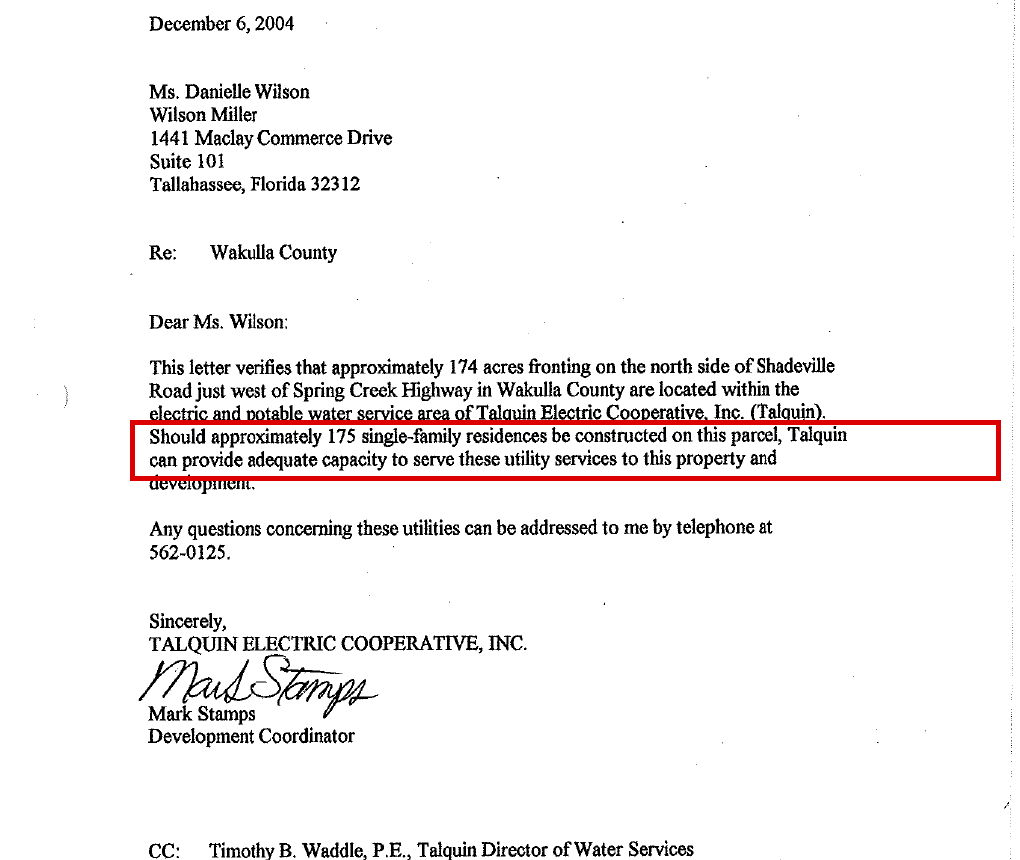
Water: A Talquin Electric letter dated December 6, 2004. It says Talquin can serve the land “should approximately 175 single-family residences be constructed.” The plan is now 191. The Talquin Electric letter is nearing 22 years old.
Sewer: A Wakulla Public Works letter dated December 21, 2004, saying the treatment plant “could serve” the land “with proper collection system and treatment capacity extensions or upgrades, if necessary.” There’s also a May 2006 county memo reserving 66,850 gallons a day of treatment capacity, based on a sewer route that was never built. In 2022 the county’s own utility reviewer told the engineer “there isn’t sewer in your ballpark currently.”
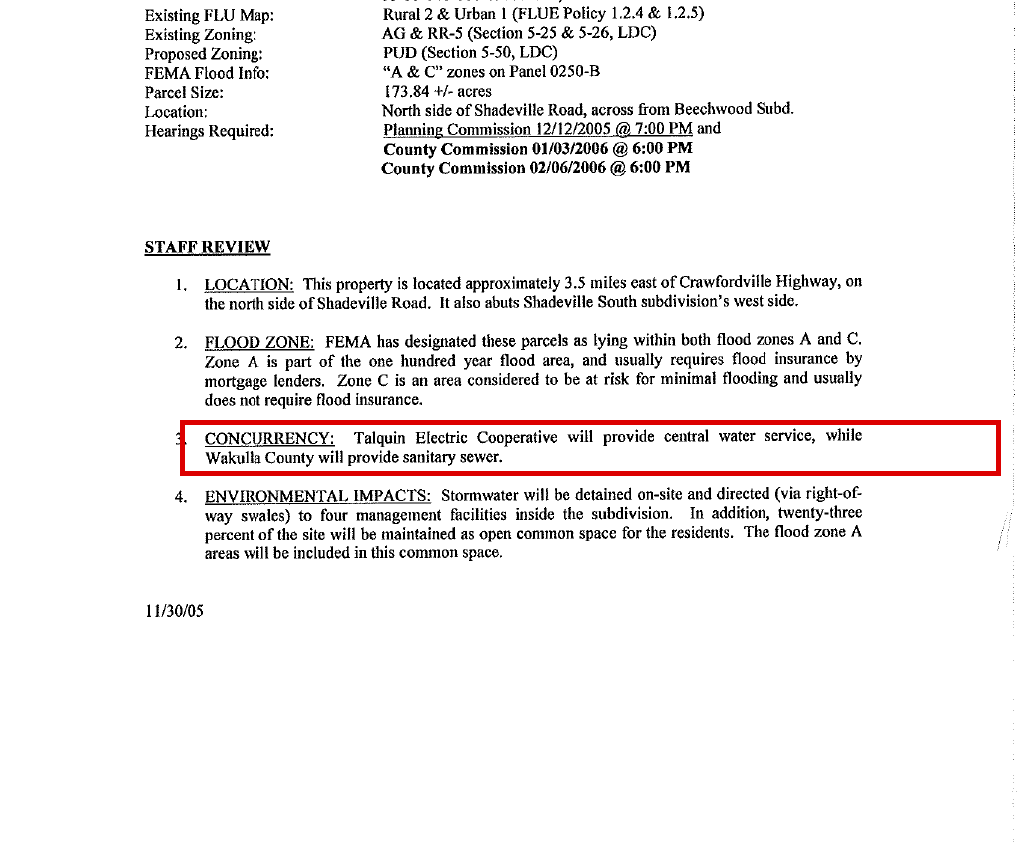
The county’s concurrency review: One line in a November 30, 2005 staff report: “Talquin Electric Cooperative will provide central water service, while Wakulla County will provide sanitary sewer.” No figures.
Traffic: A December 2004 study written for 175 homes, which assumed the project would be finished by 2008.
Soil: A geotechnical report from April 2006.
Stormwater: Modeling from July 2023, the only item less than three years old.
And here is what we could not find anywhere in the county’s file, the permit records, or the correspondence we’ve reviewed:
• A school board concurrency letter
• A current Talquin letter confirming it can serve 191 homes
• A current sewer or lift station capacity letter
• A concurrency certificate for the project
• A current traffic study
• The environmental resource permit number or the current status of any state permits (the county’s own permit lists state permits as a condition)
• Any record that neighbors were notified before the August 2026 renewal
The homeowner also wrote to Talquin on September 9 and copied county Planning. His tap water already comes out brown and smells like rotten eggs. He asked Talquin whether it had issued or planned to issue a will-serve letter for 191 homes, and what 191 more homes would do to existing customers. The Planning Director forwarded that letter to a staff planner on September 18. It’s in the county’s file.
STILL UNANSWERED: Talquin’s only reply so far was a note saying his letter had been passed along. Nothing in the county’s file shows Planning responding to the water-quality concerns it was copied on.
The Paper Trail on the Permit
February 6, 2006: The County Commission approves the rezoning and the 191-lot preliminary plat.
October 19, 2023: The county approves the development plans and development permit DP23-1554. The permit form says it is “valid for 6 months from the date of approval.”
June 17, 2025: A revised plan set is stamped approved.
August 6, 2026: The county issues DP26-1038, described on its face as “Renew DPA23-1554,” to install infrastructure for 191 lots. The permit holder of record is Pafford Properties & Construction, LLC.
If DP23-1554 was only good for six months, it ran out around April 2024, well before the 2025 revision and this year’s renewal. We couldn’t find anything in the county code that says what happens to a development permit once that window closes.
The Appeal the County Won’t Send to the Board
On September 18, the homeowner filed an appeal of the August renewal and paid a $430 fee. He was told it was the first appeal filed this year. He says no one in the office seemed sure how to process it.
County code is clear about what an appeal does:
“An appeal to the board of adjustment stays all work on the premises and all proceedings in furtherance of the action appealed from, unless the official from whom this appeal is taken certifies that by reason of facts cited in the certificate a stay would cause imminent peril to life or property.” (Sec. 3-23(3))
The county has said the same thing in its own approval letters, in 2006 and again in 2023: if an appeal is filed, “all work in reliance upon said decision must be stopped at the project site until the appeal runs its course.”
The homeowner says staff told him they were waiting on guidance from the county attorney, and the clearing kept going over the weekend. On September 21 he delivered a written stay demand to the Planning Director and copied the County Administrator, Assistant County Administrator and County Attorney. On September 22 he asked Code Enforcement for an inspection and a stop-work order. The county confirmed both letters were added to the file.
STILL UNANSWERED: No stop-work order. No “imminent peril” certificate. No written explanation of why work continued. No response from Code Enforcement.
On Thursday, September 24, four business days after he filed, Planning Director Brandon Geiger rejected the appeal as untimely. His letter says the window to appeal ran from the 2006 plat and the 2023 and 2025 plan approvals. It says the 2026 permit “does not constitute a new development approval subject to appeal” because it carries out plans already approved. The county is refunding the fee. There was no hearing, and the appeal never went to the Board of Adjustment.
The homeowner answered the same day. He says he never appealed the 2006 plat. He appealed the 2026 permit. He says the code requires staff to forward appeal paperwork to the Board rather than decide timeliness on their own. He also says no public notice of the August renewal ever started a 30-day clock for neighbors. He refused to treat the refund as a withdrawal, and he filed a second appeal challenging the rejection itself. He asked the county to confirm three things in writing:
• Will his first appeal go to the Board?
• Has the second appeal been docketed?
• Does a stay certificate exist?
The County’s Side
We want to be fair about this. The county’s comprehensive plan says “a separate concurrency review is not required for each development permit within the same project.” The county can argue that Raker’s Crossing was reviewed back in 2005 and 2006, and that this year’s permit just carries that approval forward. That appears to be the reasoning behind the rejection letter.
The problem is that we couldn’t find a concurrency certificate for this project at any stage, in 2006, in 2023, or now. And the county has taken the opposite position before. In 2022, then-Planning Director Somer Pell wrote to a property owner in a separate case that “we can’t honor that DPA from 18 years ago.” Raker’s Crossing is relying on paperwork that’s even older.
Every Question Still Waiting on an Answer
Here’s the running list. We’ll update it as answers come in.
Sept. 9: Drainage calculations at his property lines, the basin map, the rear-lot drainage condition, notice of the renewal, and the state permit number, or a written statement that they don’t exist. Unanswered.
Sept. 9: Water capacity and quality questions sent to Talquin, with county Planning copied. Acknowledged only.
Sept. 15: Four written questions on whether 2004 paperwork is enough, whether a current concurrency review was done, whether the old studies are enough, and what authorized the clearing. Unanswered.
Sept. 21: A stay demand under the county’s own code. Unanswered.
Sept. 22: A Code Enforcement request for an inspection and a stop-work order. Unanswered.
Sept. 24: Confirmation that the appeal goes to the Board, that the second appeal is docketed, and whether a stay certificate exists. Unanswered.
Our Take: This Isn’t New
Here’s the contrast, straight from the county’s own records.
The developer’s renewal was stamped on August 6. We found no notice to neighbors and no updated utility letters. When a citizen asked for the records behind it, the first thing he got was two attachments. When he asked for the rest, he paid for them. When he used the one formal tool the code gives him, an appeal, it cost $430, and the county turned it down in four business days without sending it to the board that is supposed to hear it.
Meanwhile, the questions that would actually settle this remain unanswered:
• Where does the water go?
• Is there capacity for 191 homes?
• Why didn’t work stop?
Those aren’t hard questions. A public office that works for the public answers them in writing. When the answers are “we don’t have that” or “we didn’t check,” a public office says that too.
Residents have told us for years that dealing with this county feels like a system built to wear regular people down while projects keep moving. This file doesn’t prove anyone’s intentions. What it shows is who got answers and who didn’t. You can decide what that tells you.
What Happens Now
Two appeals are technically pending. Whether either one gets a public hearing is the open question. If one is scheduled, we’ll post the date here first. That’s the room where citizens can speak, and where the county has to answer on the record.
This is a living story. We’ll keep following the facts as they develop, update the unanswered list as responses come in, and note any correction.
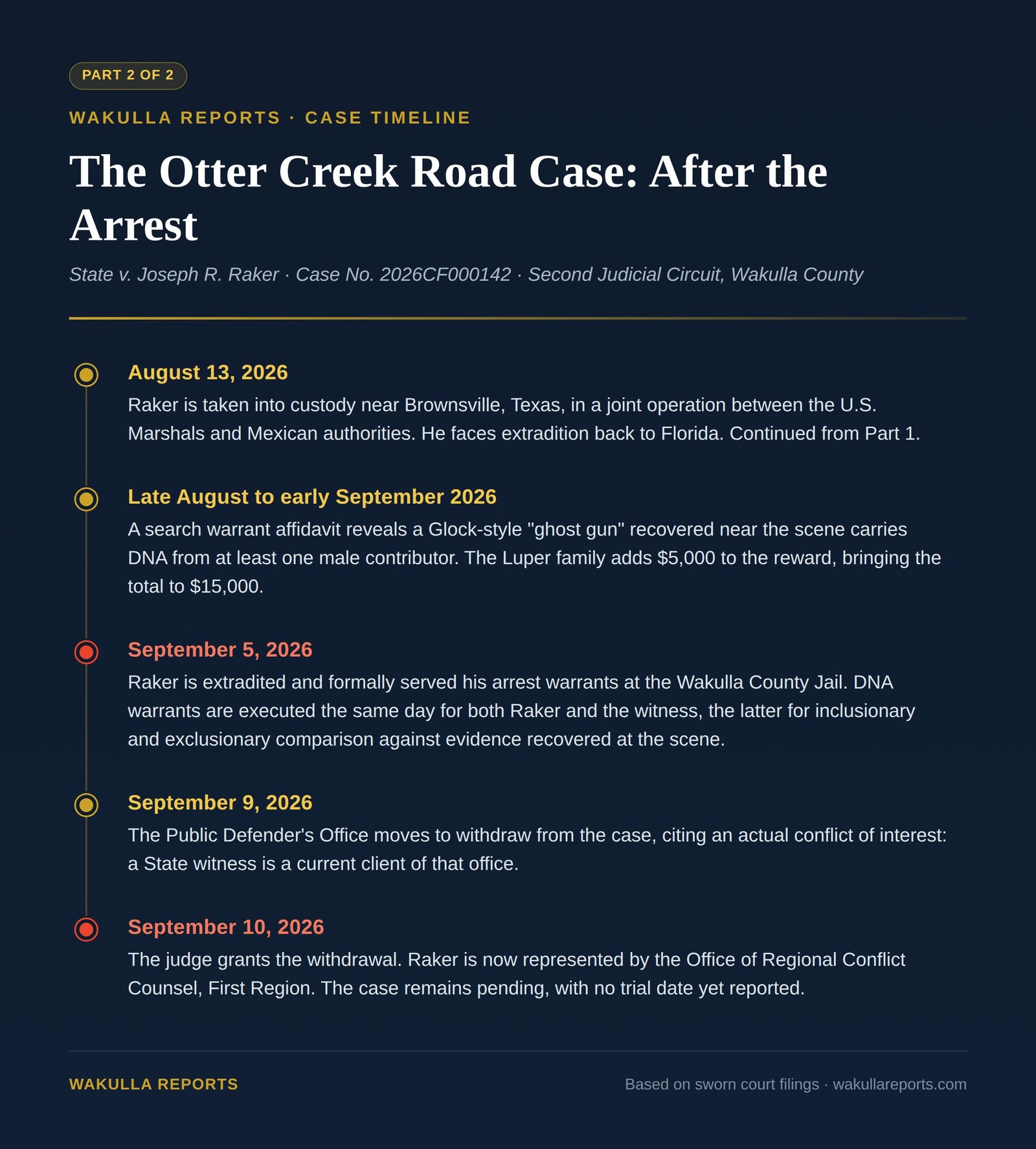
Court records unsealed over the past two weeks give the first sworn, first-hand account of what happened at 740 Otter Creek Road, Sopchoppy, on the night of August 1, 2026. We’ve read the arrest warrant affidavit, both DNA search warrants, and the public defender’s motion to withdraw from the case in full, and cross-checked them against everything WCTV, WTXL, WFSU, and FOX 13 have reported since. This is what the record shows.
One thing up front: a woman living at the residence is the person who reported this to authorities and gave detectives the detailed account much of this case is built on. She has not been charged with anything, and no outlet covering this case, including us, has published her name. We’re keeping it that way.
Who Died
John William Luper III, 49, and Rebecca Lynn Thomas, 58, were both shot multiple times on the property they shared with Joseph Ronnie Raker, 47. Luper’s sister Rhonda told WTXL, “That is my baby brother. That is the only brother I have left. My mom is brokenhearted.” The family has since raised a public reward, now totaling $15,000, and started a Facebook page dedicated to the case.
The Background, Per the Affidavit
The witness told detectives she had moved onto the property in April 2026 and was briefly involved with Luper before he reconciled with Thomas. Luper then told her she could no longer stay in the main house, but let her pitch a tent on the property instead. She described going without running water through a difficult stretch of heat. Sometime in May or June, her relationship with Raker turned romantic, and she moved into his room in the main residence. In July, Luper gave her and Raker a handwritten, three-day eviction notice. She told detectives it wasn’t legally enforceable, and nothing came of it at the time.
August 1, 2026 (Saturday): The Night of the Killings
The witness said she came home from a shift around 6 p.m. and found the air conditioning broken, which she suspected was Luper’s doing. Around dusk, Luper and Thomas returned in separate vehicles. She said she watched Luper get on a skid-steer tractor and drive it toward the area where her tent had been. She alerted Raker; he told her to stay inside, went outside, and, by her account, confronted Luper. Roughly 30 to 45 minutes later, she told detectives she heard several gunshots, a pause, then two more, while the tractor kept running.
Raker called her cellphone and told her to meet him “at the mound” with a bag from his room. She described handing off the items, watching him walk into the woods, and watching him return without them. When he came back to the house, she said, he was sweating heavily, dirty, and didn’t explain what had happened. He showered and balled up his clothes, a t-shirt, khaki shorts, and flip-flops, into the corner of the room. A mutual friend stopped by briefly that evening; the two used drugs together and the friend left. Before bed, Raker told her, “don’t worry, they’re in bed,” referring to Luper and Thomas.
August 2, 2026 (Sunday)
The witness said she left for her shift around 11 a.m.; before she left, Raker gave her a $50 bill, something she said he had never done before, and told her to put it toward child support. She returned home around 6 p.m. and found Raker sitting in the bathroom, by her description, “naked and dirty.” She said she saw the friend’s phone, wallet, and drugs in Raker’s room, but the friend himself wasn’t there. Raker told her he had asked the friend to come help him “move stuff” that day, and had walked him across the street to where Luper and Thomas’s bodies were before the friend “ran off” into the woods, frightened.
That evening, around 9:20 p.m., the witness went to Dux Discount Liquors on Crawfordville Highway and told an employee there she had information about a homicide, the report that brought deputies to the property. Separately, per the affidavit, she described a machete she had found under Raker’s bed that Sunday, out of its usual place; investigators noted the victims were found concealed under palm fronds and undergrowth, and that Raker had scrapes on his lower legs consistent with dense brush.
What Deputies Found That Night
When deputies arrived at 740 Otter Creek Road, they located a skid-steer with coagulated blood and live ammunition nearby, and spoke with a neighbor who reported hearing multiple gunshots the previous night. Luper, Thomas, Raker, and the friend were all unreachable, though vehicles belonging to Luper and Thomas were still on scene. Deputies secured the perimeter and waited on a search warrant. Around 1 a.m. on August 3, the main house caught fire. Raker was pulled from the burning home and taken to Tallahassee Memorial Hospital, treated for smoke inhalation, and at that point was not under arrest.
At the hospital, Raker gave detectives his own version: that the friend had asked him to help move something heavy and they needed a truck; that he had found the bodies already on the ground when he arrived; that he “completely panicked.” He admitted helping load the bodies into the bed of Luper’s truck, driving them into the woods, and dumping them there, and said he offered to lead police to the location. He also said he watched the friend run off after being let out of the truck.
The friend gave detectives a different, voluntarily provided account: that Raker asked him to help load something heavy without saying what it was, that he put on gloves at Raker’s instruction, and that when he lifted a sheet of plywood in the truck bed he recognized Luper’s arm by its tattoos. He said he was horrified, immediately left the property on foot, and eventually reached a friend’s house and called his landlord for a ride home.
The bodies of Luper and Thomas were found later that day in nearby brush within the St. Marks Wildlife Refuge, roughly 100 yards apart. The Wakulla County Sheriff’s Office obtained an arrest warrant for Raker on two counts of homicide (F.S. 782.04.2) on August 3 and 4, no bond, flagged for nationwide extradition.
The Manhunt
The U.S. Marshals Fugitive Task Force joined the search, along with local, state, and federal agencies contributing K-9 teams and aviation support. WCSO offered a $10,000 reward, later raised to $15,000 with the Luper family’s contribution. Sheriff Jared Miller said publicly that “anyone who helped commit these crimes, concealed evidence, or knowingly assisted those involved, we will follow the evidence, and we will find you,” signaling more arrests could follow. On August 13, Raker was taken into custody near Brownsville, Texas, close to the Mexico border, in a joint operation between the Marshals and Mexican authorities. Announcing the arrest, Sheriff Miller said Raker “can no longer hide from law enforcement or evade the justice system.” Raker was extradited back to Florida in early September and formally served the arrest warrants at the Wakulla County Jail on September 5.
What the DNA Warrants Add
Two search warrants, filed September 9 and executed September 5, haven’t been widely reported. One compelled a DNA sample (buccal swabs) from Raker himself: investigators say a firearm, described as a Glock-style 9mm “ghost gun” with no serial number, was recovered from a wooded area near the scene, and FDLE lab analysis found DNA from at least one male contributor on swabs taken from it. The second warrant compelled a DNA sample from the same witness who fled to Dux Lounge, explicitly for “inclusionary and exclusionary purposes,” meaning investigators want to be able to rule her in or out against evidence recovered at the scene, which the affidavit lists as including ammunition, gloves, clothing, firearms, and firearm magazines.
The Public Defender Conflict, and What Happened Next
On September 9, the Public Defender’s Office for the Second Judicial Circuit filed a motion to withdraw entirely from representing Raker, asking the court to appoint conflict-free counsel instead. The motion states that a State witness in this case is a current client of that office, and that representing Raker would require the office to investigate, impeach, and cross-examine its own client, an actual conflict of interest that, under Florida law, disqualifies not just one attorney but the entire office. The motion doesn’t name the witness, and neither will we.
The judge approved the withdrawal. Raker is now represented by the Office of Regional Conflict Counsel, First Region, the state entity that steps in when the public defender can’t. As of this update, the case remains pending and no trial date has been reported.
What We Don’t Know Yet
The affidavits don’t explain a motive beyond the eviction dispute, and investigators have said as much publicly. It’s also not yet clear from the public record whether the friend who helped load the bodies, or anyone else, will face charges. Sheriff Miller’s comment about “additional arrests” being expected suggests the case isn’t closed.
This piece is based on a full review of the arrest warrant affidavit, the two DNA search warrant affidavits, and the motion to withdraw filed in State v. Joseph R. Raker, Case No. 2026CF000142, in the Second Judicial Circuit, Wakulla County. Readers are encouraged to review the court file directly and reach their own conclusions.
Primary sources: Arrest warrant affidavit, DNA search warrant affidavits, and motion to withdraw, State v. Joseph R. Raker, Case No. 2026CF000142, Second Judicial Circuit, Wakulla County, Florida.
Some stories arrive in fragments. A memo. A parent’s letter. A disciplinary form that doesn’t match the timeline. A deputy who admits her mistake but insists the process that followed was not just flawed, but fundamentally broken.
The story of former Deputy Marsh is one of those cases. It is not a simple tale of innocence or guilt. It is a story about timing, judgment, leadership, and the way an agency can mishandle a problem until it becomes something much larger than it ever needed to be.
A Deputy’s Beginning
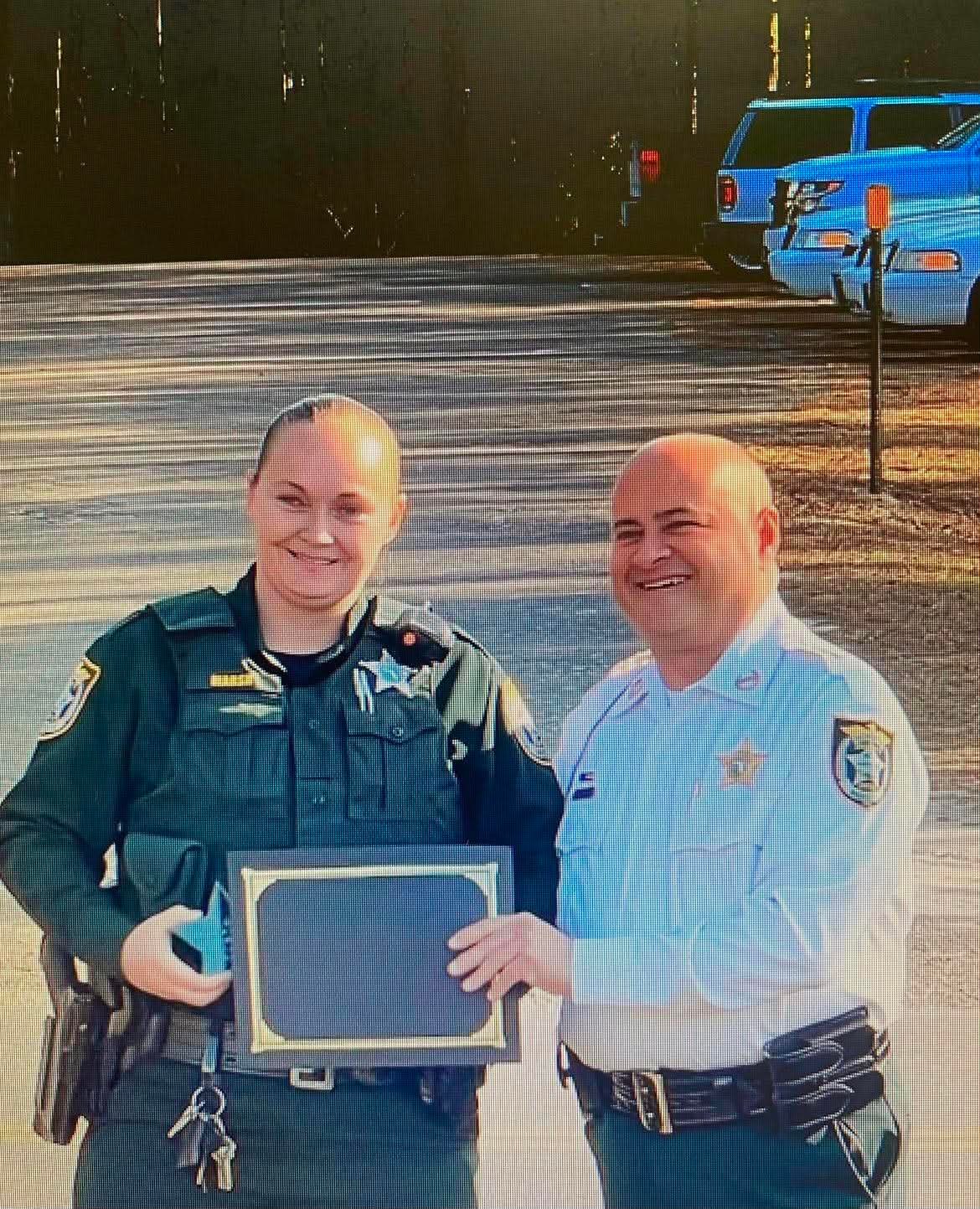
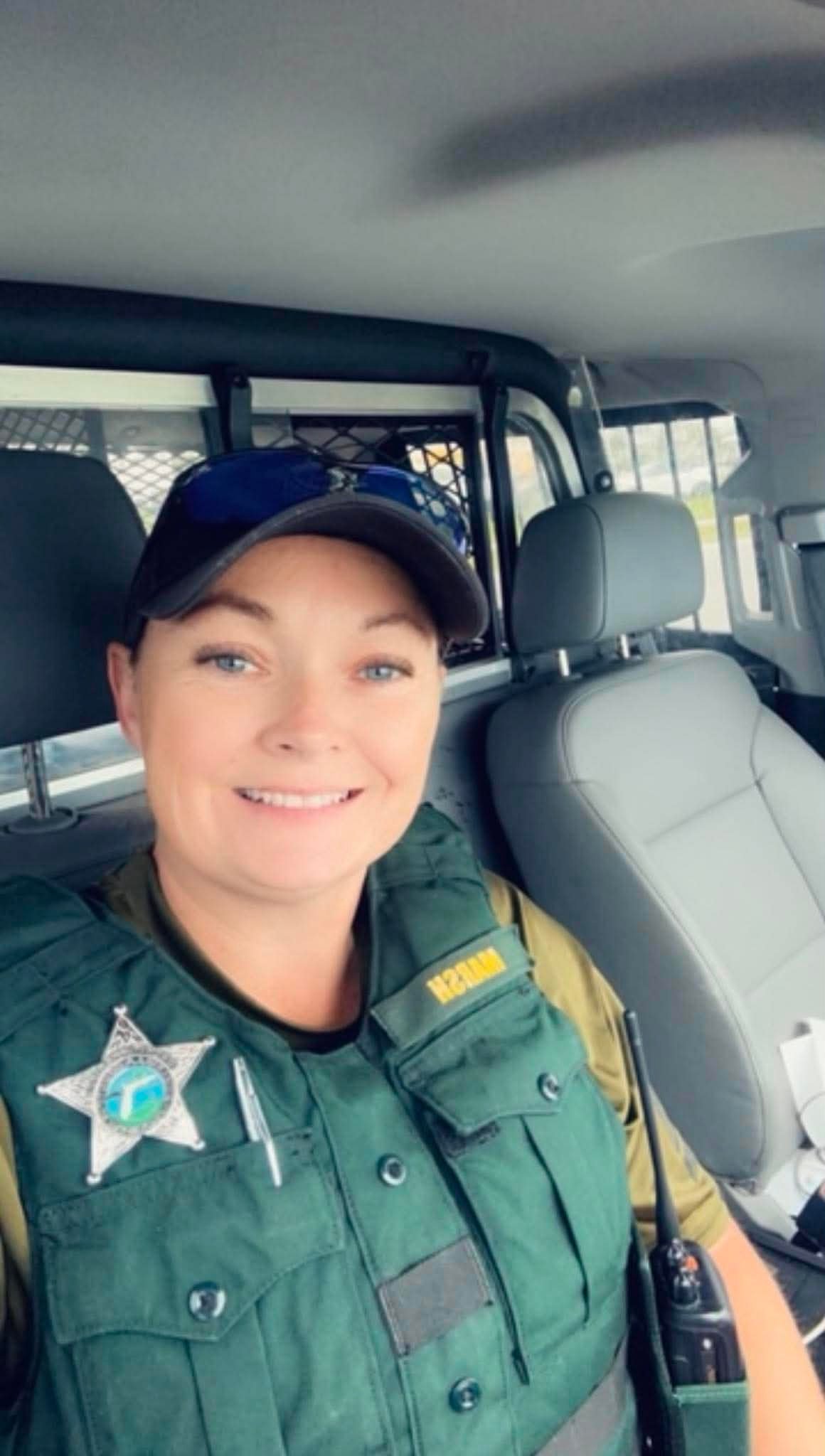
When Deputy Marsh joined the Wakulla County Sheriff’s Office in 2020, she was like many new deputies. Eager. Green. Learning the ropes. Her early evaluations show a young deputy who arrived early, kept a clean uniform, asked questions, and tried to do things the right way. Any corrective criticism by supervisors was not outside of the normal course of business.
Supervisors described her as adaptable, dependable, and willing to volunteer for extra duties. Over the next few years she became a School Resource Officer, worked at multiple schools, and eventually stepped into a leadership role with the Sheriff’s Explorer Program.
Parents saw her as steady. Kids saw her as approachable. Supervisors saw her as reliable.
Nothing in her file suggested she was on a path toward termination.
The 2021 Mistake
In early 2021, Deputy Marsh made a mistake she has never denied. She ran a name and shared confidential information with a man she knew, S. B. She was young, new to the job, and entangled in a personal situation she should have stepped away from.
She admits this. She owns it. She calls it a bad judgment call.
What is striking is what happened next.
Nothing.
No complaint was filed. No investigation was opened. No discipline was issued. No supervisor documented concern.
The agency simply moved on.
The Explorer Program Begins to Crack
Fast forward to 2023. The Explorer Program, once a bright spot for the Sheriff’s Office, was suddenly unstable. Leadership changed abruptly. Parents were confused. Cadets were upset. One parent wrote a detailed letter to Sheriff Miller describing the chaos and praising only one person for providing continuity.
That person was Deputy Marsh
The parent wrote that she was the only steady presence the kids had left. She was the one they trusted. She was the one who showed up. She was the one who kept the program from falling apart.
Sheriff Miller acknowledged this and placed her in a leadership role. But according Deputy Marsh, being a newer deputy in a tight‑knit agency made this a double‑edged sword. She often felt resistance from peers when trying to schedule training or raise concerns.
When I sat down with her and reviewed the parent’s letter during our interview, I wrote a note to myself in the margin: “this was our trigger.” It was not something from inside the agency. It was my own observation. The timing, the tension, the sudden instability in the Explorer Program. It all pointed to this moment as the spark that set everything else in motion.
A Deputy Planning Her Future
In April 2024, Deputy Marsh submitted a formal memo requesting a transfer back to Road Patrol. The memo is calm, professional, and forward‑looking. She explains her experience, her desire to grow, and her commitment to the agency. Beneath that professionalism, she was also seeking relief from the mounting pressure of managing the Explorer Program. Rather than escalate internal tensions, she attempted to transition quietly.
There is no hint of trouble. No hint of discipline. No hint of an investigation.
She believed she had a future at WCSO.
What Was Happening Behind the Scenes
While Deputy Marsh was on vacation with a colleague, (Major Dale Evans who would later file suit against the county himself) and his family, a memo was filed with WCSO. Not a formal complaint. Not a sworn statement. A memo indicating that she had looked up a woman’s car tag in 2021.
It was now 2024.
A case file was assembled during her vacation. When she returned, it was waiting for her.
June 2024: The Past Comes Back
Three years after the 2021 incident, Deputy Marsh was suddenly called into the Criminal Investigations Division. She walked in expecting to assist with a case. Instead, she found herself being questioned about her own actions from years earlier.
According to the investigative file, a mutual acquaintance of both Marsh and the purported victim, R. T., had loaned his iPad to his five‑year‑old daughter during her shared parenting time in 2024. That acquaintance, S. B., had been in a heated custody dispute with R. T. back in 2021. During that time, Marsh had been a supportive ear to S. B. and even served as a character witness in the custody matter.
In 2024, while the child used the iPad, R. T. accessed the device, discovered old messages from 2021, and later provided screenshots to WCSO nearly three years after the actual incident. Those screenshots became the basis of the new investigation.
When Marsh arrived at CID, she was not told she was the subject of the investigation until after questioning began. She was not given the complaint. She was not given witness statements. She was not given evidence. She was not given the names of complainants.
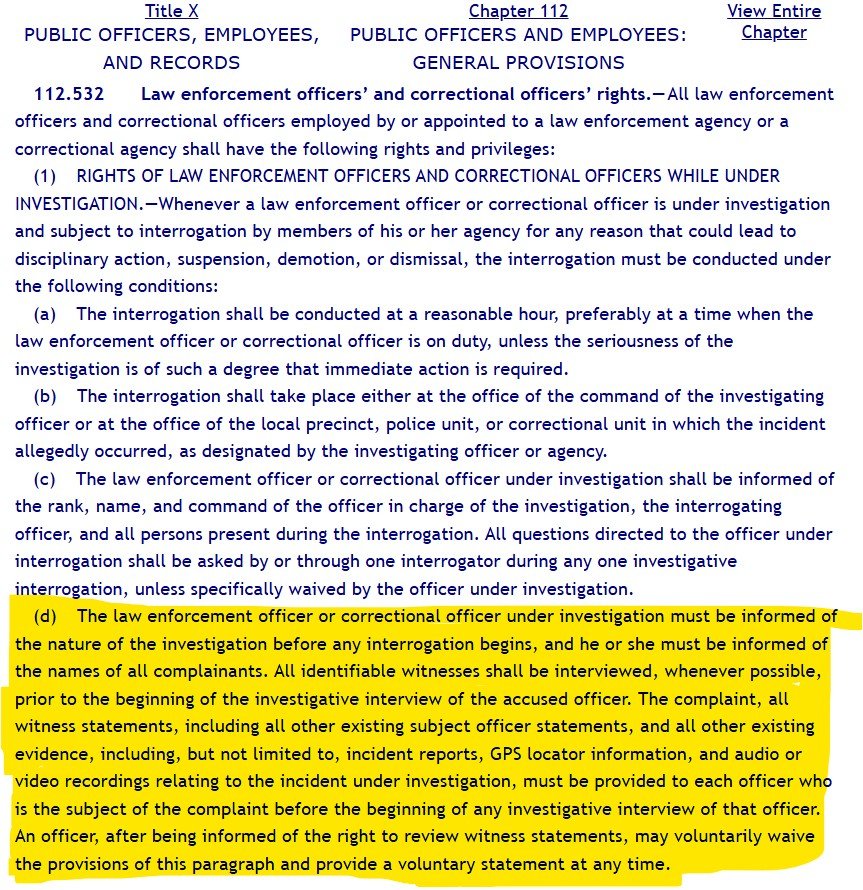
Florida law requires all of that before an interrogation. The investigation had already violated the Law Enforcement Officers Bill of Rights before it even started.
The Incident Report That Raised More Questions Than Answers
Detective O.’s report is long, detailed, and emotional. It includes screenshots provided by R. T. and her fiancé, K. G. It includes their recollections of seeing Deputy Marsh in public places. It includes their interpretations of her presence. It includes their feelings about her.
None of these recollections were reported at the time they allegedly occurred.
The complainant stated she did not report it in 2021 because she believed WCSO “looked out for their own.”
What the report does not include is the one thing any prudent investigator would consider essential.
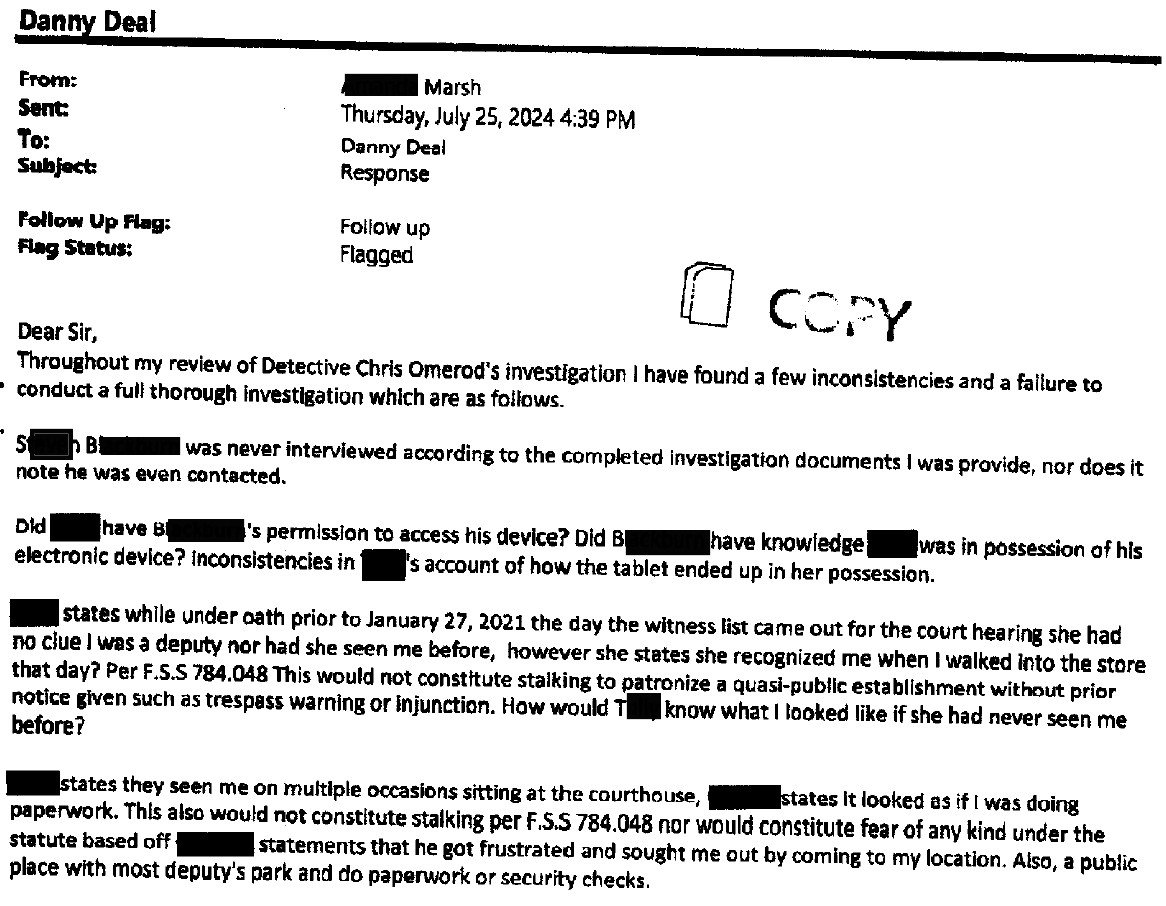
A single interview with S. B.
The man who owned the iPad. The man who received the confidential information. The man whose device contained the screenshots.
He was never interviewed.
This is not a small oversight. It is a foundational failure and is required in the statute for Law Enforcement Officers’ and Correctional Officers’ rights.
Author Note: If you would like to request the full report from WCSO, the reference number below is provided for your convenience. Redacting the entire document would render it unusable, so the essential details and relevant handling of the case are summarized here. Deputy Marsh fully admits the original violation; however, the central questions about how and why the incident was resurrected three years later remain critical to understanding this investigation.
The iPad Access
According to investigative interviews, R. T. accessed S. B.’s iPad using a password obtained from the child and reviewed private messages without his knowledge. She then saved screenshots to her own device before returning the iPad.
The information she extracted was from 2021. She accessed the device in 2024.
This raises natural questions about:
• Consent
• Chain of custody
• Authenticity
• Context
• How the screenshots were selected
• Why they surfaced three years later
These are not accusations. They are questions any reasonable investigator would ask.
The TAR Report That Never Appears
Any allegation involving misuse of FCIC or NCIC should be verified through a TAR audit. A TAR report is an automatic, permanent log that records:
• Who ran a query
• When it was run
• What terminal was used
• What type of query was performed
• The purpose code
If Deputy Marsh ran R. T.’s information in 2021, there would be a TAR entry documenting the exact date, time, and terminal used.
The incident report does not reference any specific TAR verification. The interview audio references a partial TAR report. The public records provided to Marsh do not include one.
Does it exist in its entirety or only partial? Was it reviewed at the time of the incident or subsequent to? Is there a standard TAR review process at WCSO? Or is it only pulled when a problem arises?
This is a significant gap in the investigative record.
The Stalking Allegations
The report claims that Marsh “stalked” R. T. and K. G. in 2021. Yet:
• No contemporaneous complaints were filed
• No videos or photos were taken
• No one called dispatch
• The report does not show that a vehicle number was ever provided
• No one filed a report at the time
• No one identified her by name
• No one even knew who she was
R. T. claimed she recognized Marsh from a “witness list” in her custody case with S. B. Witness lists do not contain photographs. Meanwhile, according to the report, Marsh did not even know who K. G. was until 2024. The idea that a deputy was stalking someone in 2021, yet no one thought to take out a phone, call 911, or report it until 2024, strains credibility.
Even if someone distrusted WCSO, FDLE existed in 2021.
The Detective’s Contradictions
During the recorded interview, Detective Ormerod. acknowledged that the statute of limitations had expired. In the same breath, he said it was up to the State Attorney’s Office. If the statute of limitations had passed, why was a criminal investigation conducted at all? Why wait for the ASA to say it was administrative? Why not begin with an administrative review? The contradiction raises questions about the purpose of the investigation.
The Suspicious Messages
In August 2024, Marsh received anonymous messages referencing her confidential investigation. She reported them immediately. Internal Affairs responded: “It is really odd to know that someone has infiltrated your confidential investigation.”
They asked her to allow them to review her phone. They insisted they would not use anything on her phone against her.
Her attorney advised her to decline.
Marsh’s Rebuttal
On July 25, 2024, Marsh submitted a written rebuttal to Internal Affairs. It is calm, factual, and grounded in statute. She points out inconsistencies in R. T.’s statements. She questions how R. T. could recognize her if she had never seen her before. She cites the stalking statute and explains why the allegations do not meet the legal definition. She highlights that the detective repeatedly inserted personal opinions about her relationship with S. B.
She ends with something rare in these cases:
“I take full responsibility for the policy violations for which I have committed in disclosing confidential information.”
There is no evidence that Internal Affairs ever addressed her rebuttal.
The Termination That Was Already Decided
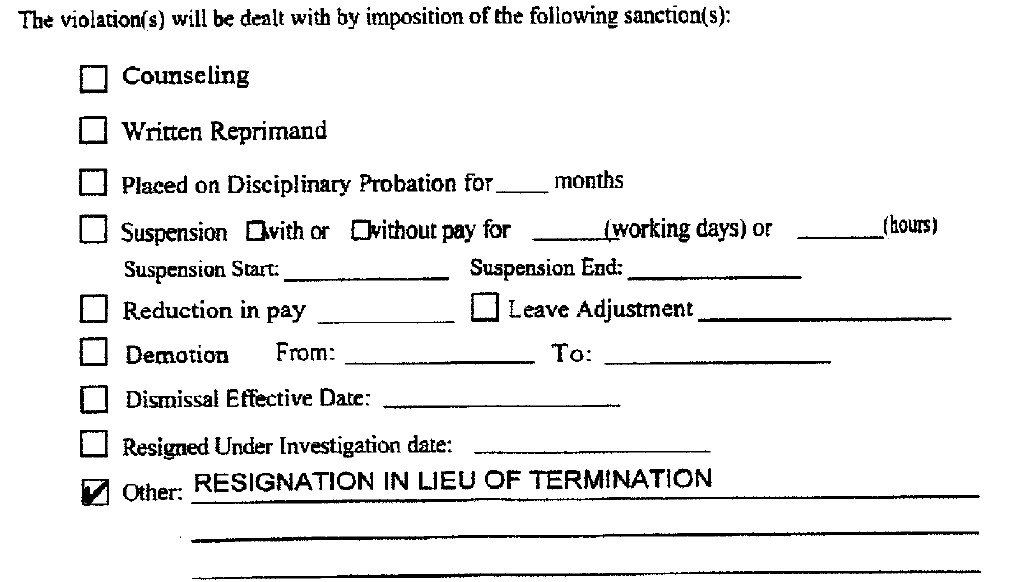
On September 13, 2024, Deputy Marsh was handed a disciplinary form that said “Dismissal, effective 9/17/24.” She refused to sign it.
Three days later, HR delivered a termination notice. She was told she could request a name‑clearing hearing, but the timeline was tight and the outcome was already clear.
On September 18, she signed a form that said “Resignation in lieu of termination.”
This was not a voluntary resignation. It was a forced exit.
The Path of the Complaint
One detail remains especially unclear.
The path the complaint took into the agency is unclear. The incident was originally reported to Tiffany Spears, a detective with WCSO who was not a witness to the events, which raises questions about how and why a three‑year‑old incident suddenly resurfaced. The original complaint did not seem to follow the same process any other citizen would have to follow.
This is not an accusation. It is a question of timing, process, and transparency.
What the Documents Show
What Deputy Marsh did wrong in 2021
• She disclosed confidential information
• She became entangled in a personal situation
• She exercised poor judgment
What WCSO did wrong in 2024
• Violated multiple LEOBR requirements
• Opened an investigation three years too late
• Failed to interview the key witness
• Pressured her to surrender her phone
• Ignored her written rebuttal
• Pre‑decided termination
• Used a report filled with opinion
• Omitted solid TAR verification
What the timing suggests
• The Explorer Program was unstable
• Parents were complaining
• Deputy Marsh was the only continuity
• She referred a parent directly to the Sheriff
• The Sheriff promoted her into leadership
• Internal resentment grew
• The old 2021 incident suddenly resurfaced
The timing is not proof of retaliation, but it is impossible to ignore.
The Story Behind the Story
This is not a story about a perfect deputy. It is not a story about a perfect agency. It is a story about what happens when a mistake is ignored until it becomes useful.
If WCSO had addressed the 2021 violation in 2021, this story would not exist. Instead, the agency waited three years, then used the old mistake as the foundation for a new criminal investigation that violated multiple legal protections.
The result was predictable. The process was flawed. The outcome was predetermined.
And a deputy who had spent four years serving schools, children, and the community was pushed out in a way that raises serious questions about fairness, transparency, and leadership.
A Pattern Bigger Than One Case
The story of Marsh does not stand alone. It sits beside other cases in Wakulla County where investigations skirted procedure, where complaints were mishandled, and where both citizens and deputies were left without answers. Different facts. Different people. The same structural weaknesses. And a flavor for “going back three years to dig up dirt”. See the Dale Evans story here.
A culture where process bends. A culture where timing is political. A culture where accountability is inconsistent. A culture where both citizens and deputies pay the price.
Where This Leaves Wakulla County
The deputies deserve a fair process, timely discipline, and termination when warranted. The Explorer Program deserves stability. And the Sheriff’s Office deserves scrutiny when its internal processes fail.
This story is not over. It is only a part of a larger conversation about accountability, culture, and the future of civic institutions in Wakulla County.
07/01/2026 Blog Update – Clarification on Interview Type & LEOBR Applicability
After reviewing the reader’s comment and taking a closer look at the statute, Wakulla Reports is adding the following clarification to ensure accuracy:
Florida’s Law Enforcement Officers’ Bill of Rights (F.S. 112.532) applies whenever an officer is under investigation and subject to interrogation for any reason that could lead to disciplinary action, demotion, or dismissal. This means that even if an agency initially frames the interview as “criminal,” LEOBR protections may still apply if the matter ultimately results in administrative consequences – which this case did.
At this time, Wakulla Reports does not have the full audio or transcript of Deputy Marsh’s interview. We agree that this information would be helpful for determining the exact nature of the interrogation. Please see the report ID above and request the records if you would like more information. While we do grab as many public records as we can, we cannot do it all and it takes community involvement just like the below comment.
While Deputy Marsh openly admits the original policy violation, the questions raised in this report focus on process, timing, and consistency – including why a criminal investigation was initiated despite the statute of limitations having expired, and why key procedural steps were omitted or unclear.
We appreciate the reader’s insight, and this update has been added to ensure the blog reflects the most accurate interpretation of the law based on the information currently available to us. Comments and records are welcome even if private. Private messages can be sent to wakullareports@gmail.com
Two lawsuits. Two different plaintiffs. Two different harms. Two different vantage points on the same institution.
One comes from the outside, a couple who moved here for a quieter life and found themselves exposed to thousands of people online. The other comes from the inside, a Major who spent twenty six years in the Sheriff’s Office and says the culture turned on him when he reported misconduct. They do not know each other. They did not file their cases together. Their stories unfold in different years, under different circumstances, involving different actors.
And yet, when you lay the filings side by side, the overlap is unmistakable. The pattern is not subtle. It is structural.
This is where the stories meet, and why that intersection matters to the public.
Speaking Up as the Trigger Point
Both cases begin at the same moment. The moment someone speaks.
For the doxing victims, it was the belief, mistaken but firmly held, that they were behind online criticism of public officials. Their supposed speech was political, public, and protected. For the Major, it was his reports of misconduct, discrimination, and policy violations inside the agency. His speech was internal, documented, and also protected.
Two different forms of expression. Same result. The temperature changed the moment they opened their mouths.
Retaliation Instead of Correction
In both filings, the response to protected speech is not investigation, not clarification, not correction. It is escalation. The doxing victims describe exposure, database misuse, and public targeting. The Major describes reassignment, isolation, investigations, and termination.
Different tools. Same direction. The filings describe a culture where criticism, whether from a citizen or a ranking officer, is met not with accountability but with consequences.
Misuse of Access and Authority
Both lawsuits describe something deeper than interpersonal conflict. They describe the use of privileged access to target the person raising concerns.
In the doxing case, an active county commissioner used a candidate only subscription database to pull a private citizen’s voter information. This is not a public records search. This is not something any resident can do. This is access granted for campaign purposes, and the filing states it was used instead to identify and expose someone believed to be a critic. Prior to this event, a deputy accessed internal law enforcement databases to obtain and share additional personal information about the same citizen. These systems exist for public safety, not political retaliation.
In the Major’s case, internal access was used in a different but equally telling way. Leadership allegedly directed investigators to go back three years and dig for anything that could be used against him after he reported misconduct. The filing describes this as a search for negative information, not a search for truth.
Two different systems. Two different roles. Two different types of access.
Same pattern. Access is used sideways, not upward. Not for accountability, but for pressure.
Intimidation That Reaches the Home
Both filings describe behavior that moves beyond the workplace or online space and into the plaintiffs’ private lives.
The doxing victims live in a cul de sac, a place where traffic is predictable, familiar, and limited. A county commissioner driving slowly past their home during an active law enforcement response was not normal neighborhood movement. It was noticed. It was recorded. And it was unexplained.
The Major describes detectives driving by his home, family members taking photographs, and the sense that the pressure had followed him out of the building and into his personal space.
Two different neighborhoods. Same message. We know where you live.
Public Humiliation as a Pressure Tool
Both lawsuits describe online humiliation as part of the retaliation sequence.
For the doxing victims, their personal information, full name, address, date of birth, voter ID, phone number, was posted to a Facebook group of more than twenty two thousand people.
For the Major, anonymous posts called him crazy, a POS, and accused him of provoking the agency.
Two different platforms. Same tactic. Public shaming as a form of control.
Shifting Explanations and Inconsistent Justifications
When the consequences escalated, the explanations shifted.
In the doxing case, a commissioner later claimed it was another person with the same name, despite having posted the exact voter data of the actual victim.
In the Major’s case, his termination was justified as a disrespectful email, even though the filing states the email was professional and raised legitimate concerns.
Two different stories. Same pattern. The justification changes when the scrutiny begins.
A Chilling Effect on Speech
Both lawsuits end in the same place. Silence.
The doxing victims say they have been deterred from participating in the community. The Major says his speech was chilled by retaliation.
Two different voices. Same outcome. People stop speaking.
And when people stop speaking, the public loses more than two plaintiffs. It loses the oxygen that keeps institutions accountable.
What This Means for the Community
When a private citizen and a Major, people with no connection to each other, describe:
retaliation after protected speech
misuse of authority
intimidation at home
online targeting
shifting explanations
lack of corrective action
and a chilling effect on participation
it stops being coincidence.
It becomes a pattern.
Is this how the system responds to criticism, no matter where it comes from?
This is where the stories meet. This is where the culture becomes visible. And this is where the public’s role begins, because patterns like this do not correct themselves.
When two people on the outside and one person on the inside describe the same pattern, the community has a responsibility to pay attention. These lawsuits are not identical, and they do not need to be. What matters is that they echo each other in the places that count. They describe retaliation after protected speech. They describe the use of access and authority in ways that fall outside the purpose those systems were built for. They describe intimidation that reaches the home. They describe shifting explanations when scrutiny arrives. And they describe a chilling effect that silences the very voices a healthy community depends on.
You do not have to take a position on the outcome of either case. The courts will decide the facts. But the public has a stake in the pattern. Because patterns like this do not stay contained. They shape how people participate, how they speak, how they report concerns, and how safe they feel doing so. They shape whether institutions correct themselves or close ranks. They shape whether the next person who sees something wrong believes it is worth the risk to say it out loud.
These cases, taken together, raise a simple question for every resident of this county. Not a legal question. A civic one.
What kind of culture do we expect from the people who hold power here, and what do we do when the stories coming from both sides of the badge point to the same place?
The answer will not come from a courtroom. It will come from the community paying attention, asking questions, and refusing to let silence become the safest option. Because when speaking up feels dangerous, the danger is never just to the speaker. It is to all of us.
Links to cases with redaction as requested by the plaintiffs and excluded non-necessary pages.
He had given the Sheriff’s Office twenty‑six years. Two decades of night shifts, narcotics work, K9 deployments, hurricanes, and the kind of calls that stay with you long after the paperwork is done. He wasn’t a rookie. He wasn’t a problem employee. He wasn’t someone who needed to be watched.
He was a Major.
And then one afternoon, according to the lawsuit he filed in federal court, everything changed.
Colonel Whaley stepped into his office and presented him with an internal incident report naming him as a suspect. The allegation: that he had sent “covert” (hidden) text messages to a deputy about her employment status. The complaint states he had never been directed to message her, never disclosed confidential information, and never violated policy. The report, he alleges, was “contrived” (manufactured).
During the confrontation, the filing says Whaley positioned himself close, reminded him he was in DROP retirement, and told him to “be careful.” The Major interpreted the comment as a warning tied to his age, disability, and prior complaints.
It was the moment where years of quiet shifts in treatment began to take a different shape.
The Diagnosis and the Shift
According to the complaint, the turning point began years earlier.
In 2018, the Major disclosed his Parkinson’s diagnosis to Sheriff Miller and the Undersheriff. He continued working and continued performing the essential functions of his job. But shortly after the disclosure, the filing states he was removed from his K9 position, reassigned to traffic enforcement, and then moved again into administrative duties.
He also began hearing comments. A Victim Advocate told him management referred to him as a “liability.” A coworker’s partner allegedly said he should be terminated because of his Parkinson’s. Younger officers, according to the filing, made remarks about “getting rid of the old Wakulla.”
The complaint says he continued working, continued managing his condition, and continued reporting to duty. But the environment around him was changing.
Reporting Misconduct
The Major’s lawsuit outlines multiple incidents he reported internally:
sexual harassment he witnessed
verbal abuse directed at other employees
discriminatory comments
hostile work environment concerns
In February 2023, he submitted a formal written complaint to Human Resources and the Undersheriff. HR acknowledged receipt. According to the filing, no corrective action followed.
After filing the complaint, the lawsuit states he was told the Sheriff didn’t trust him. He was accused of being a racist – a claim the complaint describes as fabricated and retaliatory.
He filed another complaint. Again, the filing says no meaningful action was taken.
The Text Message Incident
The confrontation in his office was tied to the allegation that he had improperly texted a deputy about her employment status. The complaint states:
he never disclosed investigative information
he never violated policy
the information the deputy referenced came from others inside the agency
he was never interviewed
he was never given a chance to respond
the report was used to target him
Shortly after, the filing says the Sheriff’s Office escalated the matter into a criminal investigation. A detective sought a warrant for his arrest. The State Attorney’s Office declined to issue it.
The complaint notes that similar conduct occurred regularly within the agency without consequence.
Isolation and Surveillance
After the confrontation, the lawsuit alleges a series of events that intensified the retaliation:
Colonel Whaley stopped communicating with him directly and routed all communication through captains.
Detectives began driving by his home in an unmarked vehicle.
He reported the drive‑bys; the agency closed the matter without action.
Family members of a detective stopped in front of his home and took photographs.
Anonymous Facebook posts appeared calling him “crazy,” a “POS,” and accusing him of trying to provoke the agency.
The Office of Professional Standards declined to investigate the posts.
Each of these details appears in the complaint as part of a pattern of intimidation and retaliation.
The August 11 Email
On August 11, 2025, the Major sent an email reporting:
fraudulent timekeeping
policy violations
leadership failures
misuse of public resources
He sent it to Colonel Whaley and Sheriff Miller. Three days later, he was suspended.
During an interview conducted by the Leon County Sheriff’s Office, an investigation initiated solely because of his email, a Major testified that WCSO leadership had instructed him to “go back three years” and “dig” for negative information about Evans..
That statement is included in the complaint as evidence of pretext.
Termination
On December 11, 2025, the Major was terminated. The stated reason: the August 11 email.
The complaint alleges the real reason was retaliation for:
reporting sexual harassment
reporting discrimination
reporting policy violations
reporting misuse of public resources
reporting misconduct by supervisory personnel
engaging in protected First Amendment speech
The filing describes the termination as the culmination of a pattern of discrimination and retaliation based on disability, age, and protected activity.
Why This Case Matters to the Public
The Major’s lawsuit is not only an employment dispute. It raises questions that extend far beyond one person’s career. The allegations describe how a high‑ranking member of the Sheriff’s Office was treated after reporting misconduct, discrimination, and policy violations. When someone with his tenure, rank, and institutional knowledge says he faced retaliation for speaking up, it becomes a matter of public concern because it speaks to how the agency responds to internal accountability.
The complaint outlines a pattern of reassignment, isolation, surveillance, and escalating investigations that followed his reports. Whether these allegations are ultimately proven in court, they describe an environment where reporting problems inside the agency allegedly resulted in consequences for the person making the report. The lawsuit also alleges that internal investigations were used selectively, that some employees were disciplined while others were not, and that leadership directed investigators to search for negative information about him after he raised concerns. The filing further describes comments about age, disability, and retirement status, as well as the handling of his medical condition. These allegations relate to how the agency treats long‑serving personnel and whether workplace protections are applied evenly.
Finally, the Major’s case matters because it parallels themes raised in the couple’s civil rights lawsuit. One case comes from outside the agency. One comes from within. Both describe retaliation after protected activity. Both describe intimidation. Both describe a lack of corrective action.
When two separate lawsuits, filed by people in very different positions, describe similar patterns, it becomes a public question rather than a private dispute.
The Major’s case stands at the intersection of authority and accountability. It describes what happens when someone inside the system raises concerns about how that system operates. It describes the consequences he says he faced for speaking up, the investigations that followed, and the environment that formed around him as he continued to report misconduct. And it describes a culture where the response to internal criticism, according to the filing, was not correction but retaliation.
When viewed alongside the couple’s lawsuit, the picture becomes larger than any single incident. One case shows what happened to citizens. The other shows what happened to a high‑ranking employee. Both describe retaliation. Both describe a lack of meaningful response when concerns were raised.
Part Three is not the end of the story. It is the point where the internal and external narratives meet. And it sets the stage for the final question this series will explore:
If these two cases, from two different vantage points, describe the same pattern, what does that say about the culture of the institution at the center of them both?
They had only lived in Wakulla County a short time when everything changed. They were still learning the rhythms of the place: the roads, the politics, the personalities, and the way conversations unfolded in the local Facebook groups where newcomers go to understand the community they had just joined. They did not post much. They did not argue. They did not stir anything up. They simply watched, the way most people do when they are trying to get their bearings in a new home. The only posting they had ever done was for a petsitter and a thank you to first responders after a hurricane.
And then one night their phones lit up.
A coworker messaged first. Then a neighbor. Then someone they barely knew. All sending the same screenshot, which at the time represented the full extent of their social connections in Wakulla.
At first they did not understand what they were looking at. Their names were there. Their address. Their phone number. Their voter registration card. Their voting history. Their political affiliation. All of it laid out publicly, tied to a political argument they had never joined, attributed to a persona they had never used: “Thunder Lightening.”
In their criminal case depositions they described the immediate aftermath.
“We were so physically scared we purchased another firearm. We added cameras to the house.”
They did not know who had their information. They did not know who believed the accusation. They did not know who might come looking for them. People do unpredictable things over politics.
They had moved to Wakulla for peace, for quiet, for space, for a slower pace of life. Instead, they found themselves installing cameras, checking windows, and sleeping lightly. A locked gate found open sent them into a spiral.
The criminal investigation later documented a clear chain of events explaining how their private information traveled from a restricted political data system to a public Facebook post.
A WCSO deputy pulled the wrong internal WCSO report and gave the wrong man’s name to Former Commissioner Kemp. Kemp passed that name to Commissioner Thomas, who ran it through WebElect. Kemp then gave the WebElect data to a citizen known for publicly outing residents they believed were “misbehaving” online.
The victim testified under oath that the exact screenshot posted by the Facebook group administrator came from WebElect and was given to her by Former Commissioner Kemp. It contained his name, address, phone number, voter registration number, voting history, party affiliation, and donation amounts with a note at the bottom stating it should not be shared. The formatting matched WebElect exactly and could not have come from the Supervisor of Elections public lookup or any other public source.
If not for the WebElect document pulled by Commissioner Thomas, none of what followed would have occurred. Wakulla Reports later verified that Thomas knew Thunder Lightening’s actual identity as far back as 2023, when he addressed him directly by his first name on the Wakulla Citizens page.
The very next morning, while the couple was filing their report with the Sheriff’s Office and Deputy Smith was still at their residence, Former Commissioner Kemp was captured on Deputy Smith’s body worn camera driving slowly past their house. The responding deputy acknowledged Kemp’s presence on camera. The couple only learned about the drive by months later, adding to their fear that the Sheriff’s Office took no steps to inform them that a suspect had passed by their home during an active report, in a cul de sac neighborhood, that is not a throughfare.
The criminal case is where they first had to relive what happened, in interviews, in statements, and in depositions. That is where their voices are already on record.
The civil case came later.
Filed on April 3, 2026, the federal civil rights lawsuit takes everything that happened in the criminal case, including the misidentification, the exposure, the chain of data, the investigative gaps, and the body cam drive by, and reframes it as a constitutional injury. It does not replace the criminal case. It builds on it. It says, in effect:
What happened to us was not just wrong. It violated our rights.
The civil complaint names Wakulla County, the Sheriff in his official capacity, a deputy, Former Commissioner Kemp, and the Facebook group administrator. It brings First Amendment retaliation claims under 42 U.S.C. § 1983 along with claims for negligence, emotional distress, and invasion of privacy.
And the emotional core of that harm is captured in their sworn criminal depositions.
When defense counsel pressed the husband on whether Kemp’s phone call and messages constituted harassment, he answered directly.
“In that phone call, instead of apologizing for what he did to me, he tried to convince me he was a great person. Yeah, I feel like what he did in that phone call was harassment.”
The wife was even more pointed. When Kemp’s attorney tried to downplay the messages, she shut it down with crystal clarity.
“I think it is important to frame that I knew that he was not being truthful from the outset of these messages when he said that there was another person with the same name that he had been talking about. I felt he was lying from moment one during these messages.”
She added that Kemp was “apologizing that it happened, not apologizing or owning his role in it.”
Their testimony was not angry. It was not dramatic. It was steady, the kind of steady that comes from people who have had months to sit with fear, confusion, and the realization that the people who harmed them were not strangers on the internet, but elected officials entrusted with public power.
Their privacy was not just violated. It was weaponized. Their voter card, their address, their political affiliation, their voting history, all used against them, all tied to a false identity, all posted publicly.
This is not a misunderstanding. This is harm.
The problem was never the alias. The problem was the reaction to it. Their real names and personal information were dragged into the open and tied to speech they did not write. And even if they had written it, the government has no authority to punish anyone for protected expression. What happened to them was not a dispute about identity. It was a misuse of power that treated political speech as a threat and anonymity as a justification for exposure.
Yet this couple was treated as if anonymity itself were evidence of wrongdoing, as if the mere existence of an alias justified dragging their real names, their real address, and their real voting history into the public square.
That is the constitutional danger at the heart of both cases.
Because if this can happen to a Wakulla couple, protected under Marsy’s Law in the criminal case, who never wrote the words they were punished for, it can happen to anyone. If a misidentification that began with a WebElect search can lead to a criminal investigation, a federal lawsuit, a public exposure, a body cam drive by during an active report, and a fear based withdrawal from civic participation, then the next part of the record becomes even more important to understand.
When a deputy alerts a suspect in real time that a citizen is filing a report about the very conduct the suspect helped create, and the Sheriff’s Office fails to warn the victims so they can protect themselves, it exposes a breakdown that should concern every resident of this county. When the deputy who trains others on proper database use accesses that same system off duty for a county commissioner and calls it a “policy violation at best,” it reveals a culture where the rules are optional even for the people enforcing them.
How safe is speech in Wakulla County. Why should anyone care?
You do not even have to belong to the county social media pages to be targeted. The husband did not. He never joined a single page and had not used his personal Facebook account in nearly eight years. Let that sink in. Had neighbors, acquaintances, or coworkers not notified this couple, would they have even known. What could this have escalated to?
Political views are protected under free speech in this country because they are rooted in personal values and moral code. We have fought wars over politics. People have been assassinated for openly speaking their political beliefs.
During the deposition, the attorney seemed to mock the couple for being afraid of a 65 year old woman they had never met. His questions implied their fear was ridiculous. But the reality is that the exchanges between “Thunder Lightening,” local officials, and the Facebook page administrator had been escalating for months, even years, in front of 25,000 to 30,000 members of the primary group, then shared across other groups. The couple had no idea they had been dragged into that history.
When the Sheriff’s Office is drawn into personal conflicts, it undermines the trust residents place in their institutions. That is something the community has a right to know about. We should be demanding a full external investigation. The fact that WCSO never interviewed the source of the information is alarming.
The lead Investigations Manager shared a last name with the suspect who posted the WebElect information. She later explained they were only distantly related and that she did not know him. Even so, WCSO chose not to elevate the case to FDLE, a step that would have strengthened public confidence in the investigation.
County commissioners oversee the Sheriff’s Office budget. That makes it notable that Commissioner Thomas was never interviewed, despite appearing 127 times in the investigative record and being contacted by the defendants at every stage of the situation.
Communities function on trust. Trust that public data is handled responsibly. Trust that investigations are thorough. Trust that elected officials and law enforcement follow the same rules they enforce. When those expectations break down, the impact reaches far beyond one couple. It affects every voter, every homeowner, every parent, and every resident who relies on their government to act with integrity. This case is not only about misidentification or a Facebook post. It is about what happens when political data, law enforcement access, and personal relationships intersect without oversight. It is about whether people feel safe participating in civic life, speaking their views, or simply existing online. If this can happen to people who never wrote the words they were punished for, the question becomes what protections the rest of us can count on.
They stared at the screen, confused.
Then the confusion turned into something heavier. Something colder.
Fear.
Because none of this was theirs. Not the words. Not the argument. Not the tone. Not the identity. But the information was.
In that moment, the ground shifted beneath them. They were new to Wakulla. They did not know who had seen the post. They did not know who believed it. They did not know who might show up at their door. They did not know why this was happening. They did not know how long it had been going on.
And perhaps the most disorienting part was this: they had no idea who “Thunder Lightening” even was. They were not plugged into local political feuds. They did not know the history. They did not know the players. They did not know they had just been dropped into the center of someone else’s war.
That moment is the beginning of the criminal case.
The wife sent the page administrator a message that night around 10:00 p.m.
With that knowledge the question becomes: what was the purpose of providing an incorrect document to Kemp? Why was Thomas never interviewed to explain the conversation between him and Kemp, to clarify, solidify, or dispel any gaps in information?
The civil complaint documents show that this was not the only time Commissioner Thomas was informed of the real identity. According to the filing, on the morning of May 7, 2024, Thomas met in person with the actual Thunder Lightening after arranging the meeting the night before.
This was not a random leak. It was not a misunderstanding. It was not a glitch in a public database. It was a chain, person to person to person, and every link in that chain is documented in the criminal case file. From the actual WCSO report summary:
The civil complaint also describes the events as part of a coordinated pattern of conduct by individuals who believed they were responding to the speech of the “Thunder Lightening” account. According to the filing, this pattern was not accidental.