Memo 2 from the homeowner surrounded on three sides by Raker’s Crossing. This is a follow-up to his first memo about the 191-home development, which you can read here.
WHERE THINGS STAND: On Oct. 28, the county board denied my appeal and said I filed it too late. I filed on day one of a 30-day window. Now my attorney is asking a judge to look at it. The deadline to file is Nov. 27, so it goes in this week. Yes, attorneys are involved now.
Who made the call?
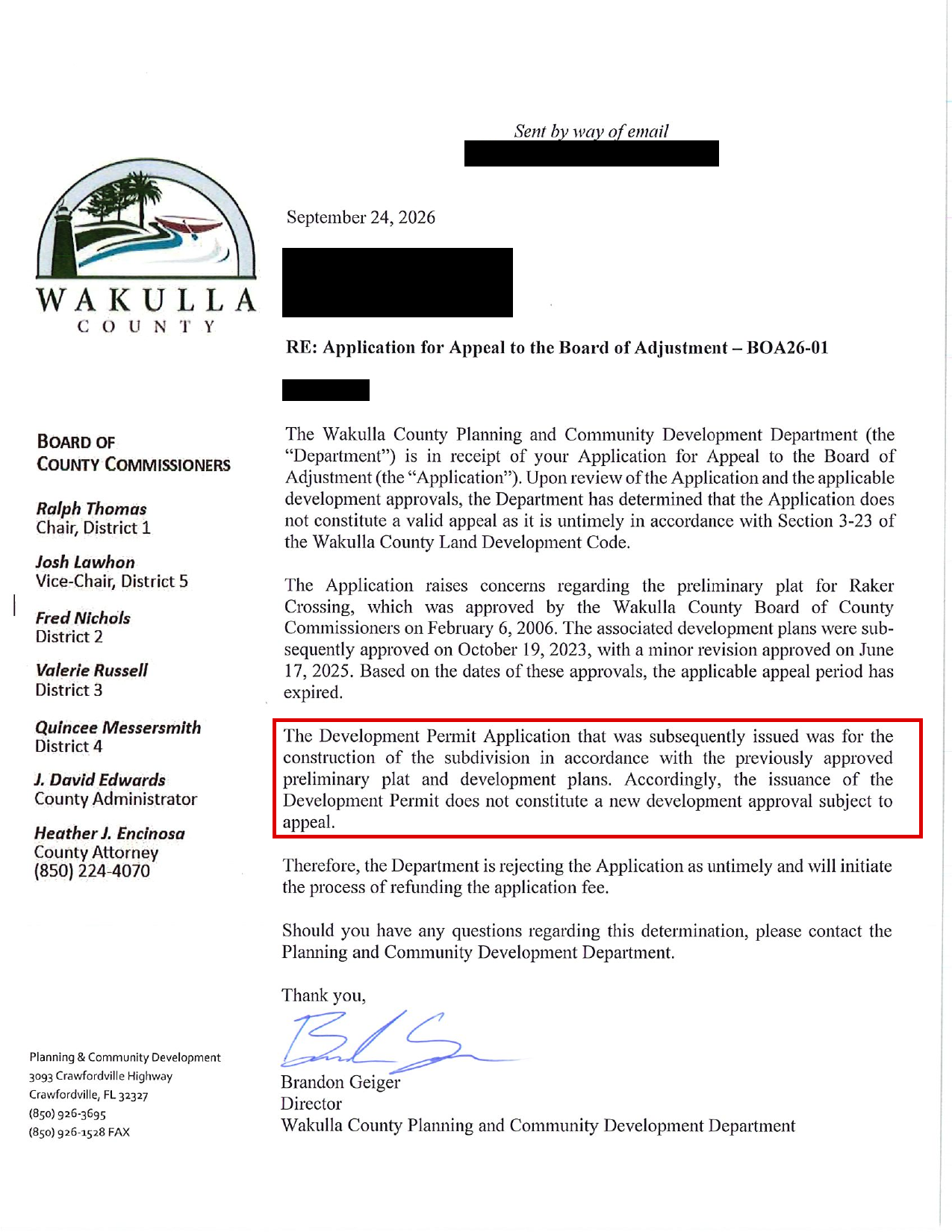
The county’s letter says the board “upheld the Planning Director’s determination” that my appeal was late.
That’s a strange way to put it. The rules say the board decides if an appeal is late, not the Planning Director. Staff doesn’t get to make the call and have the board rubber-stamp it. So why word it that way? As this heads to court, it makes you wonder if someone is already picking who gets thrown under the bus later.
The letter also ignored every other problem I raised. That’s fine. They aren’t going away.
There is no such thing as a “renewal”
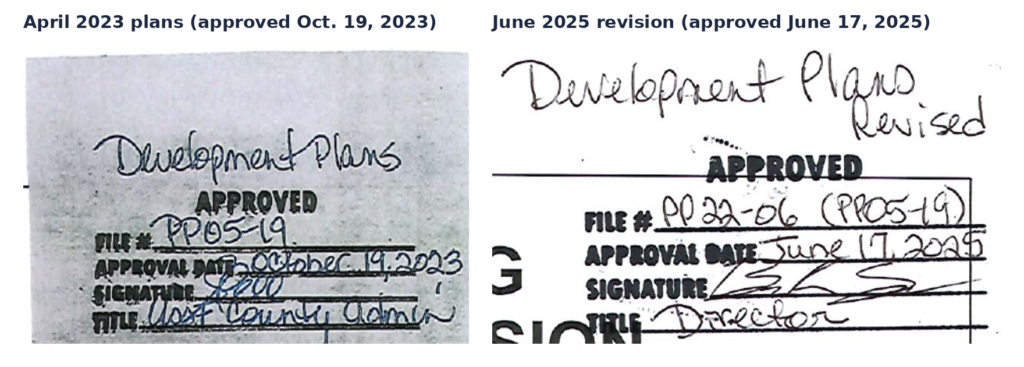
The county called the 2026 development permit for Raker’s Crossing (the permit to start building roads and pipes) a “renewal” of the 2023 permit. Here’s why that word matters. If it’s a renewal, the county can keep using studies from 2004. If it’s a new permit, it needs new studies.
The 2023 permit had expired. The county’s own website says “expired.” And there is no such thing as renewing an expired permit. There’s no renewal form and no renewal process in the county code. The only place the word “renew” shows up is a box the developer typed into.
At the hearing, the county’s second attorney (yes, they needed two) asked if my position was that renewals don’t exist. I said, “Yes sir. If there is such a thing, show me where in the code or the statutes it exists.” He had nothing to point to.
So they invented a renewal. When I called that out, they switched stories and said the permit just let construction start “based on prior approvals.” But those approvals had expired. You can’t start building on an expired permit.
It gets worse: the original approval expired too
The county first approved this subdivision’s layout (the preliminary plat) back in 2006. County code says that approval dies if the developer doesn’t file a final plan within 18 months. They never did. That means it expired around 2007, and the developer should have had to start over.
At the hearing, the Planning Director said under oath that the old approvals, including the concurrency checks, don’t expire. He said it five times. Watch for yourself in the hearing video at 32:13, 1:12:15, 1:26:30, 1:30:20 and 1:31:40: https://www.youtube.com/watch?v=e8yaCngykfk
At 1:31:40, the attorney asks him straight out if the 2006 approval expires. He says, “In this instance it does not.” That’s just wrong. Read the code above.
Why that matters: 2004 paperwork
Before the county allows new homes, it has to check that roads, water, sewer, schools, parks, trash service and drainage can handle them. That check is called “concurrency.” The county’s own plan says it has to be done “with each application.” And it says that approval expires when the permit expires.
So when the old approvals expired, the old checks expired with them.
What did the county use instead? Water, sewer and traffic letters from 2004. The only recent study is for drainage, from 2023. Twenty-year-old letters stapled to the file are not a review.
What happens next
My attorney is asking a judge to review the board’s decision. Here’s how it works:
The judge gets the hearing record and what I presented.
Both attorneys file written arguments.
The judge decides if the board followed the law. The commissioners won’t be there.
If the board didn’t, we likely get a brand-new hearing, and I can bring in the new evidence, like the expired 2006 approval.
If they invent a new reason to rule against me, we go back to court. If the first judge rules against me, I still have one more court to try.
Why I’m doing this
First, it’s my home. My water is already bad. Talquin is putting in new wells, but that’s just to keep up with the people already here. Talquin’s own technicians told me the problem is the pipe I’m on, and new wells won’t fix it. A real concurrency check is supposed to catch that. A 2004 letter doesn’t.
Second, look around. Wakulla Gardens has water that looks like mud. You can’t get through the lights on Crawfordville Highway in one try. This project would add about 400 cars, most headed to Tallahassee, and about 100 more kids to schools that already say they’re full.
Somebody has to say how absurd this is. The commission won’t, and for some reason staff is working overtime to ignore the code or invent their way around it. So someone has to ask why. Why go to all this trouble to avoid following the rules that protect the county and the people who already live here?
Thank you to everyone who has supported me, and especially to those who took off work to come to a hearing in the middle of the day. If we get another hearing, I hope it’s held after work hours so more people can show up and be heard.
This post was written with AI assistance and reviewed word for word by a member of the Wakulla Reports team.
Welcome to WR100: Wakulla County 101. Attendance is optional, parking is free, and there is no final exam, unless you count three minutes at a podium, which we will get to.
Local government touches your tax bill, your road, your sewer line, your kid’s school and your ballot. It is also the level most of us were never taught how to use. This is the orientation for the whole Wakulla Reports course series. It covers who runs what, where to find the paperwork, how to speak at a meeting, and how to get involved. After that, the courses get specific.
Lesson 1: Who runs what
Wakulla County has several separate governments, and knowing which one handles your problem saves a lot of phone calls.
Board of County Commissioners (BOCC). Five commissioners, one per district, serving four-year terms. They set county policy, adopt the budget and set the tax rate.
County Administrator. Hired by the Board to run daily operations and carry out its policies. Departments like Public Works, Planning, Building and Public Safety report up through this office.
Constitutional officers. Elected separately and not controlled by the BOCC: the Clerk of Court and Comptroller, Property Appraiser, Tax Collector, Supervisor of Elections and the Sheriff.
School Board. Five elected members with their own budget, calendar and meeting schedule.
Cities. The City of Sopchoppy and the City of St. Marks each have their own commission and rules.
The county’s governing document is the Home Rule Charter, and the county code of ordinances is searchable on Municode.
Lesson 2: Where to find the paperwork
Regular BOCC meetings start at 6:00 PM at the County Commission Chambers, 29 Arran Road, Crawfordville. They usually fall on the first and third Monday of the month, but dates shift around holidays, so check the calendar before you go.
The county posts each meeting’s agenda outline, minutes and video on its Board Meetings page. Videos go up on YouTube, usually a few days after the meeting.
Here is the catch. The county’s page does not carry the full agenda packets, and the packet is where the dollar amounts, contracts and backup documents live. The agenda page only gives item titles. Wakulla Reports keeps the full packets and other public records we have obtained at wakullareports.com/documents, and we break down BOCC agendas item by item at wakullareports.com/wakulla-county-bocc-meetings.
How to join the Interested Parties List. Go to mywakulla.com, open the “I Want To?” menu, and click “Be added to the Interested Parties List”. On that page, click the “Click Here” link to open the sign-up form, and enter your email address. The list sends agendas, press releases and other county information by email. One thing to know: under Florida law, email addresses are public records. If you do not want yours released in a public records request, the county’s page says to contact the office by phone at (850) 926-0919 or in writing instead.
Lesson 3: How to speak at a meeting
The rules are in Administrative Regulation 2.01. The short version:
Two chances to speak. “Citizens to Be Heard” appears twice on a regular agenda, once early and once after the County Administrator’s report. You can speak on any public business, on the agenda or not.
Fill out a citizen input card. Hand it to a staff member before the Board votes on the item.
You get three minutes. The Chairman can lengthen or shorten that depending on how many people signed up.
Talk to the whole Board. Address the Commission, not one member. Questions go through the Chairman.
One time per subject. Speaking on the same subject twice takes the Chairman’s permission.
Public hearings go first. Rezonings, ordinances and budget hearings are handled at the start of regular agendas.
The regulation does not describe a way for a resident to put their own item on the agenda. Public comment is the route.
Lesson 4: Records, service, and a seat at the table
Public records. Florida law gives everyone the right to inspect and copy most government records, and you do not have to explain why you want them. Use the county’s online public records request form, call (850) 926-0919, ext. 706, or mail Wakulla County BOCC, P.O. Box 1263, Crawfordville, FL 32326. Be specific, name the date range and kind of document, and keep a copy of your request. Check wakullareports.com/documents first, because we may have already pulled it.
Two Florida laws worth knowing. The Sunshine Law requires meetings where two or more members of the same elected board discuss board business to be open to the public, with notice. The Public Records Law, Chapter 119, presumes records created in the course of public business are open, with specific legal exemptions.
Serve. The county fills volunteer seats on advisory boards, such as the Code Enforcement Board and the Tourist Development Council, and posts openings as news items on mywakulla.com. Every eighth year the Board must appoint a Charter Review Commission, which is how charter changes get on the table. You can also run for office, and the Supervisor of Elections posts qualifying dates.
WR100 is the orientation. The rest of the series goes deeper:
WR101: Wakulla County Money. Funds, the spending ladder, where the money comes from and where it goes.
WR102: The Budget Calendar. When the budget gets made and when you can still change it.
WR103: Your Tax Bill. Millage, TRIM notices and the rolled-back rate.
WR201: Who’s the Boss. The charter, the Board versus the Administrator, and the five elected offices.
WR202: Citizen Power. Petitions, recall, charter changes and public comment.
WR301: Capstone. Your three minutes at the podium.
Homework. Find your commission district, join the Interested Parties List, read one full agenda packet before the next meeting, and make a records request for something you have always wondered about. Extra credit for showing up in person.
Something look wrong or out of date? Tell us and we will fix it. Times and dates change, so confirm before you go.
A note on how we work: Wakulla Reports uses AI to read through long county agenda packets and to maintain running trackers of county spending, contracts, and land use changes, which would be hard to keep up by hand. Every post is reviewed word for word by a person on our team before it is published. Figures are tied to pages in the public record, and if we get something wrong, tell us and we will fix it.
The 3% COLA: What the Board Voted On, and What the Record Shows
On November 17, the Board of County Commissioners voted 3-2 to give non-fire (they were also approved but were bound by a separate union contract) county employees a 3% cost of living adjustment (COLA), Item 16 on the agenda. The Board had already approved that raise in the budget, so under the record this vote should never have been needed. The way the item was presented that night does not match the record from the budget meetings. If you missed all of it, this post walks through what happened, in order.
Who the raises are for
When people hear “county raises,” many picture commissioners and top brass. That is not who this is about. Commissioners are five elected officials. The people Item 16 is about work in the county departments that run under the Board.
According to the staffing tables in the County’s Strategic Organizational Restructuring and Financial Sustainability Plan, those departments list roughly 196 positions, about 132 of them outside Fire. Only a handful are top brass, such as the Administrator, the Assistant Administrator and a few directors in the 16-person Administration office. The rest look like this:
Fire Rescue: 64 (59 full-time equivalents plus 5 as-needed positions). Fire is handled in Item 15 under a separate union contract.
Road and Bridge: 26.5, the crews that maintain county roads.
Wakulla Sands Golf: 20.5.
Parks and Facilities: 11.
Building Department: 8.5. Library: 8.25. Animal Services: 7.75. UF/IFAS Extension and 4-H: 7.75.
Planning, Recreation, Groundskeeping, Fleet, Public Works Administration, Probation and Tourism: from less than one full-time position up to 6 each.
The plan also lists 17 wastewater positions, but those employees work for the contractor Inframark, not the county. The Sheriff, Clerk, Property Appraiser, Supervisor of Elections and Tax Collector are independently elected and are not part of these departments. Staffing numbers come from the plan’s own tables and may have shifted since it was written.
How commissioners are paid
Commissioners do not vote themselves a raise. Under Florida law (Chapter 145, Florida Statutes), county commissioner pay is set by a state formula. It starts with a base amount for the county’s population group, adds a set amount for each resident above that group’s minimum, and is then adjusted each year by a percentage tied to the raise given to state career service employees, capped at 7%. A commissioner may choose to reduce his or her own pay, but the Board does not set the formula. That is separate from the County’s employee COLA in Item 16, which is a Board vote. Wakulla’s County Charter (Section 2.5) says the same thing: commissioner pay is set by ordinance at the level general law sets for non-charter counties, and it cannot be lowered during a commissioner’s term.
In August, county staff released a 172-page document called the Strategic Organizational Restructuring and Financial Sustainability Plan. It was written because of Amendment 3, the property tax measure on the November 3 ballot. The plan estimated that, if the amendment passed, the County’s General Fund could lose roughly $6.5 million a year. Among many suggestions, it recommended withholding COLAs until the County was financially stable.
Amendment 3 did pass on November 3. But the COLA was already in the budget the Board adopted on September 21, and passing the amendment did not undo that or create a second vote. We found no rule that required one. Even so, staff put the COLA on the November 17 agenda as Item 16 and recommended against it, so the Board was asked to vote on something it had already approved.
The plan is not Board policy
This is the key point. The Board never voted to adopt the plan. The plan describes itself as a contingency-based strategic plan, and it asks the Board for consideration and direction. At the September 8 meeting, staff described it as “plan B” and “just a proposal.” A recommendation in a document nobody voted on is not a hold, and it is not a rule the Board set for itself.
What the Board did on September 21
On September 21, the Board adopted the FY26/27 budget 5-0, and that budget included the 3% COLA. County Administrative Regulation 1.01 says a COLA is approved by the Board in the budget process. We found nothing in AR 1.01 or AR 3.03 that sets up a hold or a second vote, and we found no Board direction to hold the COLA in the budget meeting record we reviewed. See the administrative regulations for yourself.
What the minutes show
The minutes are the Board’s official record of what it decided. The June 15 workshop minutes show the Board directed staff to target the roll-back millage rate, to include the nonprofit funding requests but hold those agreements until after the November 3 vote, and to tentatively agree to the proposed special assessment rates. That is what a hold looks like in the minutes: it is written down. The minutes of the July 13 and August 17 workshops and the September 21 meeting contain no direction to hold the COLA or to bring it back. The September 21 minutes record the Board adopting the final budget 5-0, as presented by the County Administrator on July 13 and amended through that day’s agenda process. Nothing in them sends the COLA back to the Board.
The June 15 slide
This one is worth a second look. A staff slide from the June 15 workshop listed the 3% COLA as a budget recommendation. The hold was listed separately, under staff’s “Operations Plan”: “Withhold COLAs Until After November 3 General Election.” An earlier slide said that Operations Plan would be “Enacted Via Budget Letter Submitted for Board Approval After November 3.”
Read those together. The hold rested on staff’s operations plan, and that plan could not carry it. It needed Board approval after November 3, so it could not hold raises up to November 3. It was also not finished. On June 15 the Administrator said he was still working on what he called “plan B” (about 20:15). On July 13, a commissioner asked when the plan would be delivered, and the Administrator said it was about a week from being ready (about 1:07:26). The full document was released on August 17, and the Board never adopted it. We found no record of the Board receiving the full plan before then. A document that was unfinished, then released after the fact, and never adopted cannot set policy to hold raises. To be fair, the slide also said that if implemented, the raises would be retroactive to October 1, which suggests staff was talking about a delay and not an elimination. We are showing you both pieces and letting you decide.
What happened on November 17
The written agenda memo for Item 16 was accurate. The spoken presentation was where it drifted. In the November 17 meeting video, the item was described as approved to delay implementation (about 41:44) and as delayed until after the election (about 58:02). Staff also said “we said we would bring these back to you” (about 50:14). The Board then passed the COLA 3-2 (about 59:13). Item 17, the Senior Citizens Council funding, was tied back to June 15 direction by date (about 59:22), which makes the lack of a date for the COLA hold stand out.
Why it matters
Employees were told the raises were on hold. Residents watching were told the Board had to approve something. The record says the Board approved the raises when it adopted the budget, and the plan that suggested a hold was never adopted. When staff presents a different version of events, the minutes and the video are how the public checks it.
The record, by date
June 15: budget workshop, staff slides on the COLA and the Operations Plan.
This post was written with AI assistance and reviewed word for word by a member of the Wakulla Reports team.
The Board of County Commissioners meets Tuesday, November 17, 2026, at 6:00 p.m. in the Commission Chambers, 29 Arran Road. Note the day: this one is a Tuesday. The Final Agenda packet is 855 pages, revised November 12. Page numbers below are the page numbers of that PDF, so you can follow along with your own copy.
This is the first meeting since Florida voters passed Amendment 3 on November 3. County staff now ask the Board to hold back $811,687 that was already in the budget the Board adopted on September 21: raises for county employees and firefighters, and money for senior meals and a medical charity. That is the story of this meeting, and it is in Items 15 through 19.
The big picture, in one box
Staff’s own numbers: Amendment 3 passed in Wakulla County 66.73% to 33.27%, and at the current 7.7000 mill tax rate it is projected to cut county property tax revenue by about $5.3 million in FY2027/28 and another $1.1 million in FY2028/29 (pp. 596, 653). The county’s fiscal year runs October 1 to September 30. We are now in FY2026/27. The revenue loss starts in FY2027/28, which begins October 1, 2027. The cuts on this agenda would take effect now, in FY2026/27, a year before the revenue drops.
Presentations (no vote)
Internal Audit reports from the Clerk’s office (pp. 7 to 73). Katrina Cromwell of the Clerk’s Internal Audit office presents four reports. A follow-up on Animal Services donations found that recent donated goods had not been recorded in the county’s financial records because the paperwork was behind, and says recording them needs “renewed attention” (pp. 8, 9). The Accounts Payable audit (October 2025) sampled 189 county purchasing card (P-Card) buys and found that 98% of the purchases that needed a quote had none, and 67% lacked the right level of approval (pp. 10, 15). It also found that some former employees and non-employees still held active cards (p. 10). The Restricted Funds audit (February 2026) says some Tourist Development Tax spending does not line up with the state law that limits it to promoting tourism; that fuel-tax money with different legal limits is mixed together; and that a $250,000 transfer made from the Building Department fund on October 1, 2021 has never been spent; the February audit said it was nearing the four-year limit in F.S. 553.80 (pp. 44, 49, 62). The Administrator’s response adds that a 2026 state law, SB 1614, appears to end the authority for using surplus permit fees on a building for the code enforcement office (p. 67). It found the one-cent sales tax spending complied with the law (p. 44). A March 2026 follow-up on Parks refundable deposits found 79 problems still to be fixed (pp. 33, 34). The County Administrator’s written responses agree with many of the findings but push back on several, including requiring quotes on small P-Card buys (pp. 28 to 30, 66 to 69).
An HR intern also gives a five-minute update on the Fall 2026 internship (p. 1).
Consent Agenda
The consent agenda is a list of items the Board approves with one vote, without discussing each one, unless a commissioner pulls an item out for discussion. A lot of money can move this way, so here is every item.
Routine items
Item 1: Minutes of the October 28, 2026 special meeting (p. 75). The Board voted 4/0 to uphold the Planning Director’s ruling that a Board of Adjustment appeal was filed too late, and dismissed a second appeal based on it.
Item 2: Minutes of the November 2, 2026 regular meeting (pp. 77 to 80).
Item 3: Bills and vouchers for October 24 to November 11, 2026 (p. 81). The agenda sheet lists a “Statement of the Bills and Vouchers” as an attachment, but the statement is not in this packet. Last meeting’s statement ran pp. 13 to 52 of the Nov 2 packet. We can’t show you this cycle’s bills.
Item 4: Disposal of eight old computers, one from IT and seven from Fire Rescue (pp. 82 to 91).
Item 5: Updates the county’s Fraud, Waste and Abuse policy (AR 3.08): adds the hotline email address (FraudHotline@wakullaclerk.com), moves the work from Finance to Internal Audit, and drops the “toll free” wording. The hotline number stays 850-926-0356 (pp. 93, 94).
Item 6: Adds $71,983 in federal asset forfeiture money (a share of property seized in cases where the Sheriff’s Office helped federal agencies) to the FY2025/26 budget, passed through as a “Transfer to Constitutional Officer,” meaning the Sheriff’s Office (pp. 112, 114, 115). Amending last year’s budget in the first 60 days of a new year is allowed by F.S. 129.06(2).
Item 7: Signs the county into the national opioid settlement with Albertsons. The global settlement is $749,450,928.67; the county’s share is not known yet (pp. 117, 118).
Item 9: Accepts a $20,325 federal (U.S. Forest Service) grant through the state to plant trees at Wakulla Sands Golf Course. No county match. The Board’s March 2 resolution authorizing the application listed three county properties; staff submitted only the golf course (p. 506).
Item 12: Accepts a $7,000 Duke Energy Foundation grant and passes it to the Wakulla Economic Development Council to update its strategic plan. The request was $25,000 (pp. 572, 573).
Item 26: Lets staff apply, by December 4, for up to $1.6 million from the state’s Volkswagen settlement program to replace a Fire Rescue tanker and a fire engine. No county match. To qualify, the old trucks must be destroyed (pp. 582, 583).
Item 8: Lower Bridge floating dock, $134,500
Awards a contract to Arris General Contractors, Inc. to build an 8-by-30-foot floating dock with an aluminum gangway at the Lower Bridge boat ramp, 6527 Coastal Highway. Six companies bid. Arris was lowest at $134,500, $25,500 below the next bid ($160,000). The highest was $268,914.45 (p. 450). The job must be done in 60 days and is paid from the One Cent Sales Tax Public Facility Fund (p. 451). The bid sheet adds up correctly. One line stands out: Arris priced erosion control and the turbidity barrier (the floating curtain that keeps stirred-up mud in place) at $25,000, the highest of any bidder on that line, while its dock, gangway and fixed dock lines were among the lowest (p. 452). The engineer who checked the bids and recommends the award is Dewberry (p. 453). This is the second time the solicitation went out (“REBID”); the packet does not say why.
Item 10: The new library’s federal strings
The new library on Shadeville Road was built with a $3,857,918 federal grant passed through Florida Commerce (p. 534). This item signs a covenant that the building will keep providing broadband and stay in public use. If the county breaks those terms before December 31, 2034, the U.S. Treasury can demand its share back (p. 535).
Two dates that don’t match
The agenda says the county put the construction job out to bid (ITB 2025-18) on August 7, 2025, and the Board approved the contract with Estes Construction on October 20, 2025 (p. 534). The tracking letter the county will send to Florida Commerce says the bid was issued October 21, 2025, the day after the contract was approved (p. 541). Both cannot be right, and the letter is the one going to the grantor.
Item 11: Opioid settlement money, $173,147
Tracker hit: back from October 19
An opioid MOU with NWF Health Network was tabled October 19. Staff says it received this FY2026-27 version on November 2 (p. 549).
Approves an agreement for NWF Health Network to hand out this year’s regional opioid settlement money directly to four local groups. Each gets $43,286.75: Apalachee Center (addiction treatment with medication), the Sheriff’s Office (early intervention and treatment referral), the Wakulla County Coalition for Youth, and DISC Village (school prevention programs). The four add up to $173,147, the total available (pp. 547 to 549). The county still has to report how the money was spent to the state (p. 549). The agreement runs through June 30, 2027 and includes a confidentiality section, with a line saying it does not override Florida’s public records law (p. 551).
Item 13: Cayuse Drive lot deed
Accepts the deed for the 0.114-acre Cayuse Drive lot in Wakulla Gardens that the Board agreed to buy on October 5 for $7,500. Closing happened October 29 (p. 576). The agenda says the lot “is being considered” for stormwater retention, but the resolution says the deed is accepted “so that County stormwater facilities can be maintained and operated” (pp. 576, 580). The packet still names no stormwater project for the lot.
General Business
Item 14: Rural Area of Opportunity agreement
Tracker hit: back from November 2
Tabled November 2. Still no names in the packet for the two people the Board must choose.
Wakulla is part of a state “Rural Area of Opportunity,” which can waive the county’s share on some state grants and opens rural road money (p. 587). The Governor renewed it on July 8, 2025, for five years. This agreement with Florida Commerce, received October 19, 2026, makes the county’s part official (pp. 588, 589). The Board must name one county official and one person from an economic development nonprofit as contacts. If the agreement isn’t signed, the state may recommend ending the designation (p. 589).
Item 15: Firefighter raises, $261,877
Staff recommends: do not give the raises
The Board budgeted a 2% across-the-board raise plus a 2% advancement in pay grade (one step) for Fire Rescue employees in the budget it adopted September 21 (p. 595). Staff now recommends Option 2, do not approve, to save about $261,877. Fire Rescue’s budgeted salaries and wages total $7,381,718 (p. 596).
The firefighter union contracts the Board approved October 5 already say this: if Amendment 3 passes, “The County shall not fund the ATB increases” (Article 14.2, p. 611). Amendment 3 passed. The pay grade move had a similar condition. Its paragraph also says “shall not fund the ATB increases,” even though that paragraph is about pay grades, not across-the-board raises (Article 14.3, p. 611). The pay grade move was only for employees hired before April 1, 2026 with a “Meets Expectation” evaluation, which may be why the savings is less than 4% of payroll (p. 611).
Item 16: County employee cost of living raise, $434,810
Staff recommends: no 3% COLA
The adopted budget included a 3% cost of living adjustment (COLA) for all other county employees (p. 652). Staff recommends not giving it, to save about $434,810. Countywide salaries and wages, not counting Fire Rescue, are budgeted at $11,589,134 (p. 653).
Check the math: 3% of $11,589,134 is $347,674. Staff’s savings figure is $87,136 higher, about 3.75% of salaries. The packet doesn’t explain the difference. Payroll taxes and retirement contributions that rise with pay could account for it, but the item doesn’t say so, and the firefighter item next to it uses a figure below its percentage instead of above.
Both items say the cuts come from a “Strategic Organizational Restructuring and Financial Sustainability Plan” that staff wrote in August 2026 (pp. 595, 652). The plan is not attached to this packet, and the packet doesn’t show the Board ever voting on it.
Items 17, 18 and 19: Nonprofit funding
In June, the Board told staff to budget these three requests but hold the contracts until after the Amendment 3 vote (pp. 654, 665, 676).
Item 17, Wakulla Senior Citizens Council, $100,000 for senior meals, the senior center and transportation, from the General Fund. Staff recommends no (pp. 654, 655).
Item 18, Keep Wakulla County Beautiful, $40,000 for litter cleanup and recycling. Staff recommends yes, because it is paid from the Solid Waste Fund (the solid waste assessment and Waste Pro franchise fees) rather than the General Fund, so staff says it is “less dependent on Property Tax revenue” (p. 666).
Item 19, Capital Medical Society Foundation, $15,000 for medications, transportation and fewer emergency room visits, from the General Fund. Staff recommends no (pp. 676, 677).
Add it up
Items 15, 16, 17 and 19 together: $261,877 + $434,810 + $100,000 + $15,000 = $811,687 that staff recommends not spending this year, all of it already approved in the September 21 budget.
Public Hearings
Item 20: Keeping the option to bill new assessments on your tax bill
This resolution keeps the county’s option to collect special assessments (fees tied to your property, like the fire fee) on the property tax bill. It doesn’t create a fee by itself (p. 687). The agenda sheet says the county currently levies fire, solid waste, road maintenance, nuisance abatement and broadband assessments, and recommends adding emergency medical services, sewer, stormwater, and clean energy and wind resistance improvements (pp. 687, 689). The EMS assessment was tabled October 19 and has not come back.
This agenda sheet looks like last year’s
The cover sheet is dated Meeting: November 17, 2025; Submitted: October 30, 2025 (p. 687). It says the resolution must be adopted before January 1, 2026 and mailed by January 10, 2026, and that the hearing was advertised in the Wakulla Sun on October 24, October 31, November 7 and November 14, 2024 (pp. 687, 688). The resolution itself says January 10, 2027, and its first collection is the fiscal year starting October 1, 2027 (pp. 689, 690), but a “whereas” line still says collection starts “in November 2026” (p. 689). The proof-of-publication page, Exhibit A, is blank (p. 691). State law requires the hearing to be advertised weekly for four consecutive weeks before the hearing (F.S. 197.3632(3)(a)). Nothing in this packet shows the 2026 ads.
Item 21: Closing the Lake Ellen Drive water access
Tracker hit: tabled November 2
The hearing was re-advertised November 5 and comes back tonight (p. 693).
The ordinance repeals Section 23.011 of the County Code, the 2018 rules for the boat ramp at the north end of Lake Ellen Drive (motors 25 horsepower or less, no jet skis). If it passes, the county removes its signs and markings and stops maintaining the primitive ramp. The county keeps the public right-of-way from the 1961 plat, and the ordinance does not block the end of the road at the lake (p. 694). Cost: about $40 to publish, plus lost launch fees (p. 694).
Planning and Zoning
These are quasi-judicial hearings, which work more like a court: each commissioner must disclose any contact with the applicants or anyone else about the case (p. 4). The Planning Commission voted unanimously on November 9 to recommend approval of all three (pp. 697, 709, 842). No written public comments had come in on any of them (pp. 698, 711, 844).
Rezones 0.72 acres across from Gulf Coast Lumber from RR-1 (one home per acre) to LIC (Low Intensity Commercial). Applicant: Byrd Family Properties, LLC. There is a house on the lot now. Next door: undeveloped residential land to the north, timberland and wetland to the south and west, and the lumber yard (C-3) to the east (p. 698). Part of the lot is in the “A” flood zone, the 100-year floodplain (p. 698). Staff calls it consistent with nearby commercial zoning.
Items 23 and 24: 780 Crawfordville Highway, farmland to commercial
These two go together. Item 23 (CPM26-03) changes the land use map for a 5.84-acre lot between Buck Miller Road and Bloxham Cutoff from Agriculture to Rural 2. Item 24 (R26-11) then rezones it from RR-5 (one home per five acres) to C-2, General Commercial. Item 24 can only pass if Item 23 does (pp. 709, 844).
The land use change triples what can be built for business: from 12,719.52 square feet under Agriculture to 38,158.56 square feet under Rural 2 (p. 710; we checked the math: 5.84 acres is 254,390 square feet). This request is to expand a family-owned business and rebuild the family’s home, which burned in 2025, plus an accessory dwelling (pp. 711, 729). The business, an equipment, dumpster, bounce house and water slide rental company, is already operating on the property today, on land designated Agriculture and zoned RR-5 (pp. 709, 710, 729, 730). One note on the paperwork: both staff reports say the site “is currently developed with a single-family dwelling” (pp. 710, 843), while staff and the application also say that house burned in 2025 (pp. 711, 730). C-2 allows “a variety of commercial uses” (p. 843), and the rezoning option carries no condition limiting the land to the rental business (p. 844).
What to watch
The site is in Priority Focus Area 1 of the state’s cleanup plan for Wakulla Springs and has no central water or sewer (pp. 711, 746). The applicant’s traffic evaluation counted 3 peak-hour trips (p. 731); staff says a more detailed analysis comes at site plan review (p. 711). 126 of the 128 pages of application backup are scanned images with no searchable text (pp. 714 to 841).
Commissioner Agenda Items
Item 25: Commissioner Russell, a new impact fee study
Tracker hit: an old question finally moves
We’ve tracked the unfinished impact fee study since September 8, when the item was pulled with no return date.
Asks the Board to direct staff to seek proposals for a new comprehensive impact fee study. Impact fees are one-time charges on new construction to help pay for the roads, parks and services growth needs. The item says more than 60% of voters approved a 2024 charter question calling for a study in 2025 and every five years after. The 2025 study was accepted, but the item says it can’t be used to decide on fees, for two reasons: commissioners’ own concerns with the study, and the second part not being done before the state’s deadline for setting fees passed (p. 854). Cost unknown until proposals come in (p. 854).
Why the timing matters
The item doesn’t mention it, but state law currently limits what Wakulla can do here. Senate Bill 180 (2025) bars hurricane-affected counties, including Wakulla, from adopting “more restrictive or burdensome” land development rules before October 1, 2027 (Ch. 2025-190, Laws of Florida, Section 28). Whether that covers impact fees is being fought in court: on September 15, 2026, a Flagler County judge ruled Palm Coast’s increased impact fees violated SB 180 (the city has appealed), and a similar challenge to Manatee County’s fees was still awaiting a ruling in October. A study takes months. Starting the proposal process now could put a finished study in the county’s hands around the time the SB 180 restriction ends, unless a new hurricane restarts a freeze. Separately, a new state law (HB 1329, effective January 1, 2027) adds rules for how much and how fast impact fees can rise.
Next meeting
Monday, December 14, 2026, 6:00 p.m. (p. 5). The Planning Commission meets December 7 (p. 6).
A note on how we work: Wakulla Reports uses AI to read through long county agenda packets and to maintain running trackers of county spending, contracts, and land use changes, which would be hard to keep up by hand. Every post is reviewed word for word by a person on our team before it is published. Figures are tied to pages in the public record, and if we get something wrong, tell us and we will fix it.
This post was written with AI assistance and reviewed word for word by a member of the Wakulla Reports team.
The Wakulla County School Board meets Tuesday, November 17, 2026, at 5:45 p.m. at the District Administration Offices, 69 Arran Road, Crawfordville, in Room 106. The agenda is lighter than usual this month, but two items carry real weight. The district has put COAST Charter School on formal notice over its finances and a lease problem, after COAST’s savings account dropped from about $203,000 in May to $294 by the end of September. And the board is set to sign off on a $2.6 million contract for new air handling units at Riversprings Middle School. Here is what is on the table, item by item.
Lead Story · Discussion Item 7.1
COAST Charter School’s savings fell from $203,139 to $294 in four months
The district has placed COAST on formal notice over its finances and an unauthorized sublease at its 48 Shell Island Road, St. Marks facility. Source: Formal Notice of Serious Financial Concerns (Nov. 5, 2026) and Notice of Facility Lease Default (Nov. 6, 2026).
Recognitions
The board opens by honoring its November 2026 Teachers of the Month, Warner (Riversprings Middle School) and Martin (Crawfordville Elementary School), and its November 2026 Employee of the Month, Wisham, from the Transportation department.
Consent Agenda
On consent, where items pass together with one vote unless a board member pulls one out, the board is set to approve the minutes from the October 19, 2026 meeting (see our separate recap of that meeting), the November 2026 personnel recommendations, and the district’s list of 2026-2027 out-of-field teachers, meaning teachers certified but temporarily assigned outside their certification area under a state waiver.
Federal Grant Renewals
The board is also set to approve two of the district’s routine annual federal grant awards: Title I, Part A, which puts $1,037,264 toward helping disadvantaged students, and Title IV, Part A, which brings $74,489 for student support and academic enrichment. Both are standard, formula-based federal programs renewed every year, covering the 2026-2027 school year, July 1, 2026 through June 30, 2027. (Source: Florida DOE Project Award Notifications, TAPS 27A001 and 27A120.)
Riversprings Middle School’s New Air Handlers
$2,637,007.00
The board will formally sign a construction contract with D.E. Scorpio Corporation, doing business as Scorpio, to replace the air handling units (the equipment that heats and cools a building) at Riversprings Middle School. The board already approved Scorpio’s bid back in October; this item puts the board’s signature on the actual contract, a standard industry form called an AIA Document A101. The contract sets a substantial completion deadline of July 30, 2027, and spells out a penalty if the work runs late: $250 for every calendar day past that deadline, dropping to about a quarter of that rate, roughly $62.50 a day, after the first 14 days.
Source: AIA Document A101-2017 Contract between Scorpio and WCSB, pp. 1, 3.
Culpepper’s Last Payment on the ADA Sidewalks
$4,494.08
The board is also asked to approve the final payment, closing out Culpepper Construction’s $249,740 contract to add ADA-compliant sidewalks at Riversprings Middle, Crawfordville Elementary, and Wakulla Middle schools. The project is complete, and this payment releases the last of the money the district had been holding back (known as retainage) until the work was finished.
Source: Final Payment Application #3, Culpepper Construction Co.
Three Budget Amendments
The board is set to approve three budget amendments:
Amendment
Change
What it does
#3 BALOG #3, Res. B26/27-3
+$145,671 revenue
New $134,395 “Canine Grant 2026-27,” spent via Operation of Plant; +$11,276 fee-supported classes; -$3,911 Instruction.
#4 BALOG #4, Res. B26/27-4
-$55,831 revenue
Adult Basic Education cut $55,831; Instruction down $59,894; Pupil Personnel Services up $11,527.
#5 BALOG #5, Res. B26/27-5
-$54,500 fund balance
Draws down Capital Projects Fund 390 to $5,422,869 for facilities construction — third straight cycle this fund has been drawn down.
All three amendments list the board meeting date as November 16, 2026, one day off from the actual November 17 meeting date. That is the third cycle in a row with some kind of paperwork slip in this same budget amendment series; we flagged a wrong meeting date in September and a mismatched fund label in October.
Discussion
COAST Charter School Is on Formal Notice Over Its Finances and a Lease Problem
In two separate letters dated November 5 and November 6, 2026, Superintendent Richard Myhre told COAST Charter School’s governing board that the district, acting as COAST’s charter sponsor, has serious concerns about both the school’s cash position and its right to keep operating out of its building.
The finances. According to financial statements COAST itself provided to the district, the school’s Centennial savings account held $203,139.31 as of May 18, 2026. By September 30, 2026, that balance had fallen to about $294.31, a decline of more than 99 percent in a little over four months. Total cash across all of COAST’s checking and savings accounts fell from about $447,594.12 to about $55,647.58 over the same period, a drop of about 87.6 percent. As of September 30, COAST reported about $69,669 in current assets against about $139,234 in current liabilities. The district says COAST also owes it more than $100,000 in legal expenses and about $30,000 in fuel charges, and wants to know whether those obligations are reflected in COAST’s own accounts payable.
The district’s letter points to Florida’s charter school law, F.S. 1002.345, which lets a charter sponsor step in when a school is approaching a “deteriorating financial condition,” a circumstance that significantly impairs a school’s ability to cover its own expenses without triggering a financial emergency under a separate statute, F.S. 218.503(1). The district stops short of declaring that COAST has crossed that line, but says the numbers raise “a serious question” about whether it is approaching one. The district has given COAST’s governing board seven business days to turn over documentation in 12 categories, including current bank statements, a rolling 13-week cash flow forecast, payroll and benefit certifications, and a detailed explanation for the savings account’s decline.
The lease. Separately, the district says COAST entered into some kind of sublease or third-party use arrangement at its school building, 48 Shell Island Road in St. Marks, without getting written permission from the City of St. Marks, which owns the property and leases it to COAST. The district says that puts COAST in default under its own lease: Section 15 of the lease requires the City’s written approval before any sublease, assignment, or third-party use, and treats an unauthorized one as void and an immediate default. Because COAST’s charter contract requires it to have an approved facility available for students during the school day, the district says a lease default could put the school’s legal right to operate from that building at risk, even though the lease itself runs between COAST and the City, not the district. The district has given COAST’s governing board five business days to submit a corrective action plan addressing eight required points, including who at COAST approved the arrangement, a full copy of it, and how and by when COAST intends to cure the default.
Both letters are addressed to the same five people, COAST’s Governing Board: Alan Wittmier, Amy Delaney, Jeffrey LaChapelle, Brianne Allen, and Jamie Gray. Neither letter is itself an agenda action item requiring a board vote; this cycle’s agenda lists the matter as a discussion item “to inform the board of the Superintendent’s actions to monitor COAST’s financial condition and violation of their lease agreement including potential next steps.” We noted in September that it is still not clear what COAST’s May 2026 Settlement Agreement with the district actually resolved. Nothing in the public record has answered that since, and this new trouble makes it more pressing.
Sources: Notice of Facility Lease Default and Required Corrective Action Plan, Nov. 6, 2026; Formal Notice of Serious Financial Concerns and Required Governing Board Action, Nov. 5, 2026.
Next Steps on the Millage Referendum Voters Just Decided
The board will also hear an update from the Superintendent on next steps for implementing the millage referendum Wakulla County voters decided on November 3: whether to let the School Board levy an additional 1.0 mill in property taxes each year for four years, starting July 1, 2027, to help fund teacher and staff pay, free student meals, and support for arts, music, and athletics programs. Results of that vote are not yet certified — the county’s Canvassing Board meets November 16, the day before this School Board meeting — so this agenda item is the Superintendent’s update on preparing for the 2027-2028 budget year, not a vote on the referendum itself. We will follow this closely as more details become public.
Sources: Wakulla County Supervisor of Elections, Nov. 3, 2026 General Election calendar; WTXL News, Oct. 15, 2026; Nov. 17, 2026 agenda, Discussion Item 7.2.
Also on the Agenda
The rest of the agenda is routine business: personnel recommendations for November 2026 and the list of 2026-2027 out-of-field teachers (both on consent); a request to add Holley Development Corporation to the district’s Pre-Qualified Contractors List for 2026-2027; capacity letters for two Wakulla County students, certifying enrollment capacity at their schools; a three-year renewal, through June 2029, of the district’s Skyward/ISCorp student information system contract, administered through the Panhandle Area Educational Consortium alongside nine other Florida school districts; a renewal of the Regional Local Assistive Technology Specialist (RLATS) agreement for 2026-2027, a position shared across eight North Florida school districts at a combined cost of $99,900; and two student expulsion cases, listed on the agenda by case number only, without further public detail.
A note from Wakulla Reports: The memo below was written by Richard Blake, the homeowner whose property borders Raker’s Crossing on three sides. It is addressed to the public and appears in his own words, edited only for grammar. We have agreed to publish his series so residents can follow the issue and so there is a record of the series of events. All Raker’s Crossing coverage can be found in the link at the top of this page.
First, I want to personally say thank you to all the people who have been following the Raker’s Crossing saga and have offered kind words of support, and especially to those who showed up to the hearing in the middle of the day to support me.
I think it’s important for me to personally explain why I am doing what I am doing. First off, my property is surrounded on three sides by this new development, and I think we have all seen the impact irresponsible development has had on adjoining homeowners, much less on those completely surrounded by it. I have a responsibility to do everything I can to ensure this one is done correctly so that it doesn’t negatively impact me, whether that’s from runoff, flooding, stinky water or other issues. This all started with me simply investigating what was going on around my home. However, once I started looking into the permitting process, it took me down a rabbit hole that exposed issues that were simply unbelievable to me, including two-decade-old water, sewer and traffic studies that were used as part of the new permit process. And there are many more issues as well.
Many times, citizens and residents bring very valid concerns to the county and commissioners, and they are told over and over, “the law ties our hands,” or that “SB180” prevents them from doing this or that. However, in this case there are MANY laws and codes already on the books, in both the Wakulla Land Development Code and Florida Statutes, to protect homeowners, myself included, and they are flat out being ignored at best or purposely being circumvented at worst.
My goal is not to stop development. A complete moratorium is probably not a good thing; we all need jobs, and we all know that will never happen. My goal is to make sure development is done smartly and in accordance with the laws and codes already on the books.
I want to do a series that outlines these codes and laws one at a time, explaining what SHOULD have happened in this case and the absolute absurdity of the position the county has taken. The first issue I would like to address is a bit technical, but it’s the one the county has chosen to hang its hat on: timeliness.
At 8:06 a.m. this morning, I received the official denial letter rejecting my appeal. The SOLE reason given by the county was “untimely filed and therefore invalid,” and I will walk everyone through how patently absurd that is.
Under the Wakulla Land Development Code, you have 30 days from the date a decision is rendered to appeal an administrative decision. § 3-23(2): “Such appeal shall be taken within 30 days after the order, requirement or decision is rendered.” “Rendered” is the key term here, because it is actually defined by Florida law. You don’t get to interpret it and decide the meaning yourself; the meaning is defined in the law. Florida Statute § 163.3215(4)(h): “is not considered rendered or final until officially date-stamped by the city or county clerk.” So it has to be officially filed (rendered) before the 30-day clock starts.
The image below is from a public records request I made. It’s not something I found on the internet. It is the product of a public records request to Wakulla County.
The document clearly shows the application was made on 8/6/2026, was Approved on 9/18/2026 and was Issued on 9/18/2026. You could consider either the Approved or the Issued date to be the date it was rendered or filed. It was also paid for on 9/18/2026, and I have the receipt for that as well. I made my appeal on 9/18/2026, the VERY SAME DAY the permit was approved and issued. You can see this in my receipt below. Yet the county has somehow determined my appeal was untimely, even though I appealed on day one of a 30-day clock.
Now, I don’t know about you, but I consider filing on the first day of a 30-day appeal window to be the opposite of untimely. I cannot figure out how anyone could come to that conclusion, much less put it in writing that my appeal was untimely. I would also assume this letter was reviewed by the county attorney, and somehow she concluded that filing an appeal on 9/18 of a permit issued on 9/18 is untimely.
There is a little more to the story. In the original letter they sent me, and during the hearing, they stated that the appeal period had expired for the original 2006 preliminary plat and the 2023 permit. But both the preliminary plat and the 2023 permit had EXPIRED. I have no reason to appeal either of those, and I very clearly outlined in my appeal that I was appealing the 2026 permit, which is the only unexpired, valid permit on the books.
That’s a long read, but it outlines just one of the many issues with this new development permit. I will post additional updates until I have gone through all the issues and the related laws and codes. Given how clear the code is, and that no interpretation is necessary (or, in most cases, even allowed), I was under the delusion that this was a slam dunk at the hearing. However, we now know that is NOT the case, and I want to make it very clear that this is NOT over. I am taking the initial steps to bring this to the next level, where hopefully the law will prevail and the necessary steps will be taken to ensure the development is done smartly and safely.
Update, Oct 29, 2026: the committee’s 2026 report goes to the Board Monday
Item 14 on the Monday, Nov 2, 2026 BOCC agenda (6:00 p.m.) asks the Board to accept the Affordable Housing Advisory Committee’s 2026 report and give “direction regarding recommendations.” Staff recommends accepting it and giving direction. We read the agenda request and the report. Our findings are below. The short version: the 2026 report repeats the ADU rental and size recommendations, says nothing new on density, and does not mention 2 units per acre or counting an ADU as no extra unit.
The short version
In March 2025 the Board approved a plan for 23 homes and 2 commercial lots on this 31.5-acre tract on US 319. On Oct 19, 2026 a builder handed the Board a packet whose contract points toward somewhere between about 63 and 126 dwellings on the same land, by our arithmetic. Nothing has been approved. Here is what the documents say.
March 17, 2025: the Board voted 4/0 to rezone parcel 07-3S-01W-000-04313-000 (31.5 acres, west side of US 319, north of Golden Gate Forest) to the Windsor Park PUD: 23 single-family lots and 2 commercial lots, one right-in, right-out entrance.
Oct 19, 2026: a builder, The Cambridge Group, handed the Board a packet that includes a $675,000 cash contract to buy that same parcel from Pafford Properties & Construction LLC. Closing is Dec 7, 2026.
The contract depends on three things: ADUs (accessory dwelling units) with kitchens attached to the house and eligible to be rented; the plan amended to “100% residential”; and a density of “2 residential units per acre” where a house plus its ADU counts as ONE unit.
Our arithmetic: 31.5 acres at 2 units per acre is about 63 units. If every unit were a house with an ADU, that is up to about 126 dwellings. So the range is roughly 63 to 126, against 23 homes approved. Where it lands depends on how many ADUs get built. The county land use category for this tract allows 1 unit per acre.
The committee’s report: the Affordable Housing Advisory Committee’s 2025 report (accepted 5/0 on Nov 17, 2025) supports ADU rentals and larger ADUs. On density it offered “no additional recommendations.” Counting a house and ADU as one unit is not in it. The 2026 report, which goes to the Board on Nov 2, says the same on density.
The county’s own affordability rule (AR 8.09) requires 40% affordable units for 30 years, a recorded covenant and annual third-party checks. The packet uses none of it, and shows no rent cap, income limit, deed restriction or new traffic study.
The Board committed to nothing on Oct 19. We have not seen an application. That is exactly why now is the time to read the paper.
What the county already approved: Windsor Park PUD (March 17, 2025)
This land already has an approved plan, and it is much smaller than what the contract describes. The parcel is 31.5 acres on the west side of US 319 (Crawfordville Highway), abutting the northern edge of Golden Gate Forest. It was farmland zoning (AG), which allowed 1 home per 5 acres. The owner, Pafford Properties & Construction LLC, asked to rezone it to a Planned Unit Development (PUD) called Windsor Park. The application was filed in September 2024 and the Board decided it on March 17, 2025.
What was approved
23 single-family detached lots and 2 commercial lots on the highway (2.00 and 1.60 acres).
Minimum residential lot size of 0.45 acre, 60% maximum coverage, 35-foot height limit.
27% open space, central water (Talquin) and central sewer through a lift station, built in one phase. The tract sits in the Wakulla Springs protection zone, which is why the plan clusters the lots and requires central sewer.
Density tied to the county’s land use map: the PUD document says density is “one unit per one acre” under the Rural 3 designation. Staff’s report says that designation allows 1 unit per acre with central water and sewer.
What was said about traffic
The PUD document says a traffic analysis counted 60.4 PM peak-hour combined trips for the residential and commercial plan. It describes one access point on US 319 that works as right-in, right-out only, and says a right turn lane is warranted.
How it was decided
Staff recommended approval. The staff report says notices were mailed to owners within 1,000 feet, signs were posted and an ad ran in The Wakulla Sun on Feb 27, 2025. It also says the county had received no written comments as of the report. The Board approved the zoning change and the development plan 4/0 on March 17, 2025.
One more detail from the staff report that matters later: it explains the legal standard. The applicant must show a rezoning is consistent with the Comprehensive Plan. After that, to deny it, the county must show competent substantial evidence that keeping the current zoning serves a legitimate public purpose. In plain terms, once a proposal fits the plan, saying no gets harder. The time to weigh in is before that point.
What was handed to the Board on Oct 19, 2026
At the Oct 19 meeting, John Maszy of The Cambridge Group handed the Board an 11-page packet. Wakulla Reports was in the room: the packet was handed in and the Board took no action. Here is what is in it.
1. A cover letter. It asks commissioners to “adopt the Wakulla County Affordable Housing Advisory Committee’s (AHAC) recent and previous recommendations to allow for the construction of new homes that include Accessory Dwelling Units (ADUs).” It says ADUs help affordable housing, offer “a new business model in Wakulla which provides more housing while using less land and development,” and do not compete “with other businesses who develop on smaller lots and development while minimizing congestion.” The letter does not mention a specific parcel, a contract or a closing date.
2. Renderings and floor plans. The project summary describes a 1,350 to 1,450 square foot, 3-bedroom, 2-bath single-family home with a two-car garage and a 500 to 600 square foot attached or detached ADU “on a 10,000 square foot to 12,000 square foot existing platted residential lot.” The floor plan shows the ADU as a separate unit with its own kitchen, bath and entrance, joined to the house at the garage end.
3. A signed contract. This is the page that explains the rest. It is a Florida Realtors vacant land contract:
Seller: Pafford Properties & Construction LLC. Buyer: The Cambridge Group Inc.
Property: “X Crawfordville Highway,” parcel 12129-07-3S-01W-000-04313-000 (the county’s number is 07-3S-01W-000-04313-000).
Price: $675,000, all cash, $5,000 deposit, 60-day due diligence period, closing Dec 7, 2026. Signed Oct 12, 2026.
The three conditions. Paragraph 23 (Additional Terms) says the sale is contingent on the following, quoted exactly as written:
“Closing contingent upon Wakulla County Board of County Commissioners approving the Affordable Housing Advisory Council recommendations to allow for the ADU to be eligible for occupying for rental purposes. Planning and Zoning approval of ADU’s to have kitchens and be attached through a common wall connection to the single-family residence. Planning and zoning to agree to amend existing plat to 100% residential with a density of 2 residential units per acre (SFR/ADU equivalent to one residential unit). Subject to acceptable site work estimates.”
In plain English: the buyer only has to complete the purchase if the county agrees to rent-eligible ADUs, attached ADUs with kitchens, and a plan for 2 “units” per acre in which each house and ADU pair counts as one unit. The contract also says the buyer may not assign it to anyone else.
What the Affordable Housing Advisory Committee actually recommended
The cover letter leans on the Affordable Housing Advisory Committee (AHAC). So we read its 2025 Affordable Housing Incentive Strategies Report, which was Item 15 on the Board’s Nov 17, 2025 agenda. The committee is required by state law (as a recipient of state housing funds) to review a list of housing incentives every year and recommend changes. It reviewed eleven incentives. Two matter here.
Recommendation 5, accessory units (ADUs). The committee said:
The county’s code “limits the use of accessory dwelling units (ADU) to non-paying guests,” and removing that rule “would increase options for low-cost rentals.”
It also recommended raising the size limit from 600 square feet or one-third of the main house, whichever is greater, to 50% of the main house, capped at 1,200 square feet.
The report says the rental recommendation was also in an earlier AHAC report. We have not read that earlier report.
Recommendation 3, flexible density. The committee said:
“The AHAC concludes that the Live Local adequately covers this incentive and offers no additional recommendations currently.”
That is the key finding. The committee supports renting ADUs and building bigger ones. It did not recommend counting a house and its ADU as one unit for density, did not recommend a plan amendment, and did not recommend “2 units per acre.” The words “attached through a common wall” and “kitchens” do not appear in the recommendations either. Those terms are in the contract.
What staff asked the Board to do. The agenda request recommended the Board accept the report and give direction, and said staff recommends directing staff to start, “at a minimum,” recommendations 5 (ADUs) and 9 (ongoing review of housing policies). Staff added it was working with the County Attorney on policies for the Board’s consideration “soon.”
What the Board did. The minutes record one motion: to accept the report. It passed 5/0. No direction to staff and no code change is recorded.
We have not yet checked whether a code amendment allowing ADU rentals has reached the Board since. That matters because the cover letter asks the Board to “adopt” the recommendations. Accepting a report and changing the Land Development Code are two different things.
Update: the 2026 report that goes to the Board on Nov 2 (Item 14)
The contract names the Affordable Housing Advisory Committee, and the cover letter asks the Board to adopt its “recent and previous recommendations.” So the 2026 report matters. It is in the backup for the Nov 2 agenda. We read the staff agenda request (3 pages) and the report itself (8 pages).
What the paperwork says
The agenda request is dated Oct 21, 2026 and comes from the County Administrator, the Assistant County Administrator and the Planning & Community Development Director. The report’s transmittal page carries a submission date of 10/22/2026. Both dates fall after the Oct 12 contract signing and the Oct 19 handout. We do not know when the committee met or voted on its 2026 recommendations.
Staff’s recommendation is Option 1 (accept the report) and Option 3 (Board direction). The request says the Board “may review the recommendations and provide direction to staff regarding which strategies should be further evaluated and brought forward for potential implementation.”
Unlike the 2025 request, this one does not name which recommendations staff would start first.
What the recommendations say
Recommendation 3, flexible density: “The AHAC concludes that the Live Local Act & Yes In God’s Back Yard adequately covers this incentive and offers no additional recommendations currently.” Same finding as 2025, with the state’s Yes In God’s Back Yard law added. No new density recommendation.
Recommendation 5, accessory units: the same two points as 2025. Remove the rule limiting ADUs to non-paying guests, and raise the size limit from one-third of the main house to 50%, capped at 1,200 square feet. The report notes the rental point was also in the 2025 report.
Recommendations 6 and 8 point to AR 8.09: a 25% parking reduction and narrower street rights-of-way, only for affordable rental developments approved under that rule.
Recommendation 7 is the only one about PUDs. It would create incentives for PUDs that include affordable housing, with a “minimum percentage of homes to qualify as affordable.” The incentive is priority building inspections.
Nothing in the report or the agenda request mentions Windsor Park, Pafford, The Cambridge Group, this parcel, attached ADUs with kitchens, a plan amendment, or “2 residential units per acre.”
What it means, and what it does not
The report supports one of the contract’s conditions: ADUs that can be rented. It does not support the density terms. Accepting a report is not adopting its recommendations, and rewriting the Land Development Code to allow ADU rentals takes an ordinance and a public hearing. But “Board direction” is where a code change would start, so Monday is the day to watch what, exactly, the Board directs. Rental ADUs and larger ADUs are a mainstream recommendation. Density per acre, and how an ADU counts toward it, are separate questions that the committee has twice declined to take up.
Questions worth asking on Monday
If the Board gives direction on Recommendation 5, is it limited to ADU rentals and ADU size?
Is any direction on density, or on how an ADU counts toward density, being considered? The report offers none.
Do any of the report’s recommendations relate to a specific pending development or application? If so, which?
What would a code amendment for ADU rentals require, and when would it come back for a public hearing?
The county’s own affordable housing density rule: AR 8.09
Wakulla County already has a written rule for giving builders extra density in exchange for affordable housing. It is Administrative Regulation 8.09, “Live Local Act Implementation,” approved Feb 20, 2024. It follows a state law (the Live Local Act) that lets certain affordable rental projects use higher density. Here is what the county’s version requires.
Where it applies: multifamily rental projects in commercial, industrial and mixed-use zoning districts (it lists C-1 through C-4, office, industrial and the Crawfordville town districts). PUD is not on the list.
The deal: density up to the highest the county allows anywhere, which AR 8.09 says is 20 units per acre, with administrative approval and no Board vote.
What the county gets: at least 40% of the units affordable for at least 30 years; a recorded covenant the county can enforce; rentals only, never sold individually; an annual sworn compliance report from an independent third party; and connection to central water and sewer.
What it does not allow: subdividing land into three or more lots, or changing the Comprehensive Plan, still go through the normal public process.
The state law it follows pairs density incentives with affordability. We read the municipal version, section 166.04151 of the Florida Statutes. It says local governments that require affordable units must provide incentives, such as density bonuses, to offset the cost. Counties use a parallel provision, section 125.01055, which we did not read.
The contract in the Oct 19 packet does not cite AR 8.09 or the Live Local Act. It asks for density with ADUs that are “eligible for rental,” and nothing in it says the rent must be affordable, who qualifies to rent, how long, or who checks. The AHAC’s recommendations 6 and 8 also point to AR 8.09 for incentives such as reduced parking and narrower street rights-of-way. In other words, the county already has a way to attach strings to extra density. The packet does not use it.
Side by side: what was approved and what the contract asks for
The approved plan has 23 homes. If the contract’s density term means what it says and the whole 31.5 acres were built out, the plan would be about 63 units, and up to about 126 dwellings if every house had an ADU. We show a range because we cannot know how many ADUs would be built. The “about” numbers below are our arithmetic, not the county’s or the buyer’s. Roads, drainage and open space could lower them.
Approved March 17, 2025 (Windsor Park PUD)
Oct 19, 2026 contract and handout
Acres
31.5
31.5
Single-family homes
23 lots
about 63 (2 units per acre, our math)
ADUs
None in the plan
0 to about 63 (up to one per house, our math)
Total dwellings
23
about 63 to 126 (our math)
Commercial lots
2 (2.0 and 1.6 acres) on US 319
None (“100% residential”)
Density under the county land use map (Rural 3)
1 unit per acre
2 units per acre, with house plus ADU counted as one
Minimum lot size
0.45 acre
10,000 to 12,000 sq ft in the handout (0.23 to 0.28 acre)
Traffic
60.4 PM peak-hour trips for 23 homes and 2 commercial lots; one right-in, right-out entrance
No traffic information in the packet
Affordability
None required
ADU rental eligibility only; no rent cap, income limit or deed restriction shown
Sewer
Central sewer through a lift station
Not addressed
Two things stand out. First, the contract’s “2 units per acre” is double the 1 unit per acre the county’s land use map allows for this land, so it appears to require more than a change to the PUD. We have not read the Comprehensive Plan on this point, so treat that as a question. Second, because each ADU is counted inside its house’s “unit,” the paper number (2 per acre) and the number of front doors (2 to 4 per acre) are not the same.
Is this an ADU, or a duplex by another name?
The handout calls it a single-family home with an ADU. Look at what the documents describe: a second unit with its own kitchen, bath and entrance, joined to the house by a common wall, and rentable. Most people would call two kitchens under one roof with a shared wall a duplex.
Here is why the label matters. The contract counts a house plus its ADU as ONE unit (“SFR/ADU equivalent to one residential unit”). A duplex is generally counted as two units when density is figured. If the county’s code treats this as an ADU, each house-and-ADU pair counts once toward density. If the code treats it as a second dwelling, each pair counts twice, and “2 units per acre” would mean about 1 house per acre, not 2. We have not read Wakulla’s Land Development Code definitions of “accessory dwelling unit” or “duplex,” or how the code counts either toward density, so we cannot say which applies here.
The 2025 PUD also approved “single-family detached” homes. An attached unit that counts as a second dwelling would be a different kind of development than the one the Board approved.
To be fair, small attached units under an owner-occupied home are a common ADU arrangement in many places, and buyers use them for family or rental income. The contract asks that the ADU be “eligible for occupying for rental purposes.” What the packet does not say is whether the houses would be sold, rented or both, who the ADU would be for, or whether any rent or income limits would apply. Under the county’s own Live Local rule (AR 8.09), rental projects cannot be sold unit by unit and must hold 40% of units affordable for 30 years. The packet uses none of that.
Questions for the Board: Under our code, is an attached unit with its own kitchen and entrance an accessory unit or a second dwelling? Does it count once or twice toward density? Will these homes be sold, rented or both, and what will the ADU rent be limited to?
Timeline of this parcel
The county property appraiser’s record shows Pafford Properties & Construction LLC as the owner of parcel 07-3S-01W-000-04313-000 (31.513 acres), bought on Sept 1, 2023 for $575,000 as vacant land.
Date
What happened
Source
Sept 1, 2023
Pafford Properties & Construction LLC buys the tract for $575,000
Property appraiser record
Mar 18 and May 20, 2024
Board votes 4/1 (one commissioner against) to move a Pafford-applied parcel from Rural 2 to Rural 3 land use (case CPM24-02). We believe this is the same tract, because the 2025 staff report treats it as Rural 3 while its own table still lists Rural 2, but we have not confirmed it
Minutes, Mar 18 and May 20, 2024
Sept 12 to 13, 2024
Rezoning application R24-14 (AG to PUD) filed: “23 single family residential lots and 2 commercial lots”
Application
Jan 9, 2025
Windsor Park PUD document dated
PUD document
Feb 13, 2025
County technical review of the request
Staff report
Mar 17, 2025
Board approves the rezoning and the development plan, 4/0
Minutes
Nov 17, 2025
Board accepts the AHAC 2025 report, 5/0
Minutes
Oct 12, 2026
Cambridge Group and Pafford sign the $675,000 contract
Contract
Oct 19, 2026
Contract and letter handed to the Board; no action taken
Our observation; handout
Dec 7, 2026
Contract closing date
Contract
Taken together, the approvals so far moved this land from farm zoning (1 home per 5 acres) toward 23 homes plus commercial lots. The contract would go further. All of it is public record, and each step happened at a public meeting.
Fair points, and what we do not know
A post like this should say what cuts the other way.
Fair points
ADUs are a mainstream housing tool. The county’s own advisory committee recommended allowing them to be rented and making them larger, and staff recommended starting that work. The contract’s rental term matches that recommendation.
The buyer put the contract in the public handout himself. Nothing about the contingency was hidden. Making a purchase depend on county approvals is a normal way to protect a buyer.
This land is going to be developed. The Board already approved 23 homes and 2 commercial lots here, and neighboring Golden Gate Forest has lots of about half an acre, according to the PUD document. So “2 per acre” is not out of line with the neighbors on paper. The difference is the ADUs, which would double the front doors.
The Board has done nothing. No vote was taken on Oct 19 and we have not seen an application.
What we do not know
Whether an application has been filed or will be, and what it will actually say.
How the county’s code counts ADUs toward density. We have not read the Land Development Code’s PUD and ADU sections or the Comprehensive Plan.
Whether state ADU law (section 163.31771, Florida Statutes) would apply. When we read the 2024 text, it said a permit application for an ADU must include an affidavit that the unit will be rented at an affordable rate to income-qualified households. We have not checked the current text, and it depends on how the county writes its rule.
What the 2023 AHAC report says. The cover letter asks the Board to adopt “recent and previous recommendations,” and the 2026 report says its ADU rental point was also in 2025.
What conversations, if any, happened between the buyer, the seller and county staff before the packet was handed in. The contract already assumes Planning and Zoning will “agree to amend” the plat. That is a question for public records.
Questions worth asking at a public meeting
Has an application been filed for this parcel, and what does it request?
Does a house plus an ADU count as one unit or two under the county’s density rules?
The land use map allows 1 unit per acre here. What would it take to allow 2, and where does that decision get made?
Will the plan carry a rent cap, an income limit, a deed restriction or a recorded covenant like AR 8.09’s?
Will there be a new traffic analysis for US 319, since the 2025 one covered 23 homes and 2 commercial lots?
What is the sewer capacity plan, given the Wakulla Springs protection zone and the central sewer requirement?
Why the process, and US 319, matter
The sequence matters. Changing an approved PUD, and possibly the county’s land use map, is supposed to happen in the open: an application, staff review, mailed and published notice, and a public hearing before the Board votes. The 2025 rezoning on this land took about six months from application to vote. A contract deadline of Dec 7 does not change what the process requires. The buyer chose that date and made the sale depend on approvals, so the risk of missing it is the buyer’s.
The point of leverage is early. The 2025 staff report explains that once a rezoning is consistent with the Comprehensive Plan, the burden shifts to the county to justify saying no with competent substantial evidence. So the question that carries the most weight is the land use one: how many homes can this land hold at all? That is the question to follow, and to ask about, before an application reaches the final hearing.
Traffic. The only traffic number on record for this parcel counted 60.4 PM peak-hour trips for 23 homes and 2 commercial lots, using one right-in, right-out entrance on US 319. The packet from Oct 19 contains no new traffic information. A plan with several times as many dwellings and no commercial lots is a different plan, and it would need its own analysis.
Sewer and the springs. The 2025 PUD justified clustering the lots by pointing to the Wakulla Springs protection zone and said central sewer would be built to protect groundwater. More dwellings means more sewer demand on a system the county is still paying to expand.
Who knew what, and when. Residents learn about land use changes at hearings, often after months of work between applicants and staff that the public never sees. That is normal, and it is also why public records exist. The 2025 hearing on this land drew no written comments, according to staff. This time the documents are already public, before any application.
What residents can do
Read the documents yourself. Every source in this post is a public record. The documents are linked at the bottom of this post. Do not take our word for any of it.
Watch the agendas. Look for the parcel number 07-3S-01W-000-04313-000, “Windsor Park,” “Pafford,” “The Cambridge Group,” “accessory dwelling,” and “Live Local.” Agendas are posted before each meeting, and items can be added to the land use side long before a final vote.
Speak during Citizens to Be Heard. You get three minutes. You do not need to be an expert. Say what you have seen on US 319, what you read in the record, and what you want the Board to require before anything is approved.
Ask for records, and keep the request narrow. A short request is easier to fill and harder to dodge. Sample language: “Under Chapter 119, Florida Statutes, I request copies of any application, correspondence, or meeting notes between county staff and John Maszy, The Cambridge Group, or Pafford Properties & Construction LLC concerning parcel 07-3S-01W-000-04313-000, from Jan 1, 2026 to the date of this request.”
Share this post. Plans move quickly when few people are looking. More readers means more people who know to look.
We have not yet read the 2023 AHAC report, the county’s Comprehensive Plan and Land Development Code provisions on accessory units and density, or Florida’s county Live Local provision (s. 125.01055). We will add them here when we have.
A note on how we work: Wakulla Reports uses AI to read through long county agenda packets and to maintain running trackers of county spending, contracts, and land use changes, which would be hard to keep up by hand. Every post is reviewed word for word by a person on our team before it is published. Figures are tied to pages in the public record, and if we get something wrong, tell us and we will fix it.
The Board of County Commissioners (BOCC) has 16 items on Monday’s agenda. There are no rezonings or other Planning and Zoning items. Item 15, the Lake Ellen Drive Water Access Area ordinance, has been tabled (pushed to a later meeting) until the November 17 meeting (p. 2). The money is in the middle of the packet: a $210,594.52 purchase of heart monitors, a fee increase of up to 9% on commercial dumpsters, and a $151,100 bill the county would pick up if it wins a lighting grant.
$1,308,067.65 in bills, with the full itemized list attached (p. 52)
$210,594.52 for four cardiac monitors, paid with opioid settlement money (p. 76)
Up to 9% increase on commercial dumpster service, with the vote one month after the new rates start (pp. 126, 127)
$151,100 in county money, if awarded, to finish a $251,100 ballfield lighting project (p. 138)
Items 1 to 10 and 16: one vote covers the whole group
The consent agenda is a bundle of items the county treats as routine. The Board approves all of them with one vote unless a commissioner pulls an item out for its own discussion. Here are the routine ones in one place.
Item 1, Minutes (pp. 6 to 11): approves the written record of the October 19 meeting.
Items 3 and 10: a no-cost proclamation (p. 53) and a Planning Commission appointment (p. 116) need no further comment.
Item 4, Supervisor of Elections budget amendment (pp. 56 to 58): moves $15,000 out of the General Fund’s reserve for emergencies and into the elections budget for last year (FY 2025-26, the year that ended September 30). The Clerk’s office projects the elections office will overspend by about $6,600, before invoices still coming in, because of replacement equipment, setup, and testing for the General Election. The county may amend the prior year’s budget in the first 60 days of a new fiscal year under Florida Statute 129.06.
Item 16, Property Appraiser budget amendment (pp. 120 to 124): adds $6,977 to last year’s Property Appraiser budget. The state Department of Revenue ordered the increase in a letter dated September 24, 2025 (p. 122), to cover the final salary, payroll tax, and retirement figures: $4,301, $329, and $2,347, which add up to $6,977 (p. 123). With Item 4, the reserve drops from $1,087,500 to $1,065,523 (pp. 57, 124).
Item 5, TLC Lawncare mowing contract, Amendment No. 1 (pp. 59 to 63): extends the contract to April 22, 2028 and adds mowing at the new Library, Hickory Park, and the Courthouse and employee parking. Each site gets 36 visits a year: $3,600 + $6,300 + $6,600 = $16,500 per year, which checks out (p. 60). The original 2024 contract was $38,880 (p. 59); the packet does not say whether that figure is per year or for the whole term.
Item 8, Release of a Unity of Title (pp. 91 to 97): a Lake Ellen Shores property owner asks to release Lot 4, Block E, from a 2022 agreement that tied three lots together as one property for a new hair salon. A small part of the driveway sits on Lot 4. A 30-foot access easement will be recorded. No budget impact (p. 91).
Item 2: Payment of bills, October 15 to October 23
The Board pre-approves bills before the county writes the checks. This time the itemized statement is attached, 40 pages long. The report total is $1,308,067.65 (p. 52). We re-added the vendor subtotals and they match. The largest lines:
Payroll for the week ending October 18: $292,011.14 (p. 50), plus $84,708.52 in federal payroll taxes (p. 49).
Estes Homes, new Library construction: $192,403.73, on an invoice number ending “PR10Final” (p. 26). Clemons Rutherford & Associates, Library design: $92,235.36, marked FINAL (p. 23).
ClearGov, “Setup & Software” for the Board: $113,581.79 (p. 23).
Akel Logan Shafer, PA: $66,357.50, described as “RFQ2025-17 Proj Safety” (p. 16).
Neumo Enterprise: $27,180.59, described as “CASA Sp Assessment Support” (p. 36).
Dewberry Engineers: $13,458.00, Mashes Sands Pier construction inspection (p. 25).
Project Safety: the Akel Logan Shafer line is a payment labeled for Project Safety (Fund 195, the Industrial Development Authority fund, budgeted at $46,926,369 for FY 2026-27). The statement does not say what the firm did or how much the county has paid it in total.
Item 6: State firefighter grant, $22,744 for breathing gear
The State Fire Marshal awarded the county $22,744 for five self-contained breathing apparatuses (SCBA, the air packs firefighters wear into smoke). Five at about $4,548.80 each equals $22,744 (p. 70). No county match is required. The county asked for more: $113,720 for 25 air packs plus $42,475 for 25 thermal imaging cameras, $156,195 together (p. 69). The award is 14.6% of that request, and the award letter covers air packs only (p. 72). About 90 existing air packs reach their 10-year replacement date together (p. 70). The money was not in the adopted FY 2026-27 budget, so the Board must pass a resolution and budget amendment, which also creates a new line, 180-DFS-08, inside the Fire Fund (pp. 70, 74, 75).
Fund 180 (the MSBU Fire Fund): a second grant added to the Fire Fund after the budget was adopted. October 5 added $28,680 for two slip-on tanker units. With this $22,744, that is $51,424 in grants the adopted budget did not include.
Item 7: $210,594.52 for four cardiac monitors
On September 21 the Board approved Business Agreement V0321 with the Northwest Florida Health Network, worth up to $277,943.28 from the state’s opioid settlement program (CORE) for Fire Rescue equipment (p. 76). Now the county asks to spend $210,594.52 of it on four ZOLL Zenix heart monitor/defibrillators. The county is buying through a Sourcewell contract, which means another government agency already bid out the pricing (p. 77, the cooperative procurement method).
We recomputed the quote. Four monitors at $53,450 come to $213,800. Add the batteries, chargers, sensors, cases, hotspots, and one-year service plans, subtract a $32,000 trade-in credit (four older LP 15 monitors at $8,000 each), and the total is $210,594.52 (pp. 86, 87). Delivery is expected December 2, 2026 (p. 90); the quote expires December 31 (p. 86); the trade-in monitors must ship to ZOLL within 60 days of delivery (p. 87).
CORE funds, continued: the agreement itself covers four monitors and one video laryngoscope (a camera-equipped airway tool) for $277,943.28 (p. 78, scanned page). After this purchase, $67,348.76 of the agreement remains (our arithmetic). The laryngoscope purchase is not on this agenda.
Item 9: Housing plan changes for mobile homes
The State Housing Initiatives Partnership (SHIP) is the state money Wakulla uses for home help for lower-income families. A new state law, Senate Bill 594, signed June 26, 2026, requires new mobile home help in each county’s plan (p. 98). The county’s amended plan adds three things: relocation help up to $10,000 if a mobile home park closes, lot rent help up to $5,000 (six months at most), and repairs up to $15,000. The first two are grants. The repair help is a zero-interest loan forgiven after 10 years if the owner stays in good standing. Owners must claim the homestead exemption, and the home must be built after June 1994 (pp. 98, 99, 113, 114). The agenda lists no budget impact (p. 99).
The plan copy ends at page 14 of the plan with a list of required exhibits (administrative budget, timeline, goals chart, signed certification). None of them is attached (p. 115).
The plan names Anser Advisory Consulting, LLC as the outside administrator at a 10% fee (p. 107). The October 19 packet showed SHIP administration paid to Accenture Infrastructure and Capital Projects, LLC. The packet does not explain the relationship.
The plan is titled 2024 through 2027 (pp. 102, 104), but the new mobile home strategy covers FY 2026-27 through 2028-29 (p. 114). The existing rehab strategy says mobile homes are not eligible (p. 110).
Waste Pro, the county’s trash hauler, can raise non-residential rates once a year based on inflation, capped at 5%, under Amendment #3 (August 18, 2025, p. 125). Waste Pro proposes 4% on most services, 0% on the 96-gallon barrel, and more on commercial dumpsters: 8% for the 2 and 4 cubic yard bins, 7% for the 6, and 9% for the 8 (p. 126). Those go over the cap, so Waste Pro filed a petition for an “extraordinary rate adjustment” citing fuel. The county cites a federal figure showing fuel oil products up 74.2% from September 2025 to September 2026. Staff recommends approval (p. 126).
The schedule shows these prices: 2 yard $25.60 to $27.58, 4 yard $48.01 to $51.84, 6 yard $66.78 to $71.32, 8 yard $83.95 to $91.14 (p. 127). By our math those are 7.7%, 8.0%, 6.8%, and 8.6%. The county does not know the budget effect. It receives 9% of non-residential collections as a franchise fee and received $95,120 in FY 2025-26 (p. 126), which implies about $1.06 million in billings (our arithmetic).
The new rates are dated October 1, 2026 (p. 127). The Board votes November 2.
The residential column is labeled “4%,” but $195.04 to $202.22 is 3.68% (p. 127). The petition says residential stayed under the cap (p. 128). The packet does not say whether the Board is also approving the residential line.
The agenda says Waste Pro submitted its schedule September 25 (p. 125). The petition letter says September 29 (p. 128).
Item 12: Rural Area of Opportunity agreement with Florida Commerce
A “Rural Area of Opportunity” designation gives Wakulla waived match requirements on some state grants and access to rural road funding such as SCOP (p. 129). Governor DeSantis re-designated the Northwest region on July 8, 2025 through Executive Order 25-141, good through July 8, 2030 (p. 130). The designation depends on the county signing this agreement (p. 133). The Board must pick two contacts: one county official and one person from a nonprofit working on economic development. The contact page is blank and the packet does not name proposed designees (p. 136). The county can end the agreement at any time. No budget impact (p. 131).
Item 13: Ratify a lighting grant application for Medart Recreation Park
Staff already submitted this application on October 23 and asks the Board to approve it after the fact (p. 138). The National Recreation and Park Association would donate up to $100,000 in Musco lighting and give $20,000 in cash for coach and referee training. The lighting for one field is estimated at $251,100, which leaves $151,100 (60.2%) for the county (p. 138). The application names the One Cent Sales Tax Parks Fund as the source, and says the Board would vote on that money only if the county wins (p. 147). NRPA says it will announce awards by January 15, 2027 (p. 143). The existing lights are almost 50 years old (p. 146).
Staff says it learned of the grant October 13 (p. 137). NRPA’s own timeline shows the call for applications opened August 24 and held a webinar September 17 (p. 143).
The $251,100 comes from a Musco estimate that appears in the application only as a web download link, not as an attached page (p. 144).
State law requires a committee to review ways to encourage affordable housing every year. This year’s eight-member committee (p. 154) made specific recommendations on eight of 11 required areas and none on the other three (pp. 149 to 151). Staff recommends accepting the report and asking the Board for direction. The recommendation with the most reach is the one on accessory dwelling units (ADUs), the backyard apartments and attached in-law suites that can add a second home to a lot.
ADUs: allow them to be rented, not just used by non-paying guests, and raise the size cap from the larger of 600 square feet or one-third of the main home to 50% of the main home, up to 1,200 square feet (pp. 150, 156).
Waive permit fees and sewer access fees for a set number of affordable homes each year, so the county can budget for the lost revenue (pp. 149, 150).
Cut required parking 25% for qualifying affordable rentals, give priority inspections to affordable homes in planned developments, and allow narrower road right-of-way for affordable developments (p. 150).
Put deed restrictions on county lots sold from the public land inventory so the finished homes stay priced as affordable (p. 151).
Our Facebook post on this item reported that at the October 19 meeting, The Cambridge Group handed the Board a contract to buy the 31.5-acre Windsor Park PUD land on US 319 from Pafford Construction. Per that post, the contract is contingent on the Board “approving the Affordable Housing Advisory Council recommendations” so ADUs can be rented, plus an amendment to double density to “2 residential units per acre (SFR/ADU equivalent to one residential unit).” The land is already approved as a PUD for 23 homes and 2 commercial lots at 1 home per acre. The contract is not in this packet.
What the packet answers: the 2026 report recommends ADU rentals and larger ADUs (Recommendation 5, pp. 150, 156). On density, Recommendation 3 says Live Local “adequately covers this incentive and offers no additional recommendations,” the same position as the 2025 report (p. 150). Nothing in the 2026 report recommends 2 units per acre.
What it does not answer: the recommendation attaches no affordability requirement to ADU rentals. The county’s own rule for higher density, AR 8.09, requires rental only, 40% affordable, 30 years, and a recorded covenant. The two recommendations that mention AR 8.09 are the parking cut and narrower right-of-way (Recommendations 6 and 8). The packet also does not say whether an attached ADU counts as one unit or two.
The agenda states no budget impact (p. 151). Two recommendations are fee waivers, and the report gives no dollar figure for them.
The ADU recommendation as written has no rent cap, income test, or deed restriction in the packet. The same report asks for deed restrictions only on county lots.
On October 5 the Board surplused seven county lots, and the packet listed “unsuitable for affordable housing” among the reasons (Oct 5 packet pp. 330, 331). Whether those lots fall under the deed-restriction recommendation is not stated.
Item 15: Lake Ellen Drive Water Access Area ordinance (tabled)
The agenda reads “Repealing Section 23.011 of the County Code Pertaining to the Lake Ellen Drive Water Access Area” and notes the item is tabled to the November 17, 2026 meeting (p. 2). The packet has no backup for it.
Everything else
No Planning and Zoning items, Commissioner items, County Attorney items, or County Administrator items are listed. The agenda also lists two presentations: a Big Bend Hospice announcement and a recognition of Commissioner Quincee Messersmith (p. 1). The next meeting is Tuesday, November 17, 2026, at 6:00 p.m.
This guide was drafted with AI assistance from the public Board of County Commissioners agenda packet and checked against it. Page numbers refer to that packet.
A note on how we work
We read the packet so you do not have to, report what it says with page numbers, and flag what it leaves out. See an error? Tell us and we will correct it.
This post was written with AI assistance and reviewed word for word by a member of the Wakulla Reports team.
The county rejected a neighbor’s appeal as late and closed the file. He took it to the County Commission in public. Ten days later, the hearing was on the calendar. Here is what happened, what the county’s own file shows, and how to be there.
Catching Up
Last month we reported on Raker’s Crossing, a 191-home subdivision planned for about 174 acres on the north side of Shadeville Road. A homeowner whose land borders the site appealed the county’s August 2026 renewal of the project’s development permit. Here is what has happened since:
Sept. 18: The homeowner filed his appeal and paid the fee.
Sept. 24: The planning director rejected the appeal as late and said the file would be closed. The homeowner filed a second appeal the same day, challenging that rejection.
Oct. 5: He told the County Commission, during Citizens to be Heard, that the director had rejected the second appeal too and that the county’s permit portal listed both as denied. He asked the board to hear his appeal.
Oct. 15: The county posted a notice scheduling both appeals, BOA26-01 and BOA26-02, for a public hearing on Oct. 28. Read the notice here.
The County’s Side
The county’s reason for rejecting the appeal was timing. County code Sec. 3-23 allows 30 days to file an appeal. The county counted from Aug. 6, 2026, the date on the application for the permit renewal, DP26-1038, so by its count the window closed Sept. 5. The appeal was filed Sept. 18. In the Sept. 24 letter, the planning director treated the appeal as untimely and started a refund of the fee. The county’s own permit system, however, lists Sept. 18 as the date the permit was approved and issued, the same day the appeal was filed.
That is a real argument, and the board will have to weigh it. The homeowner’s answer is that whether an appeal is valid and on time is a question for the board, not for the staff member whose decision is being appealed.
What He Told the Board
On Oct. 5, the homeowner spoke for a little under four minutes. He walked the commissioners through both rejections and then laid out his reading of the code.
“There is no such thing in the land development code as an administrative denial.”
He said the decisions he was appealing were made by the planning director, so the appeal should go to the board.
“The appeal goes up. It does not go back to the person who made the call.”
He also told the board that no certificate of imminent peril had been issued. Under Sec. 3-23, as he described it, that certificate is what allows work to continue while an appeal is pending. He said work was continuing anyway. His request was simple: put the appeal on a Board of Adjustment agenda.
“The staff can make their case to you at the hearing, not in a letter to me, but to this board in public on the record the way the code was written.”
He handed the board a packet he described as receipts showing he had followed the process. The chair thanked him. No commissioner or staff member responded on the record. Ten days later, the hearing notice was posted.
Since the first post, we went back through the records the county released and checked them against the county code and state law. Here is what stands out.
A 2006 plat number on 2023 plans. The project’s preliminary plat, PP05-19, was approved Feb. 6, 2006. Under county code Sec. 7-21(2), as it read during the 2022 and 2023 review, a preliminary plat approval lapses if a final plat is not submitted within 18 months, and a new application has to be filed. For this project, 18 months would have run out in 2007. We did not find a final plat filing or an extension in the records released. Even so, the development plans approved Oct. 19, 2023 carry a county stamp reading “FILE # PP05-19.” The June 2025 revision is stamped “PP 22-06 (PP05-19),” the first time a 2022 plat number appears anywhere in the file.
To be fair to the county, the 18-month wording we have dates from 2015, and we have not seen the version that was in force in 2006. The records we have also do not show what PP22-06 is or whether it went through a public hearing.
STILL UNANSWERED: What kept the 2006 preliminary plat alive past 2007, and what is PP22-06?
The 2023 permit had expired. The 2023 development permit, DP23-1554, says on its face that it is valid for six months. The county’s permit portal shows it was issued June 3, 2025 and expired Dec. 3, 2025, more than eight months before the 2026 “renewal.” Florida law (s. 252.363) can extend a permit after a declared emergency, but only if the permit holder notifies the county in writing. We did not find such a notice in the records released. That does not prove none exists, but the record does not show why an expired permit was later “renewed.”
STILL UNANSWERED: Did the permit holder file a written emergency extension notice for DP23-1554?
The county was counting these homes in 2021. On Jan. 15, 2021, County Administrator David Edwards emailed the School Board the county’s sewer planning figures. “Rakers Crossing 191 Units” is on the list, among homes counted “based on current platted lots.” That was more than a year before the 2022 development plan review began. It is planning data, not a concurrency approval or a school capacity letter.
How to Be There
When: Wednesday, Oct. 28, 2026, at 1:00 p.m. This is a special meeting, on a weekday afternoon.
Who decides: The Board of County Commissioners, sitting as the Board of Adjustment.
Where: County Commission Chambers, 29 Arran Road, Crawfordville, west of the courthouse.
Can you speak? Yes. The notice says interested parties are invited to attend and present testimony.
Need an accommodation? Call the county administration office at (850) 926-0919 at least two days before the meeting.
What Happens Next
The board will hear from the homeowner and from staff, and it will decide two things: whether the appeal was filed in time, and if so, whether the permit renewal should stand. Either way, the decision will be made in public, on the record, which is what the homeowner asked for on Oct. 5.
We will be watching, and we will continue to follow the facts as they develop.
Correction, Nov. 24, 2026: An earlier version of this post said the 2023 permit’s six-month window would have ended around April 19, 2024, a date we calculated from its October 2023 approval. The county’s permit portal shows the permit was issued June 3, 2025 and expired Dec. 3, 2025. The earlier version also said the 2026 permit was approved Aug. 6, 2026. That is the date the county counted from; its permit system lists the approval and issue date as Sept. 18, 2026. The post has been updated.
This post was written with AI assistance and reviewed word for word by a member of the Wakulla Reports team.
Monday, October 19, 2026 at 5:45 p.m. District Administration Offices, 69 Arran Road, Crawfordville, Room 106.
The Wakulla County School Board meets Monday. We read the outline and the backup documents so you don’t have to. This month’s agenda is light on item count but heavy on substance: two budget amendments, a nearly $2.7 million construction bid, the district’s full financial report for the year that just ended, and seven policy rewrites that came to the board with no summary of what actually changed. Here is what matters.
Two budget amendments move money and draw down reserves
26/27 Budget Amendment #1 (General Fund). This amendment adds $163,137.85 in new revenue: a $150,528.00 FL Tutoring Advantage Grant and $12,609.85 in donated funds. On the spending side, it adds $346,287.88 across district budget functions. The largest piece, $254,032.28, goes to Function 5000, Instruction, the budget category that covers classroom-level spending. Other increases: Operation of Plant, up $63,890.00; Instructional Staff Training, up $10,587.36; Maintenance of Plant, up $10,250.00; Instruction-Related Technology, up $2,098.29; General Administration, up $5,000.00; Pupil Transportation, up $429.95. To balance the amendment, the district pulls $159,118.31 out of the General Fund’s reserve balance, from $9,984,785.64 down to $9,825,667.33 (about a 1.6 percent draw), along with smaller cuts to Pupil Personnel Services (down $2,850.14) and Central Services (down $21,181.58).
Source: BALOG #1 2026-27.pdf, Resolution B26/27-1, p. 1.
26/27 Budget Amendment #2 (labeled “Capital Outlay” on the agenda). This one draws $124,715.68 out of the Fund 390 capital projects balance, from $5,602,084.94 down to $5,477,369.26 (about a 2.2 percent draw), and puts the same amount into Function 7400, Facilities Acquisition and Construction. There is no new revenue attached; it is a straight reallocation from reserves. One thing worth flagging: the agenda item calls this a “Capital Outlay” amendment, but the resolution form itself checks the “Special Revenue, Projects (fd 390)” box, not the “Capital Outlay” box. Fund 390 is the same capital projects fund Wakulla Reports has tracked since September, so the substance lines up even where the label on the agenda item and the box checked on the form do not quite match.
Source: BALOG #2 2026-27.pdf, Resolution B26/27-2, p. 1.
Neither amendment crosses Wakulla Reports’ own flag threshold for a single-cycle fund swing (15 percent, or $500,000, whichever hits first), so neither lands on our fund watch list this cycle. Both are now in our tracker for comparison next time.
The year that just ended, by the numbers
Item 6.5 asks the board to approve the Superintendent’s Annual Financial Report for 2025-2026, the district’s year-end report to the state for the fiscal year that ran July 1, 2025 through June 30, 2026. (Florida school districts run on a July-to-June fiscal year, not the October-to-September calendar Wakulla County government uses.) Districtwide, the report puts total governmental revenues at $59,853,328.69 against $58,403,369.17 in expenses for the year. The report also flags year-over-year context: property tax revenue rose about 11 percent on higher taxable values and a slightly higher millage rate, while state capital grants and program-specific grants each fell about 10 percent, mostly because the district received a round of workforce capitalization grant money a year early, in fiscal 2025 instead.
This is the formal, state-facing version of numbers Wakulla Reports already verified last cycle from the district’s separate “Report of Financial Data,” which the board approved September 14: a General Fund balance of $9,984,785.64, and a Food Service fund that ran $643,285.16 in the red for the year (spent more than it took in). The AFR being approved this cycle does not contradict those numbers; it is the same year, reported on a different, more detailed state form.
$2.6 million for a middle school air handler, and the obvious-looking bidder isn’t the low one
Item 6.6 asks the board to approve Bid #2025-26-04, the HVAC air handling unit (AHU) replacement at Riversprings Middle School. Six contractors bid: Allstate Construction, $2,661,198.00; AMSCO, $2,955,999.00; Arris General Contractors, $2,694,475.00; CSI Contracting, $2,824,498.00; Scorpio Construction, $2,637,007.00; and Sperry Construction, $2,792,676.00. If you just scan the list in the order it is printed, Allstate looks like the low bid. It is not. Scorpio Construction’s $2,637,007.00 is about $24,191 lower, and the district’s own tabulation sheet circles that figure as the “lowest and best bid.” All six bidders cleared the bid bond, license, and subcontractor-list requirements.
Source: 2025-26-04 RMS AHU Replacement Bid Tab Sheet.pdf, p. 1.
A federal grant gets a $68,962 bump
Item 6.1 asks the board to accept an increase to the district’s Title II, Part A grant for 2026-2027, from a currently approved $184,966.00 to $253,928.00, an increase of $68,962.00. The Florida Department of Education approved the amendment September 11, 2026. Title II, Part A money funds teacher and principal training.
Source: 2026-2027 Title II Part A Award Notification 27A011.pdf, p. 1.
Seven policies, zero summaries of what changed (again)
Items 6.7 through 6.13 put seven different School Board policies up for a first reading and advertising: 1.10 (Beliefs of the Wakulla County School District), 2.22 (Board Meetings), 3.90 (Charter Schools), 4.12 (Exceptional Student Education), 4.70 (Home Education Program), 5.70 (Education Records), and 6.17 (Appointment or Employment Requirements). None of the seven came with a summary of what was actually changed, the same gap Wakulla Reports flagged in September over the Code of Student Conduct revision. That leaves reading the whole policy as the only way to catch a real change, and in two of the seven, leftover wording from the district’s own editing process gave the change away: both the old and the new language were still sitting in the same paragraph.
Policy 4.70, Home Education Program. The current text requires the district to offer a conference with home-schooling parents but no longer requires one (it now says the district “may offer but shall not require” it), and it adds a new sentence stating that “nothing in this policy requires the Superintendent to inspect a portfolio,” sitting next to older language that said portfolios “will be inspected by a District employee.” Put together, both changes point the same direction: a conference and a portfolio check that used to be built into the policy are now optional, meaning less required district contact with home-education families.
Policy 5.70, Education Records. The deadline for transferring a student’s records to a new school, once a student withdraws to enroll elsewhere, tightens from five days to three school days.
Two more are worth a plain-language note, even though we cannot confirm whether the wording is newly changed this cycle, because there is no prior version in the packet to check it against. Policy 4.12, Exceptional Student Education, carries both an older definition of “exceptional student” that uses outdated terms like “mentally handicapped,” and a newer definition that matches current Florida law and current terminology (intellectual disability, autism spectrum disorder, and others, citing section 1003.01(3)(a), Florida Statutes). Policy 3.90, Charter Schools, includes language that a charter contract terminates automatically after two consecutive “F” grades, but only “after all school grade appeals are final”: the same phrase the board added to Wakulla’s C.O.A.S.T. charter contract amendment back in September. We are not saying either one is a new change this cycle. We are saying the connection is there in black and white, and it is worth watching for a real redline the next time district policy comes up for advertising.
Two student expulsions
Items 6.14 and 6.15 are individual student expulsion cases, handled as always without identifying the student publicly. In the first, the parent or guardian signed a waiver, meaning there is no contested hearing. In the second, the parent or guardian refused the waiver; the district sent its notice by certified mail, the parent signed for it, and has since refused further contact with the district. Wakulla Reports does not name students in expulsion proceedings.
Also worth a mention
Congratulations to October’s Teachers of the Month and Employee of the Month, named on the agenda’s recognition items.
Also on the agenda
5.1, 5.3: Minutes of the September 14 Policy Workshop and the September 14 Final Public Hearing on the 2026-2027 budget, both routine approvals.
5.4: October 2026 personnel recommendations, routine hires, transfers, and five staff separations (one FMLA leave, one personal leave, one resignation, one retirement, two departures for jobs outside education).
5.5: The district’s Out of Field Teachers list for 2026, a standard state filing.
6.2, 6.3: Two new three-year agreements (2026-2029) with Florida Virtual School, for its Blended Learning Community and Virtual Learning Lab programs. Both are the state’s standard franchise agreements; neither carries an added district fee.
7.1: A discussion item on the district’s FSSAT school safety self-assessment, required annual state paperwork with no new information attached this cycle.
Jargon, explained
FL Tutoring Advantage Grant: a state grant that pays for extra student tutoring support.
“Function 5000, Instruction”: the budget line covering classroom-level spending, including teacher salaries and classroom supplies.
AHU, air handling unit: the part of an HVAC system that circulates and conditions air through a building.
Title II, Part A: a federal grant program that funds teacher and principal training.
“After all school grade appeals are final”: language that delays an academic-accountability consequence, like charter termination, until a school has used up its right to appeal a state-issued letter grade.
FSSAT: the Florida Safe Schools Assessment Tool, a state-required annual school safety self-assessment.
A note on how we work: Wakulla Reports uses AI to read through long county agenda packets and to maintain running trackers of county spending, contracts, and land use changes, which would be hard to keep up by hand. Every post is reviewed word for word by a person on our team before it is published. Figures are tied to pages in the public record, and if we get something wrong, tell us and we will fix it.