
May 18, 2026 Wakulla County BOCC Agenda Breakdown
From park fee changes to a rezoning and a set of ordinance updates, this meeting is a reminder that even routine items can have real impacts and are worth paying attention to.
2026
Wakulla Reports
5/15/202613 min read
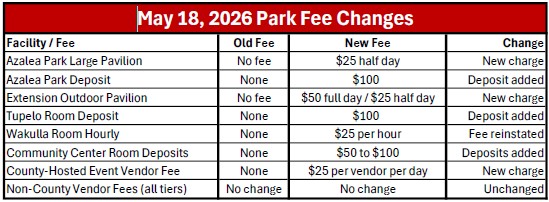
The May 18, 2026 BOCC Meeting Agenda is a good reminder of why paying attention matters. Several items that look routine at first glance carry real impacts for residents, including new park fees, a rezoning inside Crawfordville, and a few code updates that shape how businesses operate. None of these items are shocking, but they show how easily meaningful changes can move through the process when communication with the public is limited. Most people do not study government procedure, and they should not have to. It is the job of elected officials and administration to make information clear and accessible, especially in a time when technology makes that easier than ever. Tonight’s agenda is a simple lesson in staying informed.
Consent Item 4: The FDOT Emergency Use Agreement
A Community Concern That Deserves Open Discussion Before Any Vote
Residents in The Park subdivision and the surrounding area have been raising thoughtful questions about the County’s proposal to allow FDOT to use eight to ten acres of the county owned multi use parcel north of Highway 98 during declared emergencies. This item is scheduled for a vote on Monday night, and it is currently placed on the Consent Agenda.
The concerns being raised are not exaggerated or unfounded. This parcel has a long and complicated history. Years ago it was considered for a wastewater facility, and citizens pushed back because of the karst terrain, the vulnerability of the aquifer, and the direct connection to Wakulla Springs. People remember that fight. They remember why the community opposed that use. So when residents hear terms like fuel pad, staging area, equipment storage, and base camp, it is understandable that they react strongly.
What the Agreement Actually Allows
The agreement that is up for a vote authorizes FDOT to use the site only during declared emergencies and only for temporary operations. FDOT may bring in mobile fueling, sleeping quarters, showers, communications equipment, and vehicle staging. These are the types of facilities needed after a hurricane.
The agreement does not authorize permanent fuel tanks. It does not authorize permanent structures. It does not create a standing FDOT facility. It does not create a helipad. It does not allow year round operations.
The environmental language in the agreement is unusually strict. FDOT must comply with all federal and state environmental laws. FDOT must remediate any contamination at its own expense. FDOT must restore the land to its prior condition after each emergency. FDOT may not store hazardous materials on the site.
Citizens Are Asking Fair Questions
Residents are asking about groundwater protection, spill risks, noise, traffic, helicopter activity, and the long term vision for this parcel. They are asking why this item was placed on the Consent Agenda when the community clearly has questions.
These are reasonable questions. They are not anti government questions. They are community questions about safety, transparency, and land use.
The Real Issue Is the Process
Whether someone supports the agreement or opposes it, the public deserves a clear explanation before the vote. A short presentation could address the temporary nature of the operations, the environmental protections, the exact location of the eight to ten acre footprint, and the history of the parcel. It could answer questions about noise, traffic, and emergency operations.
Instead, the item has been placed on Consent. That means it would normally pass without any discussion unless a commissioner pulls it.
Given the level of public concern, this is the type of item that should be discussed openly before any decision is made.
Bottom Line
The agreement itself is not the problem. The process is. When citizens are already talking, already worried, and already connecting this proposal to past environmental battles, the County should meet them where they are. Sensitive land use decisions deserve open discussion, not silent approval.
Transparency is not only about posting documents online. It is about engaging the public before decisions are made, especially when the land in question sits over the aquifer that defines Wakulla County.
Item 5: The Vertiport Study Letter
A Strange Mix of Poor Communication, Futuristic Planning, and a Process That Raises Fair Questions
Item 5 on Monday’s agenda asks the Board to ratify a letter of support that the County Administrator already signed. The letter supports the Apalachee Regional Planning Council’s application for a state grant. On the surface, it looks routine. In reality, the communication around this item has been anything but clear.
The ARPC is applying for funding to conduct a Regional Vertiport Study. This is part of Florida’s Advanced Air Mobility initiative. In plain English, the state is exploring the future of air taxis, drone corridors, and small electric aircraft. It is the kind of planning that sounds like the Jetsons, but with a Tallahassee grant application attached. The study would look across nine counties to identify potential sites that could support vertiports in the future.
Wakulla County is not being asked to build anything. The County is not spending money. The County is not selecting sites. The County is simply being asked to support a regional planning study so that Wakulla is included in the conversation.
Even so, the way this item was handled leaves the public with fair questions. The agenda does not explain what Advanced Air Mobility is. It does not explain what a vertiport study means for local planning. It does not explain why the County Administrator signed the letter before the Board had a chance to vote on it. It does not explain why this was placed on the Consent Agenda instead of being presented openly.
There is also a relevant detail that should have been disclosed up front. Commissioner Quincee Messersmith serves on the Apalachee Regional Planning Council. ARPC is the organization applying for the grant. That does not mean anything improper occurred. It does mean the public should have been given a clear explanation of the connection and the purpose of the study before the letter was signed.
Instead, the letter was executed early due to a grant deadline, and now the Board is being asked to ratify it after the fact. That is a process issue. It leaves residents wondering who knew what, when, and why this was not brought to the Board before the signature went out.
The study itself may be harmless. It may even be beneficial for Wakulla to have a seat at the table as the state explores future air mobility. But, when a regional agency is planning to map out potential vertiport locations, even at a desktop level, residents should not have to decode that from a vague agenda item.
This is the kind of item that should have been explained clearly. It should have been placed in General Business. It should have been presented openly before any signature went out. When the County participates in futuristic planning that could shape long term land use, the public deserves more than a quiet ratification on Consent.
Good communication builds trust. Poor communication creates questions. Item 5 is a reminder that even harmless planning studies deserve clear explanations before decisions are made.
Item 6: Amendment No. 3 to DEP Grant LPS0075
What It Is, Why It Exists, and What It Means for Wakulla
Item 6 looks intimidating because it is wrapped in dense DEP language, multiple amendments, and a long project history. But at its core, this item is about one thing: more money and more time for septic-to-sewer conversions in the Priority Focus Area around Wakulla Springs.
What This Grant Actually Does
This is the same large DEP grant Wakulla County received in 2021 to convert septic systems to central sewer in the Priority Focus Area. The goal is to reduce nutrient pollution entering the aquifer and Wakulla Springs. The project covers Ameliawood, Ridgeland Place, and Highland Place off Trice Lane.
The original grant was about 8.2 million dollars. Amendment 3 increases the total to 15.5 million dollars.
The amendment also extends the project timeline to December 31, 2029.
Why the Amendment Is Needed
DEP notified the County that additional funding was available. The County requested it. DEP approved it. Now the Board must formally accept it.
The amendment does four main things:
Adds 7.29 million dollars in new funding.
Extends the project deadline to 2029.
Updates the work plan and budget categories.
Adds new DEP-required audit and reporting attachments.
Everything else stays the same.
What the Money Is For
The new funding is allocated to:
Contractual services for construction
Miscellaneous project expenses
Continued design, bidding, project management, and connections
The project will create about 169 sewer connections and decommission the same number of septic tanks.
Why This Matters
This is one of the most important environmental projects in Wakulla County. The Priority Focus Area is the zone where septic systems have the greatest impact on Wakulla Springs. Converting these neighborhoods to sewer is a major step toward reducing nitrogen pollution.
What Citizens Should Know
This item is not controversial. It does not change the project. It does not add new neighborhoods. It does not increase local taxes. It does not require a County match. It simply increases the state funding and extends the timeline.
A simple summary like this would help:
This is a long-term, multi-phase project.
It is fully funded by the state.
It protects Wakulla Springs.
It takes years because of design, permitting, bidding, and construction.
Amendments are normal when the state adds more money or adjusts timelines.
Instead, the agenda item reads like a technical manual. It is accurate, but not accessible.
Bottom Line
Item 6 is a good thing. It brings millions of additional dollars into Wakulla County for septic-to-sewer conversions in the most environmentally sensitive area of the county. It extends the timeline so the work can be completed properly. It does not cost the County anything. Communication is key.
Item 7: CDBG‑DR Hazard Mitigation Match Amendment
A Quick, Simple Update to Keep a Generator Grant Active
Item 7 is a routine paperwork update for a small federal match grant the County received years ago to install permanent generators at the Sheriff’s Office Annex and the Public Works Building. The project itself has not changed. The funding amount has not changed. The scope has not changed.
FloridaCommerce sent updated contract language and extended the deadline through December 31, 2026. The Board simply needs to approve the updated version so Wakulla stays eligible for reimbursement of the match funds.
The amendment also replaces the old audit language with the state’s new standard requirements and adds boilerplate compliance sections that FloridaCommerce now includes in all agreements. These are statewide updates, not specific to Wakulla.
This is a housekeeping item. It keeps the County in good standing with the grant and ensures the match reimbursement stays available. It is appropriate for the Consent Agenda and does not create any new obligations for the County.
Item 8: CDBG‑DR Match Amendment (M0068)
A quick administrative update
Item 8 is another routine update to a federal match agreement for the generator project at the Community Center and the BOCC Administrative Complex. The project itself has not changed. The funding amount has not changed. The scope has not changed.
FloridaCommerce sent updated contract language and extended the agreement through December 31, 2026. The Board simply needs to approve the updated version so Wakulla stays eligible for reimbursement of the match funds.
This is a housekeeping item and fits the Consent Agenda.
Item 9: CEI Rankings for the MLK Jr. Memorial Road Multipurpose Path
A routine approval, with a quick note on how scoring was done
Item 9 asks the Board to approve the Selection Committee’s rankings for RFQ 2026‑05, which will determine who provides Construction Engineering and Inspection services for the Dr. MLK Jr. Memorial Road multipurpose path. This is a standard CCNA procurement step. No contract is being awarded yet. The Board is only approving the rankings and authorizing the County Administrator to negotiate with the top‑ranked firm, Rummel, Klepper & Kahl, LLP. The final contract will return to the Board for approval.
A total of nine firms submitted proposals. Four were shortlisted for oral presentations. The Selection Committee consisted of three staff members: Melissa Corbett (Grant Research and Development Coordinator), Mike King (Director of Road and Bridge), and Susan Vickers (Senior Planner). These three individuals scored the shortlisted firms using the County’s weighted criteria for a maximum of 255 points.
Final scores were very close. RK&K ranked first with 192 points, followed by Halff Associates at 190, Neel‑Schaffer at 186, and GAI Consultants at 183. When rankings are determined by a small scoring panel and the margins are narrow, it is reasonable for the public to want clarity on how the process works. The County followed its standard CCNA procedure, and the scoring details are included here so residents can see how the rankings were reached.
This item is routine and appropriate for the Consent Agenda.
Item 17: Change Order for the Septic Upgrade Incentive Program
A budget shift caused by years of extensions and underestimated admin needs
Item 10 is a routine DEP change order for the septic upgrade incentive program. The total grant amount stays the same at $2,799,722.22. DEP is approving a reallocation of $187,379.72 from the incentive payments line to the grant administration line.
Here is the part residents deserve to know. This program has been amended four times, expanded several times, and extended from 2022 all the way to 2027. Each extension added more work, more reporting, more applications, more invoices, and more compliance requirements. The administrative workload grew, but the administrative budget did not. The County is now shifting money to cover the staff time needed to finish the program.
This does not reduce the number of upgrades funded. It does not change the program. It does not change the total grant amount. It simply reflects that the County underestimated how much administrative work would be required once DEP kept adding money and extending the project.
This is a housekeeping item and appropriate for the Consent Agenda.
Item 11: Parks and Facilities Fee Schedule Update
A full rewrite of the fee schedule with several new charges, reinstated deposits, and targeted increases
Item 11 asks the Board to adopt an amended and restated fee schedule for all County parks, facilities, and recreation spaces. This update is not a minor housekeeping change. It adds new fees, reinstates deposits that were removed in 2025, introduces a new vendor fee for County‑hosted events, and adjusts rental options across multiple facilities.
The County cites new amenities, increased cleaning needs, and gaps in the previous resolution as reasons for the changes. Residents should be aware of what is actually increasing and what is simply being added or restored.
Not every fee in the schedule increased. Many existing pavilion and room rental rates stayed the same, and the vendor‑tier fees for non‑County events did not change. The major changes are concentrated in new rental options, reinstated deposits, and the addition of a vendor fee for County‑hosted events.
Below is a clear breakdown of the changes.
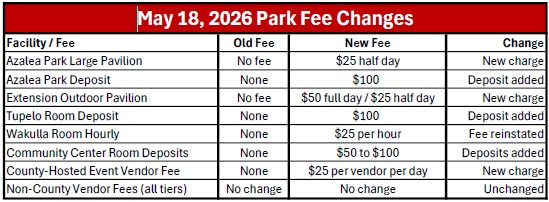
Summary of Major Changes
New or Increased Fees
New large pavilion fee at Azalea Park
New outdoor pavilion fee at the Extension Office
Deposits reinstated across nearly all rooms and pavilions
New vendor fee for County‑hosted events
Hourly rental reinstated for the Wakulla Room
New deposits for multiple Community Center rooms
Fees That Did Not Increase
Existing vendor‑tier fees for non‑County events
Many existing pavilion rental rates
Several long‑standing room rental rates
Boat launch fees (unchanged in this item)
What Residents Will Notice
Residents will see higher costs in the form of:
· New pavilion fees
· New or reinstated deposits
· Vendor fees at County‑hosted events
· Hourly rental charges returning at the Community Center
These changes increase the cost of using public spaces for birthdays, gatherings, meetings, and community events.
Meanwhile, developers continue to pay zero impact fees, despite the County repeatedly referencing the Kimley‑Horn impact fee study when adjusting resident fees. The financial burden continues to fall on residents rather than on growth.
Item 13: Rezoning Request for 521 MLK Jr. Memorial Road
RR‑5 and AG to LDR (Low Density Residential)
Item 13 is a rezoning request from RR‑5 (Rural Residential, 1 unit per 5 acres) and AG (Agricultural) to LDR (Low Density Residential). The parcel is 9.06 acres on MLK Jr. Memorial Road, between Pleasant Ridge and Mallard Pond.
The Future Land Use Map already designates this area as Urban Fringe, which allows up to 2 units per acre with central water and sewer. Because the Comprehensive Plan already supports residential density here, the only step needed is a zoning change to match the existing land use designation.
Why This Rezoning Sailed Through
Three reasons:
It is inside Crawfordville’s intended growth area. The Comprehensive Plan directs residential growth toward Crawfordville and away from rural areas. This parcel is exactly where the County planned for density.
It is consistent with the Future Land Use Map. The FLUM already allows up to 2 units per acre here. The zoning was the only thing out of sync.
No public opposition was submitted. The Planning Department reported no written objections, and the Planning Commission voted unanimously to recommend approval.
When a rezoning is consistent with the Comp Plan and no one objects, it is almost impossible for the Board to deny it under Florida law.
What Residents Should Know
If people in the surrounding neighborhoods had concerns, the time to fight this was at the Planning Commission meeting, not at the BOCC meeting.
To stop or modify a rezoning, residents must:
Show up at the Planning Commission
Submit written objections
Provide specific, fact‑based reasons the rezoning would be detrimental
Reference traffic, compatibility, infrastructure, environmental impacts, or comp plan conflicts
Without that, the Board has no legal basis to deny a rezoning that matches the Comprehensive Plan.
Bottom Line
This rezoning is consistent with the County’s long‑standing growth plan for Crawfordville. It is not sprawl, and it is not a rural intrusion. It is an infill‑type rezoning in an area already surrounded by residential development.
If residents in that area had concerns, they needed to raise them early and clearly. Once a rezoning reaches the Board with a unanimous Planning Commission recommendation and no public objections, it is almost guaranteed to pass.
Items 14, 15, and 16
Routine code updates and a canvassing board appointment
These three items are standard housekeeping actions. They are not controversial, they do not change policy direction in any major way, and they are the type of items that typically pass without debate. Still, they matter for clarity and legal compliance, so here is what residents should know.
Item 14: Definition of Automotive Sales
This item adds a formal definition of “Automotive Sales” to the Land Development Code. The term appears throughout the zoning districts, but until now it had no official definition. The new definition clarifies that automotive sales means a commercial use where four or more vehicles are displayed for sale or lease.
This does not approve any new car lots. This does not change zoning anywhere. This simply gives staff a clear standard to enforce.
The Planning Commission recommended approval unanimously.
Item 15: Off‑Premise Sign Regulations
This item updates the sign ordinance to add rules for small off‑premise signs under 32 square feet. The Code previously treated all off‑premise signs the same, regardless of size. The new rules set height limits, spacing requirements, and location restrictions for smaller signs.
Key points include: • Maximum height of 20 feet • Ten feet of clearance over pedestrian areas • No placement near scenic highways • No placement within 2500 feet of another off‑premise sign • No placement within 660 feet of a traffic signal • No placement within 500 feet of churches, schools, parks, cemeteries, or residential zoning unless approved under the exception process
There is also a remove and replace option that allows a property owner to take down an old sign and install a new one in a compliant location.
This is a technical update, not a major policy shift.
Item 16: Canvassing Board Appointments
Commissioner Lawhon had to recuse himself from serving as the BOCC substitute member on the Canvassing Board. No other Commissioner is eligible to serve. When that happens, state law requires the BOCC to recommend a qualified elector to the Chief Judge.
The recommendation is Jessica Welch.
If the Judge approves her, the alternate position becomes vacant. The Board will then appoint Mike Beauchamp as the new alternate.
This is a routine appointment, but it does add one more responsibility to Jessica’s already full workload. Congratulations Jessica! (we think?)
Stay sharp, Wakulla!
Follow Us on Social
Facebook brings you bite-sized written content, sticky-note facts, and rolling updates you can share and discuss.
NEW! TikTok You can now follow Wakulla Reports on TikTok for quick updates and BOCC video clips.
YouTube is updated less often but does still exist for historical value and for longer videos as necessary.
Prefer to browse at your own pace?
Bookmark our website and visit anytime for fresh posts, resources, and real-life examples from right here in Wakulla County.
© 2026. All rights reserved.
Sign Up for Updates!
By submitting my information below I agree to receiving emails from Wakulla Reports.