This post was written with AI assistance and reviewed word for word by a member of the Wakulla Reports team.
Welcome to WR100: Wakulla County 101. Attendance is optional, parking is free, and there is no final exam, unless you count three minutes at a podium, which we will get to.
Local government touches your tax bill, your road, your sewer line, your kid’s school and your ballot. It is also the level most of us were never taught how to use. This is the orientation for the whole Wakulla Reports course series. It covers who runs what, where to find the paperwork, how to speak at a meeting, and how to get involved. After that, the courses get specific.
Lesson 1: Who runs what
Wakulla County has several separate governments, and knowing which one handles your problem saves a lot of phone calls.
Board of County Commissioners (BOCC). Five commissioners, one per district, serving four-year terms. They set county policy, adopt the budget and set the tax rate.
County Administrator. Hired by the Board to run daily operations and carry out its policies. Departments like Public Works, Planning, Building and Public Safety report up through this office.
Constitutional officers. Elected separately and not controlled by the BOCC: the Clerk of Court and Comptroller, Property Appraiser, Tax Collector, Supervisor of Elections and the Sheriff.
School Board. Five elected members with their own budget, calendar and meeting schedule.
Cities. The City of Sopchoppy and the City of St. Marks each have their own commission and rules.
The county’s governing document is the Home Rule Charter, and the county code of ordinances is searchable on Municode.
Lesson 2: Where to find the paperwork
Regular BOCC meetings start at 6:00 PM at the County Commission Chambers, 29 Arran Road, Crawfordville. They usually fall on the first and third Monday of the month, but dates shift around holidays, so check the calendar before you go.
The county posts each meeting’s agenda outline, minutes and video on its Board Meetings page. Videos go up on YouTube, usually a few days after the meeting.
Here is the catch. The county’s page does not carry the full agenda packets, and the packet is where the dollar amounts, contracts and backup documents live. The agenda page only gives item titles. Wakulla Reports keeps the full packets and other public records we have obtained at wakullareports.com/documents, and we break down BOCC agendas item by item at wakullareports.com/wakulla-county-bocc-meetings.
How to join the Interested Parties List. Go to mywakulla.com, open the “I Want To?” menu, and click “Be added to the Interested Parties List”. On that page, click the “Click Here” link to open the sign-up form, and enter your email address. The list sends agendas, press releases and other county information by email. One thing to know: under Florida law, email addresses are public records. If you do not want yours released in a public records request, the county’s page says to contact the office by phone at (850) 926-0919 or in writing instead.
Lesson 3: How to speak at a meeting
The rules are in Administrative Regulation 2.01. The short version:
Two chances to speak. “Citizens to Be Heard” appears twice on a regular agenda, once early and once after the County Administrator’s report. You can speak on any public business, on the agenda or not.
Fill out a citizen input card. Hand it to a staff member before the Board votes on the item.
You get three minutes. The Chairman can lengthen or shorten that depending on how many people signed up.
Talk to the whole Board. Address the Commission, not one member. Questions go through the Chairman.
One time per subject. Speaking on the same subject twice takes the Chairman’s permission.
Public hearings go first. Rezonings, ordinances and budget hearings are handled at the start of regular agendas.
The regulation does not describe a way for a resident to put their own item on the agenda. Public comment is the route.
Lesson 4: Records, service, and a seat at the table
Public records. Florida law gives everyone the right to inspect and copy most government records, and you do not have to explain why you want them. Use the county’s online public records request form, call (850) 926-0919, ext. 706, or mail Wakulla County BOCC, P.O. Box 1263, Crawfordville, FL 32326. Be specific, name the date range and kind of document, and keep a copy of your request. Check wakullareports.com/documents first, because we may have already pulled it.
Two Florida laws worth knowing. The Sunshine Law requires meetings where two or more members of the same elected board discuss board business to be open to the public, with notice. The Public Records Law, Chapter 119, presumes records created in the course of public business are open, with specific legal exemptions.
Serve. The county fills volunteer seats on advisory boards, such as the Code Enforcement Board and the Tourist Development Council, and posts openings as news items on mywakulla.com. Every eighth year the Board must appoint a Charter Review Commission, which is how charter changes get on the table. You can also run for office, and the Supervisor of Elections posts qualifying dates.
WR100 is the orientation. The rest of the series goes deeper:
WR101: Wakulla County Money. Funds, the spending ladder, where the money comes from and where it goes.
WR102: The Budget Calendar. When the budget gets made and when you can still change it.
WR103: Your Tax Bill. Millage, TRIM notices and the rolled-back rate.
WR201: Who’s the Boss. The charter, the Board versus the Administrator, and the five elected offices.
WR202: Citizen Power. Petitions, recall, charter changes and public comment.
WR301: Capstone. Your three minutes at the podium.
Homework. Find your commission district, join the Interested Parties List, read one full agenda packet before the next meeting, and make a records request for something you have always wondered about. Extra credit for showing up in person.
Something look wrong or out of date? Tell us and we will fix it. Times and dates change, so confirm before you go.
A note on how we work: Wakulla Reports uses AI to read through long county agenda packets and to maintain running trackers of county spending, contracts, and land use changes, which would be hard to keep up by hand. Every post is reviewed word for word by a person on our team before it is published. Figures are tied to pages in the public record, and if we get something wrong, tell us and we will fix it.
The Sept. 21, 2026 Wakulla County Board of County Commissioners meeting is the third one we’ve put through a Receipts Check: we take the minutes the county submits for a vote and run them against its own video, line by line. This was the fastest check yet. The meeting itself lasted 28 minutes.
The short version
● Every recorded motion matches. All 9 votes taken that night, including both tabled items, the budget and millage rate, two ordinances, and adjournment, match the video on outcome and tally (5-0, every time).
● Items 15 and 16, the two firefighters’ union contracts, were tabled right at the start of the meeting, exactly as the minutes say. (We already told you these were coming back Oct. 5 as Items 20 and 21, with the full agreements attached.)
● The minutes compress the whole budget discussion into one line, “There was discussion among the Board.” The video shows that discussion included a direct, on-the-record question and answer: does this budget cut animal services, VA services, the senior center, or rec park services? The answer, from the county administrator himself, was no.
● The county’s final millage rate for FY2026/2027 is 7.7000 mills, 1.55% below the rolled-back rate of 7.8216 mills. Both the millage and the final budget passed unanimously, and the minutes and video agree on every number.
● Overall: 9 of 9 recorded motions matched. One thing worth knowing got left out.
How we checked
We compared the minutes Wakulla County submitted for approval for the Sept. 21, 2026 meeting (they go in front of the Board for a vote on Oct. 5) against the county’s own video of that meeting, posted to the WakullaClerk YouTube channel. Every timestamp below refers to the video, not the minutes.
This is where they nailed it
The agenda approval (with Items 15 and 16 pulled for tabling), both citizen comments, the full two-motion budget and millage process, the 4-H Week proclamation, the consent agenda, both ordinances (the data center ban under Planning and Zoning Item 13, and the comprehensive plan update to the five-year capital improvement schedule under Item 14), the county administrator’s library reopening announcement, and adjournment all match cleanly between the minutes and the video. Every vote the minutes record as passing 5-0 is a 5-0 vote on the video too. The two citizens who spoke during Citizens to Be Heard, one about fill dirt and flooding risk near a new house on Emmett Whaley Road, one about a neighbor’s overgrown vines damaging a fence in Wakulla Gardens, both match the minutes on substance .
This is what they (and possibly you) missed
● 14:02 to 14:31 During the final budget hearing, a commissioner thanked staff for landing below the rolled-back millage rate, then asked for the record: “I just want to clarify this budget that we’re approving does not include cutting any animal services, any VA services, any senior center services or any rec park services.” County Administrator David Edwards answered, “Correct. That is correct.” The minutes note only that “there was discussion among the Board” before the vote. If you were wondering whether this year’s budget touches any of those four services, now you have it on the record, straight from the administrator, and it’s not in the minutes.
That’s it. One meeting, nine motions, one thing worth adding.
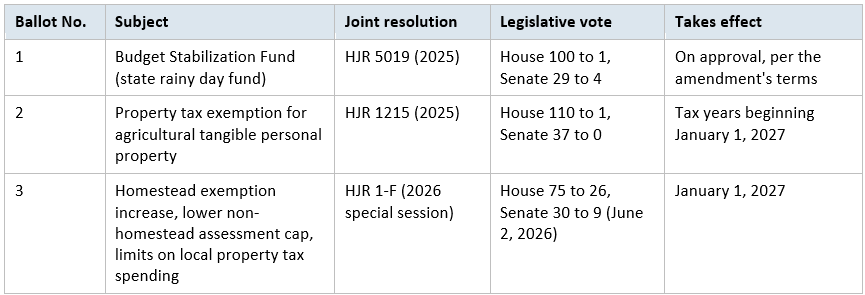
A proposed amendment placed on the ballot by the Legislature needs a three-fifths vote of each chamber, which is at least 72 votes in the House and 24 in the Senate.
To take effect, an amendment needs 60 percent of the votes cast on that amendment. The governor’s signature is not required.
All three amendments appear on the Wakulla County sample ballot as No. 1, No. 2 and No. 3, and each is a yes or no vote.
At a Glance
Amendment 1: Budget Stabilization Fund
What the ballot says
Ballot summary: “Proposing an amendment to the State Constitution to increase the amount of funds that may be retained in the budget stabilization fund from 10% to 25% of general revenue collections, require the legislature to transfer the lesser of $750 million or the amount required to reach 25% of the general revenue collections each year unless certain conditions are met, and allow the legislature to withdraw funds for critical state needs.” It amends Article III, Section 19 of the Florida Constitution.
Current law
• The Budget Stabilization Fund was created in 1992. It is capped at 10 percent of general revenue collections and has a 5 percent minimum balance requirement.
• Florida TaxWatch reports the fund’s balance at $5.056 billion, or 9.75 percent of general revenue collections. Ballotpedia reports 9.3 percent for fiscal year 2024-25. The sources use different dates and measures.
What would change
• The cap would rise from 10 percent to 25 percent of general revenue collections.
• The Legislature would have to transfer each year the lesser of $750 million or the amount needed to reach 25 percent, unless certain conditions are met.
• The Legislature could withdraw funds for critical state needs. Florida TaxWatch describes the conditions as a two-thirds vote, no more than once every five years, and only if the balance exceeds 15 percent of collections.
Fiscal facts
• This amendment moves state money between accounts rather than changing a tax. Florida TaxWatch estimates that at $750 million a year, with 2.4 percent revenue growth, reaching 25 percent would take about 22 years and about $16.4 billion in cumulative transfers by 2049.
Legislative history
• Passed the House 100 to 1 and the Senate 29 to 4 in June 2025.
Amendment 2: Agricultural Tangible Personal Property Exemption
What the ballot says
Ballot summary: “Proposing an amendment to the State Constitution to exempt tangible personal property habitually located or typically present on land classified as agricultural, used in the production of agricultural products or for agritourism activities, and owned by the landowner or leaseholder of the agricultural land from ad valorem taxation. If approved this amendment would first apply for tax years beginning January 1, 2027.” It amends Article VII, Section 3 and Article XII.
Current law
• Tangible personal property, such as machinery, equipment and tools, can be taxed by local governments as property tax.
• Florida Phoenix reports that agricultural real property makes up about 2 percent of total real property value in Florida.
What would change
• Qualifying property would be exempt from property tax. To qualify it must be habitually located or typically present on land classified as agricultural, used in agricultural production or agritourism, and owned by the landowner or leaseholder.
• The Legislature would set the specific conditions and limits in state law.
Fiscal facts
• Estimated annual revenue reduction for local governments and schools: about $31.0 million in fiscal year 2027-28, $32.3 million in the second year and $33.6 million in the third year (Florida TaxWatch).
Legislative history
• Passed the House 110 to 1 on April 25, 2025, and the Senate 37 to 0 on May 2, 2025.
Amendment 3: Homestead Exemption, Non-Homestead Assessment Cap and Local Spending
What the ballot says
The Wakulla sample ballot titles it “Increased Homestead Exemption; Lower Cap on Increases in Non-Homestead Property Assessments,” and cites Article VII, Sections 4, 6 and 9 and Article XII. The Legislature’s bill title was “Save Our Homes from Excessive Property Taxes.” The ballot summary reads
“This amendment increases the homestead exemption, for all non-school taxes, to $150,000 in 2027 and $250,000 in 2028, and adjusts for inflation thereafter. It requires the Legislature to prescribe a uniform procedure for counties and municipalities, for their respective levies, to increase the homestead exemption up to full assessed value, and allows special districts, subject to referendum approval, to do the same.
Persons who are not Florida residents on December 31, 2026, will receive the existing homestead exemption upon qualifying for a homestead exemption, with the increased homestead exemption beginning with the fifth year of exemption, to the extent permitted by the U.S. Constitution.
This amendment reduces the annual cap on assessment increases for non-homestead properties from 10% to 5%.
This amendment requires counties and municipalities to use property taxes solely for public safety, education and schools, infrastructure, natural resources, bond debt service, retirement benefits for employees, and operations and administration. Other expenditures may be approved by county officers or county or municipal governing bodies unless prohibited by general law, notwithstanding Article VII, Section 9(a) of the Florida Constitution, which allows counties and municipalities to levy property taxes for their respective purposes. This amendment takes effect January 1, 2027.”
The ballot text above is quoted from Wakulla County’s official sample ballot.
Current law
News4Jax reports that homesteaded owners currently receive a $25,000 exemption on all property taxes plus an additional exemption on non-school taxes that began at $25,000 and has adjusted for inflation since 2025.
Florida TaxWatch lists the current non-school homestead exemption at $51,411. The Property Appraiser can confirm the exact current amount for a given parcel.
Current law limits the yearly rise in assessed value of non-homestead property to 10 percent.
What would change, by component
Homestead exemption: rises to $150,000 in 2027 and $250,000 in 2028, then adjusts yearly for inflation. It applies to non-school levies only. School district levies are not affected.
New residents: someone who is not a Florida resident on December 31, 2026 receives the existing exemption when they qualify and the increased exemption beginning with the fifth year of exemption. Florida TaxWatch describes a $50,000 exemption for those first five years.
Non-homestead property: the annual cap on assessment increases falls from 10 percent to 5 percent. This covers rental property, second homes, and commercial property.
Local spending: counties and municipalities must use property taxes solely for the seven purposes listed on the ballot, with the stated exception for other expenditures.
Future increases: the Legislature must set a uniform procedure for counties and municipalities to raise the homestead exemption further, up to full assessed value. Special districts could do so with voter approval.
Legislative history and timing
The Legislature met in special session in June 2026. HJR 1-F passed the House 75 to 26 and the Senate 30 to 9 on June 2, 2026, after five floor amendments failed. It was filed with the Secretary of State on June 16, 2026. The companion Senate measure, SJR 2-F, was laid on the table.
If approved, the amendment takes effect January 1, 2027.
Wakulla County’s contingency plan states that lawmakers would finalize implementing legislation by May 2027, with implementation on October 1, 2027, for fiscal year 2028-29 (WTXL).
A related local item on the same ballot
• Wakulla County School Board Referendum No. 2026-35 asks voters to approve an additional 1.0 mill of school property tax for four years beginning July 1, 2027, with annual public reporting. The ballot lists uses of higher teacher and support staff pay and benefits, arts, music and athletics, and free meals for all students, with funds shared with charter schools in proportion to enrollment. It is separate from Amendment 3, and Amendment 3’s higher homestead exemption applies only to non-school taxes.
Voting Dates
October 5: last day to register to vote.
October 22: deadline to request a mail ballot.
October 24 to 31: early voting, 8:30 a.m. to 5:00 p.m., at the Wakulla Community Center and the Supervisor of Elections office.
November 3: Election Day, 7 a.m. to 7 p.m. Photo and signature ID are required. Call 850.926.7575 or visit WakullaVotes.gov.
The unanimous Declaration of the thirteen united States of America, When in the Course of human events, it becomes necessary for one people to dissolve the political bands which have connected them with another, and to assume among the powers of the earth, the separate and equal station to which the Laws of Nature and of Nature’s God entitle them, a decent respect to the opinions of mankind requires that they should declare the causes which impel them to the separation.
We hold these truths to be self-evident, that all men are created equal, that they are endowed by their Creator with certain unalienable Rights, that among these are Life, Liberty and the pursuit of Happiness.–That to secure these rights, Governments are instituted among Men, deriving their just powers from the consent of the governed, —That whenever any Form of Government becomes destructive of these ends, it is the Right of the People to alter or to abolish it, and to institute new Government, laying its foundation on such principles and organizing its powers in such form, as to them shall seem most likely to effect their Safety and Happiness. Prudence, indeed, will dictate that Governments long established should not be changed for light and transient causes; and accordingly all experience hath shewn, that mankind are more disposed to suffer, while evils are sufferable, than to right themselves by abolishing the forms to which they are accustomed. But when a long train of abuses and usurpations, pursuing invariably the same Object evinces a design to reduce them under absolute Despotism, it is their right, it is their duty, to throw off such Government, and to provide new Guards for their future security.–Such has been the patient sufferance of these Colonies; and such is now the necessity which constrains them to alter their former Systems of Government. The history of the present King of Great Britain is a history of repeated injuries and usurpations, all having in direct object the establishment of an absolute Tyranny over these States. To prove this, let Facts be submitted to a candid world.
He has refused his Assent to Laws, the most wholesome and necessary for the public good.
He has forbidden his Governors to pass Laws of immediate and pressing importance, unless suspended in their operation till his Assent should be obtained; and when so suspended, he has utterly neglected to attend to them.
He has refused to pass other Laws for the accommodation of large districts of people, unless those people would relinquish the right of Representation in the Legislature, a right inestimable to them and formidable to tyrants only.
He has called together legislative bodies at places unusual, uncomfortable, and distant from the depository of their public Records, for the sole purpose of fatiguing them into compliance with his measures.
He has dissolved Representative Houses repeatedly, for opposing with manly firmness his invasions on the rights of the people.
He has refused for a long time, after such dissolutions, to cause others to be elected; whereby the Legislative powers, incapable of Annihilation, have returned to the People at large for their exercise; the State remaining in the mean time exposed to all the dangers of invasion from without, and convulsions within.
He has endeavoured to prevent the population of these States; for that purpose obstructing the Laws for Naturalization of Foreigners; refusing to pass others to encourage their migrations hither, and raising the conditions of new Appropriations of Lands.
He has obstructed the Administration of Justice, by refusing his Assent to Laws for establishing Judiciary powers.
He has made Judges dependent on his Will alone, for the tenure of their offices, and the amount and payment of their salaries.
He has erected a multitude of New Offices, and sent hither swarms of Officers to harrass our people, and eat out their substance.
He has kept among us, in times of peace, Standing Armies without the Consent of our legislatures.
He has affected to render the Military independent of and superior to the Civil power.
He has combined with others to subject us to a jurisdiction foreign to our constitution, and unacknowledged by our laws; giving his Assent to their Acts of pretended Legislation:
For Quartering large bodies of armed troops among us:
For protecting them, by a mock Trial, from punishment for any Murders which they should commit on the Inhabitants of these States:
For cutting off our Trade with all parts of the world:
For imposing Taxes on us without our Consent:
For depriving us in many cases, of the benefits of Trial by Jury:
For transporting us beyond Seas to be tried for pretended offences:
For abolishing the free System of English Laws in a neighbouring Province, establishing therein an Arbitrary government, and enlarging its Boundaries so as to render it at once an example and fit instrument for introducing the same absolute rule into these Colonies:
For taking away our Charters, abolishing our most valuable Laws, and altering fundamentally the Forms of our Governments:
For suspending our own Legislatures, and declaring themselves invested with power to legislate for us in all cases whatsoever.
He has abdicated Government here, by declaring us out of his Protection and waging War against us.
He has plundered our seas, ravaged our Coasts, burnt our towns, and destroyed the lives of our people.
He is at this time transporting large Armies of foreign Mercenaries to compleat the works of death, desolation and tyranny, already begun with circumstances of Cruelty & perfidy scarcely paralleled in the most barbarous ages, and totally unworthy the Head of a civilized nation.
He has constrained our fellow Citizens taken Captive on the high Seas to bear Arms against their Country, to become the executioners of their friends and Brethren, or to fall themselves by their Hands.
He has excited domestic insurrections amongst us, and has endeavoured to bring on the inhabitants of our frontiers, the merciless Indian Savages, whose known rule of warfare, is an undistinguished destruction of all ages, sexes and conditions.
In every stage of these Oppressions We have Petitioned for Redress in the most humble terms: Our repeated Petitions have been answered only by repeated injury. A Prince, whose character is thus marked by every act which may define a Tyrant, is unfit to be the ruler of a free people.
Nor have We been wanting in attentions to our Brittish brethren. We have warned them from time to time of attempts by their legislature to extend an unwarrantable jurisdiction over us. We have reminded them of the circumstances of our emigration and settlement here. We have appealed to their native justice and magnanimity, and we have conjured them by the ties of our common kindred to disavow these usurpations, which, would inevitably interrupt our connections and correspondence. They too have been deaf to the voice of justice and of consanguinity. We must, therefore, acquiesce in the necessity, which denounces our Separation, and hold them, as we hold the rest of mankind, Enemies in War, in Peace Friends.
We, therefore, the Representatives of the united States of America, in General Congress, Assembled, appealing to the Supreme Judge of the world for the rectitude of our intentions, do, in the Name, and by Authority of the good People of these Colonies, solemnly publish and declare, That these United Colonies are, and of Right ought to be Free and Independent States; that they are Absolved from all Allegiance to the British Crown, and that all political connection between them and the State of Great Britain, is and ought to be totally dissolved; and that as Free and Independent States, they have full Power to levy War, conclude Peace, contract Alliances, establish Commerce, and to do all other Acts and Things which Independent States may of right do. And for the support of this Declaration, with a firm reliance on the protection of divine Providence, we mutually pledge to each other our Lives, our Fortunes and our sacred Honor.
Welcome back, Wakulla. This is Part 3 of our four‑part series on how land use decisions actually work in our county.
If you’re just joining us:
Part 1 explained the Future Land Use Map (FLUM), the county’s big‑picture blueprint. Part 2 walked through the approval process and why those tiny legal ads matter long before anything reaches the Board of County Commissioners.
Now we’re stepping into the next layer: zoning.
And here is the most important takeaway of this entire series:
Zoning only comes after the Comprehensive Plan.
The Comprehensive Plan sets the ceiling. Zoning fills in the details underneath it.
This is why Comprehensive Plan amendments are so important. Once the FLU category is changed, zoning can be adjusted to match it. That is when density, lot sizes, and building types shift from “theoretical” to “permitted.” If the Comprehensive Plan is the “what could happen,” zoning is the “what can happen right now.”
When a rezoning notice appears in the newspaper, it is not the first step. It is the middle step. The biggest fight is almost always at the Comprehensive Plan amendment stage, because once that door is opened, zoning changes become much easier to justify.
Why Zoning Matters
Zoning comes from the Land Development Code (LDC) Chapter 5. It controls:
• What can be built • How dense it can be • Minimum lot sizes • Setbacks and building height • Whether a parcel can hold a single home, a duplex, a mobile home park, or a multifamily complex
Zoning must match the parcel’s FLU category. For example, you cannot put R‑3 multifamily zoning on Rural‑1 FLU without a Comprehensive Plan amendment first. This guide breaks down every major zoning district in Wakulla County and what a rezoning into or out of each one really means.
You can check zoning for any parcel on the county GIS portal.
Preservation, Conservation, Agriculture, and Rural Districts
These districts protect rural character and open space. Rezoning away from them is a major warning sign for sprawl.
P‑1 Preservation
Intent: Strict protection of wetlands, habitats, and endangered species areas. Permitted Uses: Passive recreation and conservation only. Density: No residential density allowed. Utilities Impact: Utilities do not increase density; development is essentially prohibited. What Can Be Built: Nature preserves and trails. Rezoning Implications: Almost never approved. If changed, it opens the door to any FLU‑compatible use, risking habitat loss and fragmentation.
P‑2 Conservation
Intent: Protect natural resources with slightly more flexibility than P‑1. Permitted Uses: Conservation, limited agriculture or forestry, passive uses. Density: Extremely low; often functionally zero. Utilities Impact: Utilities do not increase density. What Can Be Built: Protected land, low‑impact timber or farming. Rezoning Implications: Could lead to rural estates or subdivisions if FLU allows, reducing buffers around wetlands and springs.
AG Agriculture
Intent: Support farming, timber, and rural estates. Permitted Uses: Farms, livestock, timber operations, rural homes. Density: • With sewer: Often 1 unit per 5 acres • Without sewer: Often 1 unit per 10 to 20 acres depending on FLU What Can Be Built: Agricultural operations and large‑lot homes. Rezoning Implications: Rezoning away opens the door to residential or commercial development, often leading to subdivisions.
RR‑5 Rural Residential
Intent: Very low‑density rural living. Permitted Uses: Single‑family homes. Density: • With sewer: 1 unit per 5 acres • Without sewer: 1 unit per 5 acres What Can Be Built: Large‑lot single‑family homes. Rezoning Implications: Rezoning to RSU or R‑series can increase density five to ten times, shifting rural areas toward suburban sprawl.
RR‑2 Rural Residential
Intent: Low‑density rural living with smaller lots than RR‑5. Permitted Uses: Single‑family homes. Density: • With sewer: 1 unit per 2 acres • Without sewer: 1 unit per 2 to 3 acres depending on soils What Can Be Built: Single‑family homes on moderate rural lots. Rezoning Implications: Opens the door to transitional suburban creep.
RR‑1 and RR‑1(a) Semi‑Rural Residential
Intent: Bridge rural and suburban areas. Permitted Uses: Single‑family homes, sometimes limited attached units. Density: • With sewer: 1 unit per acre • Without sewer: Often 1 unit per 2 acres What Can Be Built: Single‑family homes. Rezoning Implications: Rezoning to denser districts moves the area toward full suburban development.
Semi‑Urban and Residential Districts
These districts allow more homes. Rezoning into them accelerates suburban conversion.
RSU‑1 Semi‑Rural Residential
Intent: Transition from rural to suburban. Permitted Uses: Single‑family and some attached units. Density: • With sewer: 2 units per acre • Without sewer: Often 1 unit per acre What Can Be Built: Single‑family homes with smaller lots. Rezoning Implications: Increases density and traffic.
RSU‑2 Semi‑Urban Single‑Family
Intent: Higher‑density single‑family neighborhoods with utilities. Permitted Uses: Single‑family homes. Density: • With sewer: 3 to 4 units per acre • Without sewer: Often 1 to 2 units per acre What Can Be Built: Compact single‑family homes. Rezoning Implications: Classic suburban pattern with higher strain on roads and water systems.
R‑1A and R‑1 Single‑Family Residential
Intent: Standard single‑family neighborhoods. Permitted Uses: Single‑family homes only. Density: • With sewer: 4 units per acre • Without sewer: Often 1 to 2 units per acre What Can Be Built: Traditional single‑family homes. Rezoning Implications: Rezoning to R‑2 or R‑3 allows duplexes or apartments.
R‑2 Two‑Family Residential
Intent: Moderate density with attached housing. Permitted Uses: Duplexes and attached units. Density: • With sewer: 6 units per acre • Without sewer: Often 2 to 3 units per acre What Can Be Built: Duplexes and attached units. Rezoning Implications: Doubles housing potential and increases traffic.
R‑3 Multifamily Residential
Intent: High‑density residential areas. Permitted Uses: Apartments and condos. Density: • With sewer: Up to 10 units per acre (sometimes more with bonuses) • Without sewer: Multifamily generally not permitted What Can Be Built: Multifamily buildings. Rezoning Implications: Major density increase that can overwhelm rural infrastructure.
RTH Townhouse Residential
Intent: Clustered attached homes. Permitted Uses: Townhouses. Density: • With sewer: 6 to 10 units per acre • Without sewer: Townhomes generally not permitted What Can Be Built: Attached townhome developments. Rezoning Implications: Allows compact, clustered development.
RMH‑1 and RMH‑2 Mobile Home Residential
Intent: Mobile and manufactured housing. Permitted Uses: Individual mobile homes or mobile home parks. Density: • RMH‑1 with sewer: 4 to 6 units per acre • RMH‑2 with sewer: 8 to 10 units per acre • Without sewer: Often 1 to 2 units per acre What Can Be Built: Mobile homes on lots or in parks. Rezoning Implications: Expands affordable housing options and increases density in RMH‑2.
Commercial, Industrial, and Mixed‑Use Districts
These districts do not have residential densities but do shift land toward business activity:
• CO Office Commercial • C‑1 Neighborhood Commercial • C‑2 General Commercial • C‑3 Heavy Commercial • C‑4 Downtown Commercial • I‑1 Light Industrial and I‑2 Heavy Industrial • TC Town Center and CC Cottage Commercial • HIC and LIC • LDR and HDR Overlays
Rezoning to these districts increases traffic, noise, and commercial intensity but can concentrate growth in town.
Other and Special Districts
CTTP Travel Trailer Park
RV parks and similar uses.
PUD Planned Unit Development
Flexible mixed‑use zoning with custom rules. Often used for large subdivisions. Can include density bonuses. Requires close attention.
RC‑1 Rural Commercial
Older district for small rural businesses.
Bottom Line
Zoning is not the first step. The Comprehensive Plan sets the limits. Zoning fills in the details. Rezoning is where the impacts become visible, but the real battle is often one step earlier, when the FLU category is changed.
Always check FLU consistency, concurrency, environmental impacts, and the county GIS map to understand what is possible on any parcel.
This year, we wanted to give our community a Christmas gift that reflects everything we’ve built together : clarity, accountability, and a shared commitment to staying informed. One of our contributors has generously gathered every single blog post we’ve published since launching our dedicated website in 2024, and organized them into one clean, comprehensive recap.
Below you’ll find all Wakulla Reports blog posts, grouped into three easy‑to‑navigate categories:
Issue‑Specific
Education
Meetings & Recaps
Each section is arranged in date order.
If you prefer a searchable format, you can also download our Excel database, which allows you to sort, filter, and quickly locate any topic you’re hunting for (Control + F is your friend).
Happy exploring — and happy hunting.
As we look toward the new year, we will continue to distribute information, help you get answers, and shine sunlight wherever it’s needed (and sometimes where it’s not!). Your support, your questions, and your submissions are the cornerstone of Wakulla Reports, and we are endlessly grateful for every one of you.
Here’s to a brighter, more informed 2026.
Issue Specific
Florida’s Property Tax Reform Push: What’s on the Table for 2026 From immediate elimination to phased relief, senior exemptions, insurance‑linked incentives, and portability reforms-these bills are moving through committees now and may appear on the November 2026 ballot. 12/17/2025
“I Followed Every Rule—Now They Want Me to Tear It Down.” A Wakulla Reports reader shares her exhausting journey through the Building Department and Planning & Zoning. This is her story—and she’s asked us to share it with you. 10/24/2025
How Wakulla County “Increased” the Millage Rate for FY2025: A Simple Breakdown Uncover how Wakulla County’s “steady” 7.9 millage rate for FY2025 is actually a stealthy 5.3% tax hike, capturing extra revenue from booming property values while skipping the rolled-back cut—leaving homeowners with bigger bills. 10/13/2025
Wakulla County’s 2025-2026 Budget: A Simple Guide for Everyday Folks The Board of County Commissioners (BOCC) is set to finalize next year’s money plan (Fiscal Year 2025-2026, starting October 1) at a public hearing on Monday, September 15, 2025, at 5:00 p.m. in the Commission Chambers. 9/13/2025
The Future of Impact Fees in Wakulla County: The Beginning Discover how Wakulla County’s proposed impact fees for Fire, EMS, Transportation, and Parks could affect residents. Drawing on the Kimley-Horn study comparing five Florida counties, this comprehensive post explores why fees are needed to fund growth, their potential to raise housing and consumer costs, and ways to ease the burden on citizens. Learn how you can shape Wakulla’s future through public engagement. 8/3/2025
Wakulla County’s 2024 Audit: The Good News and What It’s Not Telling You – Part 1 of 4 Wakulla County’s 2024 audit confirms accurate financial records but doesn’t reveal if your tax dollars were spent wisely or aligned with community priorities. This first post in a four-part series breaks down the audit’s findings and sets the stage for digging into spending, debt, and accountability. 6/28/2025
Wakulla County Landowners: Know Your Rights When the Government Wants Your Land Wakulla County landowners facing eminent domain are entitled to fair compensation and protections when the government takes their property for public projects like roads or utilities, but they must know their rights to avoid being shortchanged. Wakulla Reports explains the process and key cases, urging taxpayers to stay vigilant for fair treatment and transparency. 6/24/2025
Wakulla Reports: Uncovering the Truth About Wakulla County’s COVID-19 CARES Act Funds – Part 1 This introductory blog post by Wakulla Reports examines a citizen’s questions about the allocation of $5.8 million in CARES Act funds to Wakulla County, revealing vague responses from the county and setting the stage for an investigative series to uncover how the funds were spent. 5/25/2025
Wakulla School Board’s U-Turn: Foreign Teachers Approved at $13,500 Each After 2023 Rejection On January 21, 2025, during an unprecedented ice storm that left 15,000-16,000 residents without power, the Wakulla County School Board quietly approved a contract with TPG Cultural Exchange to hire international teachers on J1 visas for the 2025-2026 school year. This comes just two years after the same board rejected a similar TPG proposal in January of 2023. 5/11/2025
Wakulla’s 2023 Frenzy—Thomas, Messersmith, and the BOCC’s Developer Addiction The 2022 sewer crisis was a warning Wakulla ignored. In 2023, the growth machine roared louder—$1.23 billion in major land deals, 300+ new lots approved, and Commissioners Ralph Thomas and Quincee Messersmith at the center, voting for nearly every deal while Thomas pocketed mortgage fees. 5/4/2025
Wakulla’s $17 Million Radio Deal: Sketchy Bids and Local Buzz Explore the controversy surrounding Wakulla’s $17 million radio deal involving sketchy bids and abrupt transactions. Discover the local buzz and insights into this unfolding story in Wakulla news. 4/3/2025
April 7, 2025 Wakulla Commissioners: Rubber-Stamping Your Money Into a $70.6M Hole Wakulla County’s commissioners are set to rubber-stamp another agenda on April 7, 2025, burning your tax dollars on a $4.55M library and more while ignoring a $70.6M debt—$2,150 per citizen. Two years without pulling an item proves they’re clueless, and you’re paying for it. 4/3/2025
Florida’s Two-Party Consent Law and Why It Needs a Rethink A previous post exposed allegations of a county attorney pressuring a whistleblower, whose recording of the incident may be inadmissible under Florida’s two-party consent law. This follow-up explores that law’s limits, using the case as a springboard to argue for reform, especially when the whistleblower faced a home search after cooperating. 4/2/2025
Wakulla 2025: New Jobs, Old Problems, and a $60+M Question Mark From animal shelter woes to boat ramp grumbles, debris cleanup to housing debates, the county’s juggling growth and safety while locals wonder: are we putting new jobs over old priorities? 3/26/2025
Elections, Employment and Tantrums: A Look at the Sparkman Case A overview of the election and employment law debacle of 2020 involving the Wakulla County Property Appraiser’s Office, the County Administrator, and the then acting Supervisor of Elections. 3/9/2025
The Person Behind the Curtain: Your County Administrator Get to know your local County Administrator through his career work experience. Government employees’ applications are available to the public through a public records request. 2/21/2025
Taxpayer Funded Insurance: Understanding The Taxpayer Premium Explore how our commission views taxpayer funded insurance premiums and the implications when insurance carriers propose claim settlements. Is there a disconnect between taxpayer costs and insurance funding? Discover the insights! 1/3/2025
Wakulla County’s Contracted Attorney: A Closer Look at Representation The question of whether the county attorney is a good fit for our community is one that deserves careful consideration. Community values, needs, and priorities should align with the attorney’s approach. 12/31/2024
Clarifying Communication: An Update to Bonnie’s Letter to the Editor I reached out to Bonnie and we have worked together to better curate a letter to you, the community, to foster understanding of her departure from Wakulla Animal Services after 15 years of selfless service. 12/29/2024
How It Works Part 5: Where County Law Fits into State Law – The Hierarchy Explained Ever heard “the state won’t let us” at a BOCC meeting and wondered if that’s actually true? This post breaks down the legal ladder—from federal to state to county—and explains how preemption, Home Rule, and charter powers really work in Wakulla. 10/16/2025
How to Obtain Records: Paid Resources and Organization Discover effective strategies for how to obtain records and how to safeguard them. From internet search tips to exploring historical court cases, learn about essential resources like the Wayback Machine and PACER. Bookmark this guide to streamline your information search! 2/20/2025
Beginner’s Guide to Requesting Public Records Learn how to effectively request public records with our beginner’s guide. Discover essential communication tactics and tips to ensure your requests yield positive results. Access valuable resources and highlights to enhance your understanding. 2/16/2025
Introduction to Florida Public Records Resources Discover how to access public records in Florida and explore valuable resources available for free. Learn tips on maintaining your anonymity while navigating public records for your needs. 2/12/2025
Wakulla County Commission Meeting: November 3, 2025 This week’s Board of County Commissioners meeting is a consent-only affair. That means all items will be voted on in one motion unless pulled for individual discussion. 10/30/2025
Wakulla County’s June 16 Agenda and Audit Digest: Easements, Grants, and Roads Meet Financial Fumbles Wakulla County’s June 16, 2025, BOCC agenda dives into sewer easements, $92 million sewer upgrades, $18 million loans, and new subdivisions, while audits expose $12,670 permit overcharges, $6 million sewer fee errors, and library bookkeeping lapses. Wakulla Reports unravels it all for taxpayers, urging transparency to keep the county’s financial tide from turning murky. 6/12/2025
Welcome back, Wakulla neighbors! In our six-part series on Florida’s state-county framework, we’ve already covered the basics of state government (Part 1), how our local structure works (Part 2), who controls what (Part 3), and where state and county governments collaborate (Part 4).
Today, we’re tackling the legal scaffolding that holds it all together: the hierarchy of laws and how county ordinances must align with state law—or risk being struck down.
🔺 The Law Ladder: Who’s on Top?
Think of it like a pyramid:
At the top: U.S. Constitution and federal law
In the middle: Florida Constitution and state statutes
At the base: County and municipal ordinances
Wakulla County is considered a “political subdivision” of the state. That means our Board of County Commissioners (BOCC) can pass local rules—but only if those rules don’t conflict with state law. If they do? The state law overrides. Every time.
This isn’t about blame—it’s about structure. When you hear “the state won’t let us,” it’s worth asking: Is it truly a state-level restriction? Or is it a local choice, budget limitation, or misunderstanding?
🧠 Preemption: When the State Says “Nope”
Florida uses a legal tool called preemption to keep rules consistent across all 67 counties. Preemption comes in two forms:
Explicit preemption: The statute clearly says “this area is preempted.”
Implied preemption: The state fully regulates the topic, leaving no room for local variation.
Preemption prevents counties from creating rules that are stricter, looser, or different from state law. It’s designed to avoid a patchwork of conflicting regulations—but it can also block local solutions.
Example: If Wakulla wanted to pass a local gun storage ordinance near schools, it couldn’t. Florida Statute 790.33 preempts all local firearm regulations. The county must enforce the state’s baseline—no additions allowed.
Another example: Local governments can’t ban gas appliances. Recent legislation (like HB 113) preempts rules on appliance types, even if they’re tied to environmental concerns.
Bottom line: If a local ordinance steps over the line, it can be invalidated by the Attorney General or challenged in court. That’s why fact-checking claims of “state won’t let us” is essential. Use municode.com or leg.state.fl.us to verify.
🏠 Home Rule vs. Dillon’s Rule: What’s the Difference?
Florida counties fall into two categories:
Non-charter counties (47 total) follow Dillon’s Rule, which means they can only do what the state explicitly allows. No assumptions.
Charter counties (20 total), including Wakulla since 2008, operate under Home Rule. This gives them broader authority to pass local ordinances on any matter not inconsistent with general law.
So what does “not inconsistent” mean? It means charter counties like Wakulla can act independently—unless the state has preempted the issue or passed a law that directly conflicts.
Example: Wakulla can regulate noise levels locally because there’s no conflicting state law. But we can’t pass a stricter gun ordinance, because that’s preempted.
Charter counties have more flexibility, but they still operate within the same legal hierarchy. State law always wins.
🧩 Real-World Examples with Wakulla Context
Let’s walk through a few areas where preemption and Home Rule collide:
Firearms: Florida Statute 790.33 prohibits counties from regulating gun possession, sales, or discharge. Wakulla can’t add local rules. Enforcement is through the Sheriff’s Office, but the rules come from Tallahassee.
Environment: Florida Statute 373.414 and HB 113 limit what counties can do with wetland protections and impact fees. Wakulla can set buffer zones, but we can’t exceed state nitrate limits. Our sewer projects must blend local goals with state mandates.
Taxes and Spending: Florida Statute 200.065 caps how much counties can raise millage rates without voter approval. Wakulla’s current rate (7.9 mills) is locally set, but state formulas and audits shape our budget. Blame for shortfalls often lands on the state—but local efficiency matters too.
Short-Term Rentals: Florida Statute 509.032 preempts counties from banning short-term rentals outright. Wakulla can require registration and set limits, but we can’t prohibit them entirely. When neighborhoods feel overwhelmed, it’s partial control—not full authority.
🛠️ How Ordinances Get Reviewed
Here’s how a local ordinance moves through the system:
The BOCC proposes a rule
The County Attorney reviews it for conflicts with state law
A public hearing is held
The board votes
If passed, the Clerk records and enforces it
If the ordinance conflicts with state law, it can be challenged under Florida Statute 86.011. The Attorney General or a lawsuit can trigger review. Appeals can go all the way to the Florida Supreme Court—but counties rarely win unless the ordinance is clearly non-conflicting.
✅ Key Takeaways
Hierarchy matters: Federal > State > County. Wakulla must align or adjust.
Preemption is real: It’s statutory, not selective.
Home Rule helps: Our charter gives us flexibility—but not immunity from state law.
Clarity wins: Use public tools to verify what’s possible and what’s prohibited.
💬 Heard a “state won’t let us” claim that didn’t add up? Drop it in the comments—let’s fact-check together.
What’s up, Wakulla watchdogs? Your civic truth squad is back, slicing into Part 4 of our six-part series on Florida’s state-county dance. If you’ve been riding shotgun since Post 1 (Tallahassee’s top-dog rundown) through Post 3 (our lane lines and lane hogs), you’re ready for the “collaboration” chapter—where teamwork meets tension. Oh, and here’s Post 2 in case you missed it!
Sure, there’s hurricane handshakes and grant bucks for roads. But let’s be real: sometimes it feels like the state’s tossing candy with one hand while rifling through our receipts with the other. As Tallahassee turns up the heat—think DOGE’s line-by-line audits and “waste” callouts from Gainesville to the Gulf—counties like Wakulla are bracing for impact.
We’re spotlighting the joint plays that keep us afloat, the funding trail, and the friction behind the scenes. Brew that chicory coffee and let’s dissect the duo—no rose-colored glasses, just local grit.
🤝 Introduction: Partners or Power Imbalance?
“Intergovernmental cooperation” sounds noble. In practice? It’s often the state calling the tune while counties foot the bill. Florida’s Constitution tags us as “political subdivisions”—we carry out state plans, but on their dime and deadline.
Examples? State sets election rules, Wakulla runs the ballots. DEP maps water lines, our inspectors trace them. It’s scale meets boots-on-the-ground.
But with DOGE’s latest push to spotlight “wasteful” local spending (hello, Alachua County), the vibe’s shifting: prove you’re not squandering Tallahassee’s tax dollars. Our Home Rule charter gives us some wiggle, but let’s be clear—collaboration’s a two-way street, even if one side’s driving the bus.
🔄 Intergovernmental Relations: The Reluctant Relay
This is the daily grind: counties implement state mandates, often with strings (and audits) attached.
• Elections? Our Supervisor runs clean contests—but certification hoops come from the state.
• Health codes? AHCA sets the baseline, our clinics tweak the details.
• FAC lobbies for balance, but lately it’s more “show your receipts” than shared vision.
In Wakulla, our BOCC and Administrator sync with state desks—DEP for spring checks, FDOT for traffic signals. It works for consistency, but when audits hit (like those recent “frivolity” flags), it feels less like teamwork and more like probation.
🧩 Examples of Cooperation: Lifelines Under the Microscope
🌪️ Disaster Response: Storms Force the Band Back Together
Hurricanes don’t care about jurisdiction. After Helene and Milton (2024), SERT funneled FEMA aid through our Emergency Management. D-SNAP food drives popped up at the Civic Center, and NRCS helped flooded farms fix wells.
State matched our generator buys ($29K+ via Rebuild Florida), but DOGE’s audit trail means extra paperwork to prove we’re not feathering nests. Smooth evacuations with state troopers? Yes. Post-storm scrutiny? Less smooth.
🚧 Transportation: State Builds, County Pays the Tolls
FDOT’s our road buddy on US 319 widenings ($20M+ south of East Ivan). Closures hit in 2025 for drainage fixes—our Public Works flags detours to soften the blow.
Airport runway stretch? FDOT-funded, BOCC-approved. SR 267 resurfacing? Courtesy of the Five-Year Work Program. But as the state pushes tax cuts, we’re left justifying every maintenance dollar.
DEP’s $15M+ springs grants help cut septic runoff in The Park. Florida Forever snagged 717 acres near the caves. NRCS handles burns and oysters, we match the effort.
But unfunded mandates and DOGE’s green-spend probes? That’s fuel for local side-eyes.
💼 Economic Development: Jobs Lure, But Who’s Footing the Bill?
DeSantis’ $3.5M Job Growth Grant helped Point Blank expand (300 jobs, FSU training). Add $4.5M in Rural Infra, SHIP homes, and $6.2M for sewer upgrades.
With DOGE’s waste hunts, rural counties wonder if the next grant comes with a forensic accountant. Rightfully so, they are your tax dollars!
💸 Funding Flow: Trickle-Down with a Side of Scrutiny
State collects the big bucks—sales, property, gas taxes—and trickles them down via formulas and grants.
• Schools? ~$40M to Wakulla yearly.
• Roads? FDOT’s $10B program.
• FY 2025/2026 prelim: $117M intergov, including sewer aid.
But DOGE’s 2025 audit demands mean every grant is a potential spotlight.
⚠️ Challenges: When “Teamwork” Feels Like a Takedown
• Unfunded mandates: State sets rules (election upgrades, green regs), Wakulla pays.
• Red tape: Hurricane aid’s fast, but FEMA matches get buried in probes.
• Preemption: Coming soon in Post 5—state overrides on local laws.
• Grant grind: We landed three in 2025, but flops sting—especially under DOGE’s glare.
Net gain? Yes. But every win comes with a receipt request; state tax dollars, are tax dollars too.
🧠 Key Takeaways
• Collab basics: State blueprints + funds, Wakulla executes—tuned but tense.
• Wakulla wins: Storm aid (D-SNAP, gens), FDOT roads (US 319), DEP springs ($15M+), job grants (Point Blank).
• Cash trail: $117M state drip for infrastructure and schools—vital, but audited.
• Hiccups: Mandates sans cash, DOGE digs stirring local defenses—watch your wallet.
Howdy, Wakulla crew! 👋 Your go-to truth squad at Wakulla Reports is back with Part 3 of our six-part series on how government actually works—no jargon, no fluff, just straight-up civic clarity.
If you caught Post 1 (the Tallahassee overview) and Post 2 (our county crew’s playbook), you’re already ahead of the curve. Today, we’re diving into the sweet spot where Florida and Wakulla stay in their own lanes. No turf wars—just smart separation that keeps things running (mostly) smooth.
So pour that coffee ☕, grab your sticky notes 🗒️, and let’s lane-split.
🛣️ Not Every Road Trip Needs a Co-Pilot
Florida’s state government and Wakulla County aren’t riding tandem—they’ve got their own highways. The state handles the big-picture stuff that affects all 67 counties. Wakulla? We handle the hyper-local quirks that make our slice of the Panhandle special.
This setup comes straight from the Florida Constitution, which calls counties “political subdivisions” but gives charter counties like ours some elbow room. 🧭
⚖️ Dillon’s Rule vs. Home Rule: The Power Split
• Dillon’s Rule = strict parent. Non-charter counties can only do what the state says.
• Home Rule = cool aunt. Charter counties (like Wakulla since 2008) can act independently, as long as it doesn’t clash with state law.
We’ve got more freedom than our non-charter neighbors—but the state can still override us when it wants (more on that in Post 5). For now, separate lanes = less gridlock. 🛑🚗
🏛️ The State’s Solo Roles: Big-Picture Plays Across Florida
When it’s statewide, Tallahassee takes the wheel. These are the uniform rules that keep 22 million Floridians on the same page—from Miami beaches to Wakulla backroads.
🔑 State-Only Powers:
• 🚘 Driver’s Licenses & Vehicle Tags – FLHSMV runs the show. Wakulla’s office is just a state outpost.
• 🏥 Medicaid & Healthcare – AHCA sets the rules. Counties help with admin, but don’t call the shots.
• 🎓 University Funding – SUS Board of Governors controls budgets and standards. Wakulla students benefit, but we don’t set tuition.
• 🌊 Everglades Restoration – DEP and water districts lead billion-dollar efforts. Counties assist, but don’t direct.
• ⚖️ Criminal Sentencing & Prisons – Florida Department of Corrections handles felonies. Local jails = county turf, but state sets the rules.
These keep Florida cohesive. Even Wakulla’s Home Rule can’t rewrite these.
🏡 Wakulla’s Solo Roles: Homegrown Rules for Our Patch
Flip the script—when it’s pure local flavor, Wakulla calls the shots. Our charter lets us pass ordinances tailored to our community, enforced by code officers and constitutional officials like the Sheriff.
🧩 Local Powers in Action:
• 🔊 Noise Complaints – Chapter 21, Article IV caps decibels. Deputies measure for 10 minutes; fines follow. River racket? We’ve got ordinances for that.
• 🏗️ Building Codes & Permits – We enforce the Florida Building Code with local tweaks for springs and coastal builds.
• 🎉 Local Events & Parks – Azalea Park festivals, boat ramps, and more—funded by our budget and tourist taxes.
• 🏚️ Zoning Nuisances – Ordinances on junkyards and short-term rentals keep neighborhoods tidy.
These are Wakulla exclusives—quick fixes for everyday gripes, no Tallahassee permission slip required. 📝
🌊 Real-Life Contrast: Everglades vs. Wakulla Springs
Let’s make it pop:
• Everglades = $20B+ in state-led restoration. Counties help, but DEP drives the bus.
• Wakulla Springs = Our turf. The 1994 Springs Protection Ordinance limits development in recharge zones. We’ve acquired 8,000 acres for buffers. A 2023 gas station proposal near the spring? BOCC shot it down using local rules. 💪
State helps with grants, but the day-to-day guardrails? That’s us.
Bonus: State runs elections via the Secretary of State, but Wakulla’s Supervisor handles our precincts and voter drives. Local flavor on a state frame. 🗳️
🧠 Why It Matters: Efficiency in the Separation
This isn’t bureaucracy for fun—it’s intended to be smart design.
• State solos prevent chaos (imagine 67 different driver’s license rules 😵).
• County solos let us respond to Wakulla weirdness—like river noise or spring safeguards—faster.
• Home Rule aims to boost innovation and participation.
📌 Key Takeaways
• State solos = licenses, Medicaid, Everglades, prisons—uniform and untouchable.
• Wakulla solos = noise, zoning, springs—local wins via Home Rule.
• Why care? It streamlines life—from safer roads to cleaner waters.
• Pro tip: Check municode.com for our ordinances. It’s public gold. 🏆
Next up: Blog Post 4—where Florida and Wakulla team up for the big stuff.
🗓️ They meet twice a month (1st & 3rd Mondays, 5 PM at 3093 Crawfordville Hwy).
📣 Public comment is open (for three minutes)—your voice, emails, and social media activity matter.
💰 FY 2025/2026 budget? Around $200 million. Priorities: roads, public safety, and infrastructure.
👔 County Administrator: The Day-to-Day Boss
Hired by the BOCC, the Administrator is like Wakulla’s CEO.
• Oversees departments
• Preps the budget
• Executes the Board’s vision (as of recent, more like the board executes the Administrator’s vision)
⚠️ Real talk: Sometimes the Administrator steers the ship more than expected. That’s why paying attention matters.
🗳️ Constitutional Officers: The Specialists
These five positions are elected countywide—no districts, just Wakulla voters.
🧾 These roles add checks and balances. For example, the Clerk audits county spending—catching any funny business.
These five positions are elected countywide—no districts, just Wakulla voters deciding. They’re established by the Florida Constitution and operate independently from the Board of County Commissioners, but they collaborate to keep county government accountable and running smoothly.
👮 Sheriff
Role: Law enforcement, jail operations, and public safety
Responsibilities:
• Patrol and protect Wakulla communities
• Manage the county jail
• Respond to emergencies and criminal investigations
• Coordinate with other agencies during disasters
Real-Life Impact: From hurricane evacuations to neighborhood patrols, the Sheriff’s Office is your frontline for safety.
📑 Clerk of Circuit Court & Comptroller
Role: Court clerk, auditor, treasurer, and financial watchdog
Responsibilities:
• Maintain court records and public documents
• Process marriage licenses, passports, and jury duty
• Audit county spending and manage contracts
• Record BOCC meeting minutes and provide financial reports
Real-Life Impact: The Clerk ensures transparency—catching financial missteps and keeping public records accessible.
💸 Tax Collector
Role: Revenue collection and licensing
Responsibilities:
• Collect property taxes and fees
• Issue vehicle tags and registrations
• Handle hunting, fishing, and business licenses
• Administer local revenue programs
Real-Life Impact: From renewing your car tag to paying your property tax, this office keeps Wakulla’s revenue flowing.
🏠 Property Appraiser
Role: Property valuation for fair taxation
Responsibilities:
• Assess the market value of homes, land, and businesses
• Maintain property records and maps
• Ensure equitable tax assessments across the county
Real-Life Impact: Your tax bill starts here—accurate assessments mean fair contributions from all property owners.
🗳️ Supervisor of Elections
Role: Oversees voter registration and elections
Responsibilities:
• Maintain voter rolls and registration systems
• Organize and run local, state, and federal elections
• Ensure ballot security and election integrity
• Educate voters and promote participation
Real-Life Impact: From early voting to election day, this office protects your voice at the ballot box.
🛠️ Departments: The Hands-On Crew
Under the Administrator’s watch, Wakulla’s departments deliver the goods.