Category: Money & Finance

  • Employee Raises With Amendment 3 Passing? Read That Again.

    Employee Raises With Amendment 3 Passing? Read That Again.

    The 3% COLA: What the Board Voted On, and What the Record Shows

    On November 17, the Board of County Commissioners voted 3-2 to give non-fire (they were also approved but were bound by a separate union contract) county employees a 3% cost of living adjustment (COLA), Item 16 on the agenda. The Board had already approved that raise in the budget, so under the record this vote should never have been needed. The way the item was presented that night does not match the record from the budget meetings. If you missed all of it, this post walks through what happened, in order.

    Who the raises are for

    When people hear “county raises,” many picture commissioners and top brass. That is not who this is about. Commissioners are five elected officials. The people Item 16 is about work in the county departments that run under the Board.

    According to the staffing tables in the County’s Strategic Organizational Restructuring and Financial Sustainability Plan, those departments list roughly 196 positions, about 132 of them outside Fire. Only a handful are top brass, such as the Administrator, the Assistant Administrator and a few directors in the 16-person Administration office. The rest look like this:

    • Fire Rescue: 64 (59 full-time equivalents plus 5 as-needed positions). Fire is handled in Item 15 under a separate union contract.
    • Road and Bridge: 26.5, the crews that maintain county roads.
    • Wakulla Sands Golf: 20.5.
    • Parks and Facilities: 11.
    • Building Department: 8.5. Library: 8.25. Animal Services: 7.75. UF/IFAS Extension and 4-H: 7.75.
    • Planning, Recreation, Groundskeeping, Fleet, Public Works Administration, Probation and Tourism: from less than one full-time position up to 6 each.

    The plan also lists 17 wastewater positions, but those employees work for the contractor Inframark, not the county. The Sheriff, Clerk, Property Appraiser, Supervisor of Elections and Tax Collector are independently elected and are not part of these departments. Staffing numbers come from the plan’s own tables and may have shifted since it was written.

    How commissioners are paid

    Commissioners do not vote themselves a raise. Under Florida law (Chapter 145, Florida Statutes), county commissioner pay is set by a state formula. It starts with a base amount for the county’s population group, adds a set amount for each resident above that group’s minimum, and is then adjusted each year by a percentage tied to the raise given to state career service employees, capped at 7%. A commissioner may choose to reduce his or her own pay, but the Board does not set the formula. That is separate from the County’s employee COLA in Item 16, which is a Board vote. Wakulla’s County Charter (Section 2.5) says the same thing: commissioner pay is set by ordinance at the level general law sets for non-charter counties, and it cannot be lowered during a commissioner’s term.

    You can read the law yourself at the Florida Legislature’s Chapter 145.

    How the plan got tied to the raises

    In August, county staff released a 172-page document called the Strategic Organizational Restructuring and Financial Sustainability Plan. It was written because of Amendment 3, the property tax measure on the November 3 ballot. The plan estimated that, if the amendment passed, the County’s General Fund could lose roughly $6.5 million a year. Among many suggestions, it recommended withholding COLAs until the County was financially stable.

    Amendment 3 did pass on November 3. But the COLA was already in the budget the Board adopted on September 21, and passing the amendment did not undo that or create a second vote. We found no rule that required one. Even so, staff put the COLA on the November 17 agenda as Item 16 and recommended against it, so the Board was asked to vote on something it had already approved.

    The plan is not Board policy

    This is the key point. The Board never voted to adopt the plan. The plan describes itself as a contingency-based strategic plan, and it asks the Board for consideration and direction. At the September 8 meeting, staff described it as “plan B” and “just a proposal.” A recommendation in a document nobody voted on is not a hold, and it is not a rule the Board set for itself.

    What the Board did on September 21

    On September 21, the Board adopted the FY26/27 budget 5-0, and that budget included the 3% COLA. County Administrative Regulation 1.01 says a COLA is approved by the Board in the budget process. We found nothing in AR 1.01 or AR 3.03 that sets up a hold or a second vote, and we found no Board direction to hold the COLA in the budget meeting record we reviewed. See the administrative regulations for yourself.

    What the minutes show

    The minutes are the Board’s official record of what it decided. The June 15 workshop minutes show the Board directed staff to target the roll-back millage rate, to include the nonprofit funding requests but hold those agreements until after the November 3 vote, and to tentatively agree to the proposed special assessment rates. That is what a hold looks like in the minutes: it is written down. The minutes of the July 13 and August 17 workshops and the September 21 meeting contain no direction to hold the COLA or to bring it back. The September 21 minutes record the Board adopting the final budget 5-0, as presented by the County Administrator on July 13 and amended through that day’s agenda process. Nothing in them sends the COLA back to the Board.

    The June 15 slide

    This one is worth a second look. A staff slide from the June 15 workshop listed the 3% COLA as a budget recommendation. The hold was listed separately, under staff’s “Operations Plan”: “Withhold COLAs Until After November 3 General Election.” An earlier slide said that Operations Plan would be “Enacted Via Budget Letter Submitted for Board Approval After November 3.”

    Read those together. The hold rested on staff’s operations plan, and that plan could not carry it. It needed Board approval after November 3, so it could not hold raises up to November 3. It was also not finished. On June 15 the Administrator said he was still working on what he called “plan B” (about 20:15). On July 13, a commissioner asked when the plan would be delivered, and the Administrator said it was about a week from being ready (about 1:07:26). The full document was released on August 17, and the Board never adopted it. We found no record of the Board receiving the full plan before then. A document that was unfinished, then released after the fact, and never adopted cannot set policy to hold raises. To be fair, the slide also said that if implemented, the raises would be retroactive to October 1, which suggests staff was talking about a delay and not an elimination. We are showing you both pieces and letting you decide.

    What happened on November 17

    The written agenda memo for Item 16 was accurate. The spoken presentation was where it drifted. In the November 17 meeting video, the item was described as approved to delay implementation (about 41:44) and as delayed until after the election (about 58:02). Staff also said “we said we would bring these back to you” (about 50:14). The Board then passed the COLA 3-2 (about 59:13). Item 17, the Senior Citizens Council funding, was tied back to June 15 direction by date (about 59:22), which makes the lack of a date for the COLA hold stand out.

    Why it matters

    Employees were told the raises were on hold. Residents watching were told the Board had to approve something. The record says the Board approved the raises when it adopted the budget, and the plan that suggested a hold was never adopted. When staff presents a different version of events, the minutes and the video are how the public checks it.

    The record, by date

    Minutes for each meeting are posted on the County’s workshops page and board meetings page.

    As always, we are not here to tell you what to think. We are showing you what we found so you can decide for yourself. Stay sharp, Wakulla.

  • Your Wakulla County Ballot, Explained: The Amendments and the School Tax Vote

    This post was written with AI assistance and reviewed word for word by a member of the Wakulla Reports team.

    Wakulla Reports · Oct 17, 2026

    Along with the candidates, your Wakulla County ballot has four questions to settle: three state constitutional amendments and one local school tax vote. This post explains each one. A companion post, Meet the People on Your Wakulla County Ballot, covers the candidates and judges. Election Day is Tuesday, November 3, 2026, and early voting runs October 24 to 31.

    For each question, a Yes vote adopts the change and a No vote leaves current law as it is. All three amendments need at least 60% of voters to approve them. The School Board vote needs a simple majority. Wakulla Reports does not endorse and does not tell you how to vote; where there is a debate, we describe both sides.

    On your ballot What it is Who votes
    Amendment 1 State rainy-day fund (Budget Stabilization Fund) All Florida voters
    Amendment 2 Property tax exemption for farm equipment All Florida voters
    Amendment 3 Bigger homestead exemption, lower business assessment cap, and a list of what property tax money can be spent on All Florida voters
    School Board Referendum 2026-35 An extra 1.0 mill of school property tax for four years Wakulla County voters

    Amendment 1: Budget Stabilization Fund

    The state keeps a rainy-day savings account called the Budget Stabilization Fund. This amendment would let it grow larger and require the Legislature to keep adding to it.

    • Raises the most the fund may hold from 10% to 25% of general revenue collections.
    • Requires the Legislature each year to transfer the lesser of $750 million or the amount needed to reach 25%, unless certain conditions are met.
    • Lets the Legislature withdraw money for critical state needs.

    By the numbers. The fund holds about $5.06 billion, or 9.75% of general revenue. At $750 million a year, reaching 25% could take until 2049 under one scenario, and if state revenue grows 3% a year the transfers alone would never get there (Florida TaxWatch).

    The case for. Supporters, including Senate President Ben Albritton and House Speaker Daniel Perez, say a bigger reserve protects the state in a downturn. The Legislature put it on the ballot with votes of 100 to 1 in the House and 29 to 4 in the Senate.

    The case against. House Democratic Leader Fentrice Driskell and a Florida AFL-CIO representative argued that mandatory transfers tie the hands of future legislatures and that the money could fund needs that go unmet today. TaxWatch reports no organized campaign on either side.

    Effect on you. This is a state budget question. It does not change your property tax bill.

    Amendment 2: Property tax exemption for farm equipment

    Currently, equipment and other movable business property (what the tax code calls tangible personal property) on a farm can be taxed. This amendment would exempt it.

    • Exempts tangible personal property that is habitually located on land classified as agricultural, is used to produce agricultural products or for agritourism, and is owned by the landowner or leaseholder of that land.
    • Land and buildings are not covered. The Legislature would set the details.
    • If approved, it would first apply to tax years beginning January 1, 2027.

    By the numbers. Statewide, local governments and schools would lose about $31 million a year at first, rising to about $33.6 million. TaxWatch notes the impact is minor for large counties but could be significant for small, rural ones. We did not find a Wakulla-specific estimate (Florida TaxWatch).

    The case for. Supporters, including Agriculture Commissioner Wilton Simpson (who is also on your ballot) and the Florida Farm Bureau, say it relieves farmers and supports food security. The House passed it 110 to 1 and the Senate unanimously.

    The case against. Rep. Anna Eskamani cast the one House vote against, arguing the benefit would flow mostly to large agribusinesses with many accounts and is not targeted enough.

    Effect on you. Most Wakulla homeowners would see no change in their own tax bill. Local governments that lose the revenue could face a small gap.

    Amendment 3: Homestead exemption, assessment cap and spending list

    This is the amendment most likely to affect your tax bill and your county’s budget. It has four parts.

    • Bigger homestead exemption for non-school taxes. The exemption rises to $150,000 in 2027 and $250,000 in 2028, then adjusts for inflation. It does not change what you pay toward the School Board’s levy. The Legislature would also set a procedure for counties and cities to raise the exemption further, up to full assessed value, and special districts could do the same with voter approval.
    • Lower cap on business and rental property assessments. The yearly cap on assessment increases for non-homestead property drops from 10% to 5%.
    • A five-year wait for new residents. People who are not Florida residents on December 31, 2026 get the existing exemption when they qualify, and the larger exemption starts in their fifth year, to the extent the U.S. Constitution allows.
    • A list of what property taxes may pay for. Counties and cities would be required to use property taxes solely for public safety, education and schools, infrastructure, natural resources, bond debt service, employee retirement benefits, and operations and administration. Other spending may be approved by county officers or the local governing body unless general law prohibits it.

    A note on your sample ballot. The county’s sample ballot prints that last item, the spending list, in its own box with its own Yes and No, between Amendment 2 and the School Board vote. It has no title or number. State summaries of the amendments show it as part of Amendment 3’s ballot language, not a separate measure (ClickOrlando; Florida TaxWatch). Before you vote, call the Supervisor of Elections at 850-926-7575 or check WakullaVotes.gov to confirm how it will appear on your actual ballot.

    By the numbers. Statewide, local governments would collect an estimated $4.9 billion less in 2027, $8.7 billion less in 2028 and $11.8 billion less by 2031. At the statewide average non-school tax rate, a homeowner would save about $1,035 in 2027 and $2,085 in 2028. Your own savings depend on your local rate (Florida TaxWatch).

    The case for. Gov. DeSantis and others say homeowners should not feel they are renting their homes from government, and the Florida Realtors support the property tax relief.

    The case against. Many law enforcement, firefighter and local-government groups and several non-profits oppose it or have raised concerns. They warn of cuts to public safety and other services and say the burden would shift to renters, businesses and owners without homestead. Florida TaxWatch, a taxpayer research group, argues the spending list does not meaningfully restrict what local governments can do, since they can approve other spending.

    Wakulla County School Board Referendum No. 2026-35

    This is the only local money question on the ballot, and only Wakulla County voters decide it. The ballot title is “Approval of 1.0 Mill Ad Valorem tax for school district operations and student programs.” The ballot text reads:

    “To increase teacher and support staff salaries and benefits; increase support to arts, music, and athletic programs; and provide free meals to all students, with funds shared with charter schools proportionate to student enrollment as required by law, shall the School Board of Wakulla County, Florida, levy an additional 1.0 mill in ad valorem property taxes each year for four (4) years, beginning July 1, 2027, with annual public reporting?”

    What it does. A mill is a tax of $1 for every $1,000 of taxable property value. The levy would be added to the school taxes already charged, would run for four years starting July 1, 2027, and comes with annual public reporting. The current school tax rate is 5.377 mills. On a home with $300,000 in taxable value, WTXL estimates the school tax would rise by about $300 a year, from a little over $1,600 to roughly $1,900. Your own number depends on your taxable value, which is on your property tax bill (WTXL). This is a school tax, so Amendment 3’s larger homestead exemption does not reduce it.

    What the money is for. Per the ballot: teacher and support staff pay and benefits, arts, music and athletics, and free meals for all students, with charter schools receiving a share in proportion to enrollment. Superintendent Richard Myhre has said the focus would be on teacher and bus driver pay, and that the district can cover free lunch from its operating fund for one more year, after which it would have to start charging again. He put the cost to a family at “$4 lunch, 180 days a year, $720” (WCTV).

    The case for. Myhre and Cassandra Johnson, president of the Wakulla Classroom Teachers Association, say it would help keep teachers who might leave for higher-paying neighboring counties. Some residents on fixed incomes told WTXL they would support it, one asking that the money be audited.

    The case against. No opponent agreed to speak on camera in the coverage we found. In WTXL’s informal social media poll, most of the dozens of comments opposed raising the tax; that is not a scientific measure of opinion. The County Commission voted to place the question on the ballot, but commissioners cannot approve or reject the tax itself. Voters decide.

    What a vote means. Yes approves the added tax for four years. No means it does not take effect.

    For context. Wakulla is not alone in asking. Statewide, 29 of Florida’s 67 school districts, about 43%, are asking voters for a new property tax levy this year (WFSU).

    Questions worth asking before you vote

    • Amendment 3: How much would Wakulla County lose in the year the changes take effect, and what would the Legislature’s implementing bill say? Which services on the county’s contingency list would you rather keep or give up?
    • Amendment 3: What is your own non-school tax rate, and what would the larger exemption save you?
    • School vote: How much money would the extra mill raise, and how would it be split among pay, arts and athletics, and meals? The ballot does not say.
    • School vote: Where will the annual public reports be posted, and what happens when the four years end?

    How to vote

    • Early voting: October 24 to 31, 8:30 a.m. to 5:00 p.m., at the new Wakulla Community Center (it replaces the Riversink Fire Station) and the Supervisor of Elections Office.
    • Election Day: Tuesday, November 3, 7 a.m. to 7 p.m., at your neighborhood polling place. The Supervisor of Elections Office is not a polling site that day.
    • Mail ballots: Request one by October 22, sign your return envelope, and track it at WakullaVotes.gov.
    • ID: Bring a picture and signature ID to vote in person.
  • Does Wakulla Sands Golf Course “Make Money”? Here’s the Math — and the Question Only You Can Answer

    Header image for the post: Does Wakulla Sands Golf Course “Make Money”? Here’s the Math — and the Question Only You Can Answer

    Wakulla Reports | We Read the Fine Print and Hand it to You – FILES LOCATED AT THIS LINK

    For years, the claim has come up at BOCC meetings: Wakulla Sands Golf Course makes money. The county’s own books do show a profit.

    We pulled the county’s own financial statements and check registers to see how that works. Three fiscal years of Statements of Revenues and Expenditures, plus two years of check-by-check vendor spending. We recomputed every total by hand rather than trusting the summary numbers, and everything the county added up, added up correctly.

    So the math isn’t in dispute. What’s worth talking about is what the math is counting, and that’s a question the county’s spreadsheet can’t answer for you. This post lays out both sides and leaves the call to you.

    First, what this place is

    Wakulla Sands didn’t start life as a county investment in recreation. It started as a wastewater problem, and that history matters for everything below.

    In 2021, the county was looking for somewhere to spray treated effluent after an earlier plan, a 107-acre parcel on porous karst limestone near Wakulla Springs, drew heavy public opposition. Around 200 residents turned out to protest after a hydrologist warned it could send contaminants toward the aquifer that feeds the Springs. The county was already spraying up to 200,000 gallons a day on the Wildwood Country Club golf course under a contract with its private owner. In October 2021, commissioners voted to buy the course outright. WCTV reported the price: “about $1.4 million.” The goal was to take 600,000 gallons a day. County Administrator David Edwards said of that figure: “That suits it today, we have to have more going forward.”

    The course was rebuilt and reopened to the public in August 2024 as Wakulla Sands Golf Club. At the reopening, Commissioner Ralph Thomas told WCTV: “So we created this facility that is primarily an aquifer recharge site, and secondarily is a golf course.” The same report said the site takes “more than one million gallons of wastewater produced by the county each day,” held in a six-million-gallon pond used for irrigation. And Thomas added: “The commission made it very clear that… our goal (is) we want the golf course to pay for itself.”

    That’s the county’s own framing: a wastewater facility first, a golf course second, with a stated goal of the golf side paying for itself. So, does it?

    The two ways to read the same books

    Here’s the Golf Course Fund (Fund 011) for the two most recent fiscal periods we have. Both columns come straight from the county’s own statements; the only thing that changes is whether you count one line: Interfund Transfers, which comes from the sewer fund.

    Image from a public record or document discussed in the section: The two ways to read the same books

    Source: FY24-25 and FY25-26 Golf Course Rev/Ex statements, Fund 011. FY25-26 is a partial year; about a month remained to be counted when the report was pulled.

    So with the transfer counted, the fund shows a profit both years. Without it, golf on its own cleared about $13,000 on nearly $2 million of activity in FY24-25, and is running about $72,000 in the red so far in FY25-26. In plain terms: if not for the transfer, the golf course makes very little, if any, money.

    What the transfer is

    Here’s how we understand it. The transfer is not a bailout. The golf course is the county’s spray field: treated wastewater goes onto the turf instead of the sewer system having to dispose of it some other way, and the golf course gets irrigation water it would otherwise have to supply itself. Each side saves money. The two funds split the difference, using what it would cost each of them to handle the water without the other.

    The golf course’s own books back up that the two operations are tied together: every year, the Greens Maintenance budget carries a line called “WWTP Chemicals” , $126,962.32 in FY23-24, $129,452.84 in FY24-25 and $129,758.37 so far in FY25-26. A golf course doesn’t normally need wastewater-treatment-plant chemicals.

    What we don’t have is the document that sets the formula , an interlocal agreement, rate study or staff memo showing how the transfer amount is calculated and what the avoided disposal cost actually is. Without it, nobody outside county government can check whether $217,000 to $227,000 a year is a fair split. That’s one of the questions at the bottom.

    The case that the savings count

    Reasonable people read this as income. The county really does avoid a cost. The golf side really does take on a job , receiving and using the water , and gets paid for it in a line printed in plain sight on the statement. If a private landowner took the county’s effluent on his pasture and got a check for it, nobody would say the check wasn’t revenue. And the course exists in its current form largely because of this role, which the commission describes as the primary one.

    The case that they don’t

    Reasonable people read it the other way. The transfer isn’t money golfers paid; it comes from a different pot of county money, and the savings land on the sewer side. The county also carries the expense and risk of owning, maintaining and upkeeping a golf course that don’t show up in a “profit” line: the purchase price, the rebuild, hurricane exposure, liability, and the administrative time it takes to run it. And a cost-share formula that outsiders can’t see makes the number hard to evaluate as income.

    What’s on the other side of the ledger

    None of the following appear in the FY24-25 or FY25-26 operating results above, which is why we’re listing them separately. Some are one-time, some may recur, and , more importantly we can’t tell from the documents how much of the construction spending was golf course and how much was wastewater infrastructure, so don’t read these as “the golf course’s bill.”

    Image from a public record or document discussed in the section: What’s on the other side of the ledger

    Add every fund that touched the golf course in FY23-24 and the net is a $2.13 million outflow , the same fiscal year the main Fund 011 statement shows a “profit” of $56,714.40, because that statement nets one huge transfer against one huge construction project. Both numbers are accurate. They’re measuring different things.

    A few things worth a question for your civic leaders

    These aren’t accusations. They’re spots where the numbers as printed don’t reconcile on their own.

    A likely duplicate payment. Two checks, six weeks apart, both for $18,741.77, to the same vendor, both described as pro-shop furniture “with custom white wash finish,” on invoice numbers that differ only by an asterisk. That’s $37,483.54 total, but the county’s financial statement shows only one $18,741.77 charge for that furniture. Our own read is that this was likely a duplicate. A resident has also recently raised questions about other checks in the registers, so it’s worth watching whether this is one instance or a pattern.

    A budget line that collected almost nothing. FY24-25’s adopted budget set aside $713,000 for cart rental revenue, more than a third of the entire fund. Actual collections on that line: $3.77. It may be a category-mapping error (cart revenue may be bundled into green fees); either way, it’s worth asking how closely budget lines are reviewed before adoption.

    A truck bought against a different line. In FY25-26, the county spent $50,692 on a new Ford pickup for the course, charged to a category with no money appropriated for equipment, while $15,000 budgeted for landscaping supplies went unspent. Florida Statute Chapter 129 generally requires a board-approved amendment for that. The documents don’t show whether one happened.

    Payroll. On-course staff, grounds, pro shop, food and beverage, are paid out of the golf fund itself: $1,168,096.40 in FY24-25 and $1,089,028.93 so far in FY25-26, mostly hourly wages. We found no outside management company. We did find a $450 correction booked to the General Fund instead of the golf fund, which shows cross-fund coding does happen. Whether larger overhead costs sit outside the golf fund is unknown. The county’s public BOCC payroll summary may cover golf staff; we haven’t yet matched it to these department codes. A new “Executive Salaries” line appears for the first time in FY25-26 ($843.04, with $0 budgeted), and we don’t know who holds that position.

    You decide

    We’re not saying the sewer-fund payment is improper, on what we can see, it looks like a payment for a real service.

    Here is what we are saying. Without the transfer, the golf course makes very little, if any, money. With it, the county’s books show a profit. Whether that saving counts as “making money” depends on what you think the golf course is: a business that has to stand on its own, or one part of a wastewater system that happens to have a pro shop. Reasonable people land in different places, and you may weigh the ownership costs and risks differently than we do.

    A few questions that may help you decide:

    • What document sets the cost-share formula, and what is the avoided disposal cost it’s based on?

    • How was the FY23-24 capital project split between golf and wastewater?

    • How much of the Hurricane Helene spending does the county expect FEMA to cover?

    • Was the furniture invoice paid twice, and did the truck purchase go through a budget amendment?

    • Who is on the golf course payroll, once the BOCC payroll summary is matched to golf department codes?

    We’d encourage you to ask them too, the next time this comes up at a commission meeting.

    Methodology: figures are drawn from the county’s own Statements of Revenues and Expenditures for FY23-24, FY24-25 and FY25-26 (partial year, through 8/28/26) and BOCC Check/Voucher Registers by Vendor for FY2025 and FY2026, all provided to Wakulla Reports directly. Every total was independently recomputed from the underlying line items rather than taken from the documents’ own subtotals. The wastewater and spray-field history, and all quotations, come from public reporting by WCTV (4/20/2021, 10/19/2021 and 8/27/2024) and the Florida Phoenix (7/15/2021). The description of the transfer as a cost-share between the sewer and golf funds reflects Wakulla Reports’ own understanding; we have not seen the document that sets the formula. A fuller line-by-line breakdown, with page and check citations for every figure above, is available on request.

  • Lake Ellen Access: Dedication, History, and Navigable Waters

    Header image for the post: Lake Ellen Access: Dedication, History, and Navigable Waters

    October 5, 2026 BOCC Agenda, Item 19 (County Attorney memo, pp. 413-422) · October 4, 2026

    The short version

    · The County Attorney’s memo (Agenda pp. 413 to 422, updated September 2026) says the public’s right to use Lake Ellen requires one of two things: the lake is a public, navigable waterbody, or the dedication of Lake Ellen Drive includes a public right to use and access the lake (p. 413).

    · The 1961 plat dedicates the streets as “public highways.” It does not mention the lake. The memo calls that language “lacking in clarity and description” (pp. 414, 421).

    · The county has acted as if the lake is public at times, but the memo says the public’s use “would ideally need to be documented and described” to make that argument (p. 422).

    · Navigable status turns on whether Lake Ellen was navigable in 1845. The state has not determined that (pp. 413, 415 to 418).

    · The memo’s conclusion: neither question can be resolved “with any degree of certainty absent judicial review” (p. 413).

    What the dedication actually says

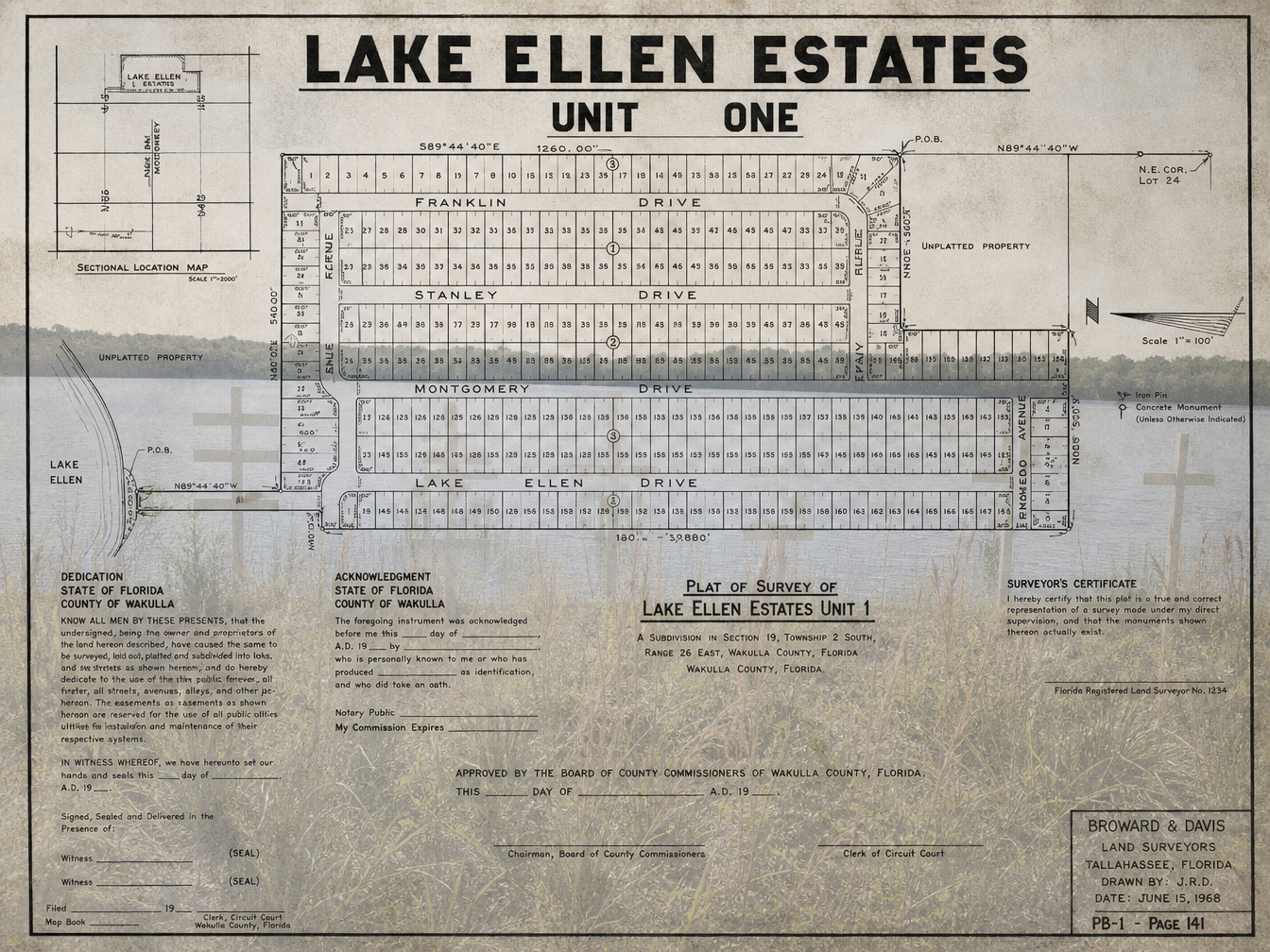
    The subdivision, Lake Ellen Estates Unit One, was platted in 1961. The plat says the developer “does hereby dedicate to the perpetual use of the public as public highways the streets as shown hereon,” and reserves the right to take the streets back if the public abandons them or the law discontinues them (p. 414).

    The plat drawing shows Lake Ellen Drive running “all the way up to the shores of Lake Ellen,” where it ends at a spot marked “Proposed Ramp.” The north end of the road serves no platted lots, and a recent survey shows the county’s right of way “extends all the way into the waters of Lake Ellen” (p. 414).

    The memo says there are no separately recorded documents about the county’s right of way, so the question “largely involves interpreting the dedication language found on the Plat” (p. 420). It then calls the words “public highway” “lacking in clarity and description,” and asks four questions it does not answer (p. 421):

    · Is the right of way only for vehicles going in and out?

    · If so, for which properties, since no lots depend on this part of the road?

    · Is it also meant to provide a public access point to the lake?

    · Does the dedication include littoral rights to use the lake?

    What the history of use shows

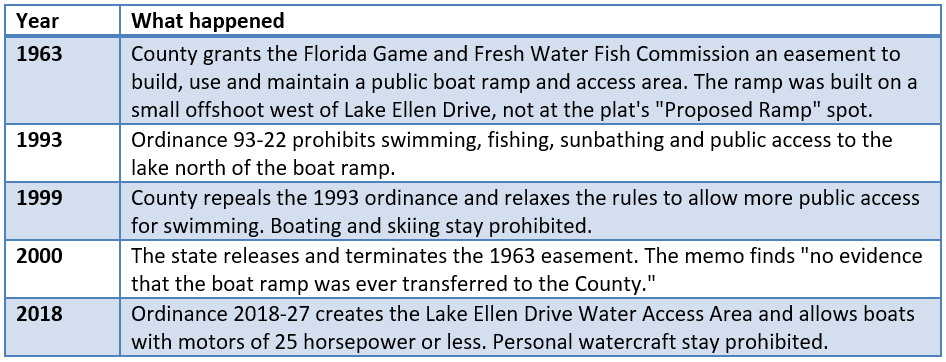
    The memo’s record of how the county and the public have treated the lake points in more than one direction (p. 414).

    Image from a public record or document discussed in the section: What the history of use shows

    The memo says parts of this history help the county. It cites the public’s “apparent historical use” of the lake for “bathing, fishing, and boating,” and a ramp the state operated for years. It says the county’s own actions, the easement and two ordinances, “reflect that it understood Lake Ellen to be a public waterbody” (p. 422).

    It also lists the limits. Public use alone making a lake navigable has “significant equitable appeal” but “limited judicial support” (p. 418). The court case behind the idea was a dissenting opinion decided before the main Florida navigability ruling (p. 417, footnote 2). And footnote 6 says the extent of the public’s use “would ideally need to be documented and described in order to properly craft the argument” (p. 422).

    A 2018 reader letter on the ramp

    A citizen sent Wakulla Reports a letter to the editor that ran in The Wakulla News, “Failure of vision at Lake Ellen” (August 2, 2018, page 4). It gives one lakefront property owner’s account of the ramp’s past. It is an opinion piece, not a county record, and the points below are the writer’s claims. Wakulla Reports has not confirmed them.

    · The writer says the state wildlife agency “gave back to the county the Lake Ellen Boat Ramp” after a death at the lake, and that the county then closed the ramp and “over the following years opened and closed it multiple times.”

    · The writer says the agency returned it because it “did not want the liability of having a boat ramp next to a swimming area.”

    · The writer says four deaths have occurred at the lake, two of them after the commissioners reopened the ramp, and points to a Tallahassee Democrat clipping and a WCTV story as sources.

    · The writer describes the 2018 ordinance as allowing swimming at county boat ramps, parks and facilities, and says he has spoken against the ramp and swimming area since the 1970s.

    What the law says: navigable waters

    Whether Lake Ellen is a public waterbody “held by the state … in trust for all the people” turns on whether it “was a navigable waterbody in 1845” (p. 417). Most of the memo’s legal analysis is about that one question.

    The test

    · Article X, Section 11 of the Florida Constitution says the state holds title to lands under navigable waters “in trust for all the people,” if those lands have not been sold off (p. 415).

    · The date that counts is 1845, when Florida was admitted to the union. Only a water body “navigable in its natural state” then is state-owned (p. 415).

    · Navigability “is based on the water body’s potential for commercial use in its ordinary and natural condition” (p. 416).

    · The Florida Supreme Court has said the “capacity for navigation, not usage for that purpose, determines the navigable character” of the water (p. 416).

    The limits

    · Section 253.141(2) says navigable waters do not extend to lakes lying over areas “conveyed to private individuals” by the federal government or the state “without reservation of public rights” (p. 416).

    · A “meandered” lake is one whose shoreline appears on an original government survey or plat. The Florida Supreme Court has said “nonmeandered lakes and ponds are not to be classified as navigable bodies of water,” though it also called the tests “at best broad guidelines” (p. 417).

    · Of about 7,000 Florida waterbodies, only 200 are meandered. The memo says it is unknown whether Lake Ellen is meandered, or whether an original survey of the lake exists (p. 418).

    What the state has said about Lake Ellen

    · The Department of Environmental Protection said on at least two occasions that it was unable to determine whether Lake Ellen is state owned. In June 2017 it sent two letters saying it lacked enough information (pp. 415, 417).

    · Lake Ellen has been included in the state’s water quality assessments, which “target publicly owned lakes” (p. 417).

    · A November 15, 2017 internal DEP email says, “We know that Lake Ellen is non-sovereign,” but “neglects to explain the reasoning behind that conclusion” (p. 418). As of September 21, 2026, the county “has not been provided with a copy” of the determination behind it (p. 415, footnote 1).

    The deeds

    The memo says it “appears that at some point the submerged lands underlying Lake Ellen were conveyed into private ownership.” Deeds to property along the lake appear to include parts of the lake bottom (Official Records Book 1027, pp. 77 to 79). But that is “not dispositive,” because when the state conveys land under navigable water, the title passes “subject to the public easements and to the riparian rights allowed by law” (p. 418).

    Note: Wakulla Reports posted a short video navigating the Wakulla County Property Appraiser’s website showing the lake being deeded to the bottom.

    The public-use route

    If the meander question cannot be answered, the memo says a court would have to review the lake’s capacity for navigation around 1845. The public’s historical use for boating, fishing and bathing “would likely support the County’s argument.” Evidence of actual use for commerce before 1845 “would be particularly compelling,” but even without it, the lake’s capacity to support navigation or commerce “is the critical issue” (p. 418).

    How the pieces connect

    The dedication argument depends on the navigability question. Florida case law says water rights come with a street easement “only when and at the points where the street … extends to a navigable body of water” (p. 419). Even if the lake is private, the memo says a government can hold littoral rights, which include access to the water, and “Governmental entities can be littoral owners” (p. 419).

    The county’s argument is that the road is dedicated to the public, touches the water, and the plat does not reserve the ramp area for the developer. Ambiguities in a plat are “construed in favor of the public,” and there is a “strong presumption” that what a plat shows is dedicated to the public. The memo calls this “a compelling argument” (p. 421).

    Then it adds a caution. These are “merely arguments that may be presented to a court,” and using a road dedication to give the public rights on a private lake “appears to be a somewhat novel one” (p. 422). The memo also notes the county “could itself presumably become a littoral owner by simply obtaining a fee interest abutting the Lake” (p. 422).

    The memo’s own summary: neither question “is capable of being resolved with any degree of certainty absent judicial review” (p. 422).

    What it could cost, and the questions for residents

    This post is not about whether there should be public access to Lake Ellen. It is about what it takes to get that access legally, and what the county is willing to spend to get there.

    Item 19 lists the budget impact of buying the property as the purchase price plus due diligence, legal fees, recording and closing costs (p. 343). It gives no figure for defending a lawsuit. Any purchase price, settlement, judgment or legal fee would be paid with county funds, which means taxpayers pay.

    What the memo and legal references say, with the caution that this is not legal advice and we found no Florida case on these exact facts:

    · Under the memo’s own test, sovereign status depends on whether the lake was navigable in 1845, not on who owns the parcels today (p. 415).

    · The memo says the county’s theories are “merely arguments” and “somewhat novel,” and that neither question can be settled “absent judicial review” (p. 422).

    · Inverse condemnation is a claim that government action took private property for a public use without compensation. A Florida county attorneys’ association paper lists the elements and says the government’s intent does not matter and physical occupation is not required (pp. 2 to 3).

    · The same paper says sovereign immunity is not a defense to inverse condemnation, and that a successful plaintiff recovers attorney’s fees and costs (pp. 4 to 5).

    · A Florida Bar Journal article says navigability is decided case by case in court, depends on historical evidence and expert witnesses, and calls that method “cost prohibitive.”

    The memo says the deeds along the lake appear to include lake bottom (p. 418). If Lake Ellen is not navigable, the owners of that bottom could raise claims against the county if it buys the property and opens the area to the public. Whether such a claim would succeed depends on facts the packet does not give.

    Questions for the Board and the County Attorney

    1. Has the county assessed in writing the risk of inverse condemnation or trespass claims from owners of lake bottom if it buys the property and opens the area to the public?

    2. If a court has to decide whether Lake Ellen is navigable, what is the budget, and who sets the limit?

    3. Will the county formally request the 2017 state determination that it says it was never given (p. 415, footnote 1)?

    4. If the county buys the property, does it plan to open the lake itself to the public, or only the parcel it owns?

    5. If neighboring owners challenge the purchase, who pays to defend it?

    Questions for residents

    1. Are you willing to pay, through county funds, for a purchase, legal fees and possibly years of court review to settle whether Lake Ellen is navigable?

    2. Would you support buying the whole 150-acre lake bottom to control access? The agenda packet has no cost estimate for that.

    3. Should the Board set a spending limit before it chooses between continuing negotiations and closing the access area?

    Sources

    · Wakulla County Board of County Commissioners, October 5, 2026 Final Agenda packet, Item 19, County Attorney memorandum “Lake Ellen” (Nabors, Giblin & Nickerson, P.A.), packet pp. 413 to 422. Page cites in this post are to the packet’s page numbers.

    · “Failure of vision at Lake Ellen,” Readers Write, The Wakulla News, August 2, 2018, p. 4 (opinion letter sent in by a citizen; author omitted).

    · Florida Association of County Attorneys, Inverse Condemnation Avoidance and Defense (written materials, 2018), faca.fl-counties.com.

    · The Florida Bar Journal, Sovereignty Lands in Florida: It’s All About Navigability (Part I), floridabar.org.

    · October 5, 2026 Final Agenda packet, Item 19 request, p. 343 (budgetary impact).

    · Cited by that letter and not independently reviewed by Wakulla Reports: Tallahassee Democrat clipping (tallahassee.newspapers.com/clip/11643543/tallahassee_democrat) and a WCTV story (wctv.tv/home/headlines/8236252).

  • One Bill, Two Pockets: What Wakulla County Says About the Fire Fund, In Its Own Words

    Header image for the post: One Bill, Two Pockets: What Wakulla County Says About the Fire Fund, In Its Own Words

    A fire fee going from $263 to $277 a year sounds small. Then you sit through two months of the county’s own meetings and hear county staff say the fund doesn’t pay for itself, hear a commissioner say it does, and hear the county administrator correct him to his face fifty seconds later. We pulled every clip. Every timestamp below is one you can go check yourself.

    We went back through every Wakulla County Board of County Commissioners meeting and budget workshop posted to the county’s own YouTube channel since February, all the way through this month’s meeting, looking for two words: general fund. What we found wasn’t a number hidden in a spreadsheet. It was the county’s own finance staff, on camera, walking commissioners through exactly how the fire assessment on your tax bill relates to the rest of what you pay the county, admitting the two have been propping each other up for years, and then, seven weeks later, watching a commissioner tell the public the opposite.

    We’re going to keep the dollar figures light in this one on purpose. Some of the numbers that came up across four different meetings didn’t quite match from one to the next, and we’d rather not build a story on a number we can’t fully verify. What we can verify, word for word, timestamp by timestamp, is what got said and when. That’s the part that actually matters here. Watch it for yourself.

    How This Actually Works

    The county keeps a fire fund separate from its general fund. Each fund is supposed to pay its own way. The fire fund is paid for by the fire assessment, the flat annual fee on your tax bill, separate from your property tax rate. Part of what that fee is supposed to cover isn’t trucks and salaries. It’s a documented share of the county’s own overhead: the clerk’s office, HR, payroll, the people who write the checks and keep the books. County government has a name for that share. They call it “the allocation.” Every fund that isn’t the general fund itself, fire, solid waste, tourism, is supposed to pay it back to the general fund every year.

    For years, by the county’s own admission, the fire fund hasn’t paid it.

    July 13, Afternoon: The Workshop Where They Said It Out Loud

    The board held its second budget workshop of the summer on the afternoon of July 13, ahead of that evening’s regular meeting. (Wakulla County BOCC Workshop 07.13.2026.) At the 35:18 mark, the county’s budget staff, referred to on camera by her first name, Kelly, walked through the fire fund’s numbers.

    “In my projection, I do not expect the fire fund this year to make its transfer, its general fund allocation transfer, to the general fund,” she told the board at 35:55. “So in order to see the fire fund positive cash balance by the end of this year, the general fund is subsidizing the fire fund.” (36:04–36:14)

    Then she gave the board the history, at 36:22: “When you look back at the history, the fire fund has only made its allocation, its full allocation, to the general fund one time in the last five years. One other year it made about half.”

    That’s not a one-time gap. That’s five years of a pattern, described in those words, by the person whose job it is to track it.

    At 39:08, she laid out what the proposed increase would actually buy: “We budgeted to make about 50% of the recommended allocation transfer to the general fund next year. So we budgeted to make $412,000 transfer from the fire fund to the general fund if we increase those rates.” Not full repayment. Half.

    July 13, Afternoon: Why It’s Happening Now

    Here’s the part that didn’t make it into the two-sentence version of this story anywhere else, and it’s worth watching in full rather than taking our word for it. Starting around 40:43, the conversation turns to Amendment 3, the property tax measure headed to voters this November. If it passes and the county’s property tax revenue drops, staff explained, every fund that isn’t the general fund, fire included, would need to start paying its full allocation, not the discounted rate being proposed that night, to make up the difference.

    At 41:15: “It would be very important, if our property tax revenue was reduced significantly next year, for every fund to make its full allocation transfer to the general fund.”

    At 41:46, staff credits a commissioner by name for having already asked them to run these numbers: “If I believe we were, believe it was Commissioner Thomas, we were looking at this model.” Two sentences later, at 41:53: “If the property tax thing was to pass, then we would have to take the full allocation, because you would lose that on the property tax side. So this fund would have to pay for itself. That would automatically jump this, the next year, to right at $375 per residential unit,” up from the $263 residents were already paying and the $277 on the table that night.

    Sit with the order of events here. Before Amendment 3 has even gone to voters, the county is already modeling, at a sitting Commissioner Thomas’ request, how much higher the fire assessment would need to climb to backfill lost property tax dollars, using a fee that isn’t touched by a homestead exemption the way property tax is. The increase on the table in July gets the fire fund to half of what it’s supposed to pay back. The reason that matters, by the county’s own account, is that if the ballot measure passes, the county intends to come back for the other half, and every other special assessment right behind it.

    Then, a few minutes later at 45:04, Clerk of Court & Comptroller Greg James put the whole arrangement in plain English, and this is the line worth sitting with, word for word off the tape:

    “The way I would rephrase it is, you’re already charging your citizens 360. You’re just putting 260 of it in the fire fund and you’re charging your taxpayer through the general fund the difference. They’re already getting it. You’re already charging them. You’re just not putting it all in the fire fund. You’re subsidizing the fire fund with the general fund, as we talked about earlier.”

    (The auto-captions garble a couple of the exact digits in that exchange, so treat the two numbers above as “give or take,” not gospel. The sentence structure, and the point being made, is not in dispute. Nobody in the room corrected him.)

    One commissioner replied, “That’s an excellent point.” At 45:49, another put a number on what all of this would mean for the county’s main checking account if the ballot measure also goes against the county: “General fund is what’s going to be on life support if this passes.” The room laughed. Nobody said it wasn’t true.

    Set the exact dollar amounts aside for a second. What the county said, in its own words, in an open public meeting, is this: the total amount you pay the county for fire protection doesn’t change much no matter which bill it lands on. What changes is which fund gets credit for collecting it, which fund quietly eats the difference every year without a vote or a headline, and, if November goes a certain way, how fast the county will charge you more for the same spending model just, in reverse.

    July 13, Evening: The Vote

    Three hours later, at the regular meeting, the board took up the actual resolution to raise the fire assessment, item 22. (Wakulla County BOCC Meeting 07.13.2026.) At 26:02, a different staff member spelled it out for the public record, item by item.

    “We have a documented allocation that states that the fire fund should be paying $824,000 to the general revenue,” he said. “There are folks that provide services that benefit the fire service, but they’re not firefighters or EMTs. It’s staff, HR, personnel, the board… The way it stands today, all those things are still being paid, but they’re being paid from general revenue. So general revenue is subsidizing the fire fund. In a perfect world, the fire fund would pay for itself. And we’ve never done that. We’ve never had enough money in the fire fund to do that.” (26:12–26:53)

    That $824,000 figure, unlike some of the others in this piece, came through clean and complete on the tape. It’s one of the only hard numbers we’re comfortable printing without a caveat, and it lines up exactly with the “half” figure from the workshop three hours earlier: $412,000 is half of $824,000, on the nose.

    At 26:53: “What’s being proposed here is to at least take fifty percent of that, transfer will come out of the fire fund and pay half of what it should be paying in the general revenue. The alternative, if we hold it flat, we’re going to eat up all the reserves and we’re still not going to be able to pay any money toward that… And it’s still going to be subsidized from general revenue.”

    “Yes, exactly,” came the reply at 27:24, from the same seat that had run through the numbers a few hours earlier. The vote passed unanimous at 27:41. Residential rate: $277. Half the debt still forgiven, permanently, by the general fund, every year, going forward, same as the last five.

    Worth noting from that same meeting, for contrast: item 21, just before it (20:53–22:31), was a proposed increase to the solid waste rate, from $214 to $222, fully justified by the county’s own rate study. The board voted it down and held solid waste flat. Fire went up. Both funds carry the exact same obligation to pay their share back to the general fund. Only one of them got asked to.

    August 17: A Quick Check-In

    At the third and final budget workshop, at 28:27, staff gave the board an update: “The fire fund, because the board approved a fee increase this year, that is going to allow that fund to catch up. It’s kind of been right on the edge for a while.” (Wakulla County BOCC Workshop 08.17.2026.) Nothing new here, just the county confirming its own plan is on track, three weeks before the fund would be back in front of the board for the final vote.

    September 8: The Commissioner Who Said the Opposite

    The fire assessment came back on September 8 for its final, statutory hearing, the last date the county could legally lock in the rate for the new fiscal year. (Wakulla County BOCC Meeting 09.08.2026.) This is where it gets genuinely hard to square with July.

    First, one commissioner pushed back before the vote, starting at 1:02:50: “It’s not that I don’t support fire. This isn’t a vote about the importance of public safety. My concern is whether we have fully exhausted other options before asking taxpayers to pay more… I feel like we’re decreasing the millage, but then we’re adding another assessment.”

    At 1:05:41 she asked directly: “How many times have we increased it since ’21, the fire assessment?” Someone answered: “Several times.” She kept going, at 1:06:02: “I just want to make sure we’ve exhausted every option before we put the burden on the taxpayer.”

    Then, at 1:06:15, Commissioner Thomas responded, and this is the part worth watching in full rather than reading a summary of, because the tone is doing as much work as the words:

    “I want to say, to make sure the public understands, that not all funds stand alone, and this, this fund pays for itself. And so when we’re looking at fire services, we look at this: this is the total cost of the fire services… I like the idea of keeping it on its own. That way, when you see that 277, you’re not paying for animal control by that 277. You’re not paying for the sheriff. You’re not paying for road and bridge. You’re not paying for the library. You’re paying for fire services with that 277, and it’s whole, and it stands alone by itself.” (1:06:15–1:07:04)

    He continued, at 1:07:52, calling it “probably one of the purest funds that we have because it stands on its own.”

    Fifty seconds later, at 1:08:22, County Administrator David Edwards said this, on the record, immediately after him:

    “As we talked about in other workshops on this, the one thing we’re not doing is we’re not taking the full allocation to the general fund. So it’s not paying for itself.” A second voice, agreeing: “There you go. So this fund doesn’t pay for itself.” (1:08:22–1:08:39)

    Two months earlier, in a workshop Commissioner Thomas himself had asked staff to run projections for, the county’s own finance office said this fund has covered its full obligation to the general fund exactly once in five years, and that the increase on the table was designed to get it to roughly half. On September 8, with that same increase up for its final vote, Commissioner Thomas told the public the fund is “whole” and “stands alone by itself.” County Administrator David Edwards corrected him inside the same meeting, less than a minute later. We’re not characterizing that. We’re pointing you to 1:06:15 and 1:08:22 in the same video, so you can watch the fifty seconds in between for yourself.

    What This Actually Means for Your Bill

    We’re not here to tell you the county is doing something illegal. It isn’t. Allocating shared overhead across funds, and deciding some years not to collect the full amount, is a normal, legal budgeting choice that plenty of local governments make. Every year, county staff has walked the board through exactly what it’s doing and why.

    But “legal and disclosed” and “well understood by the people paying for it” are two different things, and the county’s own words this summer make clear the stakes are bigger than one $14 increase. In the clerk’s own framing back in July, the money was never really new, it was just uncounted, sitting on the general fund’s side of the ledger instead of the fire fund’s. What the county’s own staff described, at a sitting commissioner’s request, is a plan to move that money over in full the moment property tax reform actually costs the county revenue, starting with fire and moving to every other special assessment behind it. The increase that passed this summer is step one of that plan, arriving months before voters even decide on Amendment 3 in November. And the same commissioner who asked staff to run those numbers in July stood up in September and told the public the fund it’s meant to shore up already pays for itself. County Administrator David Edwards said otherwise, in the same room, less than a minute later.

    You can decide for yourself what to call that. We’re just telling you it was said, exactly when it was said, and exactly where to go watch it yourself.

    Stay sharp, Wakulla.

    Sources: Wakulla County BOCC Workshop 07.13.2026 (35:18–46:00) · Wakulla County BOCC Meeting 07.13.2026 (items 21–22, 20:53–27:41) · Wakulla County BOCC Workshop 08.17.2026 (28:27–28:50) · Wakulla County BOCC Meeting 09.08.2026 (item 2, 1:02:50–1:12:46). All videos published by the Wakulla County Clerk of Court on the WakullaClerk YouTube channel. Timestamps are drawn from the platform’s auto-generated captions; we encourage you to watch the cited ranges directly rather than take our word for the exact wording.

    Image from a public record or document discussed in this post: One Bill, Two Pockets: What Wakulla County Says About the Fire Fund, In Its Own Words
  • Wakulla County’s Debt Nearly Doubled in FY 24/25, Says the Most Recent Debt Report

    Header image for the post: Wakulla County's Debt Nearly Doubled in FY 24/25, Says the Most Recent Debt Report

    On August 17, 2026, the Wakulla County Board of County Commissioners spent about six minutes on the item, combined with an unrelated audit report, no less, approving the county’s Annual Debt Report for the fiscal year that ended September 30, 2025. The report itself is 20 pages, written by Clerk of Court Greg James, and it says the quiet part reasonably clearly if you read past page 4: the county’s debt jumped by two-thirds in a single year, blew through its own self-imposed debt ceiling, and the number everyone’s been quoting, $36.4 million, isn’t actually the county’s total debt. It’s less than half of it.

    None of that makes the county’s borrowing strategy a scandal. Every county borrows money, and there’s a real, coherent explanation for what’s happening here. But “coherent explanation” and “no red flags” aren’t the same thing, and a few of the numbers Clerk James and County Administrator David Edwards presented to the board don’t add up as cleanly as the meeting made them sound.

    The headline number, and why it jumped

    Wakulla County’s outstanding capital debt went from $21,859,164 at the end of FY23/24 to $36,414,642 at the end of FY24/25, a $14.6 million, 66.6% increase in one year (p.4). The county paid $22.3 million in debt service that year, most of it principal.

    The driver is a $100,000,000 line of credit with JP Morgan Bank, approved by the board back in April 2023, meant to cash-flow a wave of grant-funded sewer and infrastructure projects rather than draining county cash on hand while waiting for grant reimbursements to arrive. As of the report’s September 30, 2025 cutoff, the county had drawn $68 million of it, three draws of $30M, $20M, and $18M (p.6).

    That single line of credit accounts for $27.6 million of the county’s $36.4 million total debt. Strip it out and the county’s actual long-term debt is closer to $8.8 million, which Clerk James pointed out to the board himself. Almost all of the growth is filed under “business-type activities” (sewer and solid waste) rather than general government, business-type debt went from $11.7M to $34.5M of the total, while governmental debt actually fell, from $10.1M to $1.9M, because a separate $15 million the general fund had borrowed for “certain governmental activities” was paid off this year (per Clerk James at the meeting, this loan isn’t itemized anywhere in the written report itself, so if you want to know what it actually funded, that’s a records request, not a report page).

    By the time the board voted on it, the report was already aging. Ten and a half months passed between the fiscal year-end this report covers (9/30/25) and the meeting where it was presented (8/17/26). In that gap, the county drew another $17 million from the line of credit, on July 3, 2026, bringing total draws to $85 million of the $100 million facility, with only $15 million left to borrow. The amount currently owed on the LOC has actually dropped to about $23.25 million, because the first $30M tranche has since been fully repaid with grant reimbursements. None of that is in the document the board formally adopted; it only came out because Clerk James mentioned it verbally.

    The county blew past its own debt limit, and undersold by how much

    Wakulla’s debt policy sets a benchmark of no more than $500 of debt per resident. For FY24/25, actual per-capita debt is $956, 91% over the county’s own limit (p.14). To be fair to the report, it says so plainly, and it’s honest that the LOC (line of credit) is the reason: pay off the JP Morgan line, and per-capita (per citizen) debt is projected to fall to around $230, well under the limit.

    But there’s a second, quieter problem with that $500 figure: it hasn’t been changed since the debt policy was adopted in 2015. Eleven years of inflation later, Clerk James told the board that adjusting for inflation would put the real value of that limit somewhere over $700 today, meaning the “$500” benchmark the county is measuring itself against is worth less in real terms every year it goes unrevised, at the same time the county is spending more.

    The $36.4 million isn’t the county’s real debt

    Here’s the number that should really be the headline, and it’s on the very last page of the report, item 5 under “Other Potential Debt Obligations”, not in any of the 15 charts that come before it:

    The county’s total debt, per its own annual financial report, is $69,794,416, $1,832 per citizen. (p.20)

    The difference between that and the $36.4 million figure everyone’s been quoting is $33.4 million in obligations the debt report doesn’t count because they’re not “capital infrastructure” debt: a $27.8 million unfunded pension liability, $3.1 million in retiree health benefits (OPEB), $1.76 million in compensated absences (unused leave the county owes departing employees), and $641,000 in landfill post-closure monitoring costs (p.19-20). All of that is real money the county will have to pay. None of it shows up in the debt-per-capita chart, the debt-service-ratio chart, or any of the projections the board actually discussed. If you’re going to hold the county to a per-capita debt benchmark, $1,832 is the number to hold it to, not $956.

    Two funds can’t currently cover their own debt payments

    The report calculates a “debt service coverage ratio” (DSCR) for each fund, basically, does the fund bring in enough cash to cover its own debt payments, with anything above 1.0 considered healthy. Two funds are currently below zero or barely above it:

    • The Sewer Fund’s DSCR is -0.03 for FY24/25, negative, meaning it did not generate enough revenue to cover its debt service and is leaning on grant reimbursements to get by (p.17).

    • The Revenue Stabilization Fund’s DSCR is 0.06 (p.18).

    • Separately, the county’s own “business-type debt service ratio”, debt payments as a share of operating expenses for sewer and solid waste, hit 460.50% against a 15% benchmark this year, an all-time high, driven again by the line of credit (p.15).

    The report frames all of this as temporary and LOC-related, and that’s a fair read of the mechanics. But “temporary” here means years, not months, staff’s own three-year forward projection keeps the business-type ratio at 166%, more than ten times the benchmark, through at least FY27/28.

    Two big-ticket items aren’t in any of the county’s debt projections

    A ~$10 million office relocation that isn’t budgeted anywhere. Widening Crawfordville Highway will require demolishing the current County Administration building along with the offices of the Property Appraiser and Supervisor of Elections. The state (FDOT) will pay the county for the value of the buildings and land, but the report itself says that money is “highly unlikely” to be enough to build replacements elsewhere. Estimated project cost: $10 million, with roughly $8.5 million expected to be borrowed, except the timing is unknown, so it’s been left out of every 10-year debt chart and projection in the report (p.19).

    A new $25 million economic development deal, mostly not on the books yet. “Project Safety” is a plan with Point Blank Enterprises to relocate a manufacturing operation from South Florida to Opportunity Park, a 20-acre purchase and a roughly 118,000-square-foot facility, projected to create 300 jobs. It’s largely grant-funded ($13.5M from Triumph Gulf Coast, $4.5M+ from Florida Commerce, another $3.5M pending), but the county has secured a separate Ameris Bank line of credit of up to $10,000,000 at 5.55% to cash-flow it, and expects to convert its own $3.5 million share into a 10-year loan (p.11). At the meeting, staff confirmed the $25M for this project sits inside a $67.4 million “design and engineering” pipeline (some not related to project safety) that will require a separate borrowing from anything in this report (Aug. 17, 2026 meeting, general business item 14/21).

    What the county is saying it won’t do

    In fairness, the meeting had a genuinely reassuring moment too: Administrator Edwards told the board that once the last $15 million of the JP Morgan LOC and the Point Blank borrowing are drawn, the county’s stated plan is to stop borrowing for the roughly $27.5 million in projects still in the design pipeline, and instead slow construction and cash-flow those projects internally. That’s a decision, not a guarantee, but it’s on the record, and worth holding them to.

    The bottom line

    The county’s debt roughly doubled in FY 24/25, but the report is honest that most of that is a temporary, grant-repaid line of credit rather than new permanent obligations, and the plan to let it retire by 2027 is credible on its face. Where this gets worth watching: the per-capita debt limit designed to catch exactly this kind of growth is stuck at an 11-year-old number and the number that actually represents what Wakulla County owes, $69.8 million, not $36.4 million, is sitting on the last page instead of the first.

    Sources: Wakulla County Annual Debt Report, Fiscal Year Ending September 30, 2025 (prepared by Clerk of Court Greg James, presented to the BOCC August 17, 2026); BOCC meeting video/transcript, August 17, 2026, general business items 14 and 21.

  • Industrial Development Gets $47 Million. Citizens Get Threatened With Losing Services.

    Header image for the post: Industrial Development Gets $47 Million. Citizens Get Threatened With Losing Services.

    A $10 million line of credit for a private factory. A pink slip for 4-H, the animal shelter, and Veterans Services. A $46.9 million fund nobody’s explained. And a vote this Tuesday that could begin the lock in.

    This page wasn’t born – it was provoked. So was this one.

    Last week, Wakulla County released a 172-page “Strategic Organizational Restructuring and Financial Sustainability Plan,” just before the FY2026/27 tentative budget the Board of County Commissioners votes on this Tuesday, September 8. The report reads like a warning siren. Pages of talk about fiscal crisis, hard choices, and services the county says it may no longer be able to afford.

    We don’t take a document’s word for it. We read it. All of it. Then we pulled the actual budget tables, the itemized list of every change made since July, and cross-checked every number against every other number. What follows is what we found. Every figure is the county’s own. Every claim is cited to the page. If you bring us a claim, bring the receipts, so here are ours.

    For those of you looking for the payroll summary, it can be found here.

    First, let’s clear something up: Who’s Voting on What?

    If you’ve seen the 172-page report, you’ve seen the words “Amendment 3” a lot. That’s the source of the crisis narrative, a proposed state constitutional amendment that would expand the homestead exemption and cap taxable-value growth. It’s a real thing, and it would have real effects on county revenue if it passes.

    Here’s what the report doesn’t put front and center: Amendment 3 is on the statewide ballot in November 2026. Every Florida voter decides it, not just Wakulla’s. Even if it passes with the required 60%, it doesn’t take effect until January 1, 2027. And by the county’s own math (p. 12–13), the earliest budget year it could actually touch is FY 27/28, a full fiscal year after the one being voted on this Tuesday.

    Tuesday’s hearing is the county’s own, routine, state-mandated TRIM hearing (Truth in Millage) where the Board sets its tentative millage rate and budget for the year starting October 1, 2026. That’s a decision entirely within the county’s control, right now, regardless of what happens in Tallahassee or at the ballot box in November.

    We want to be straight with you about why that matters: it means everything below isn’t about some future hypothetical. It’s about choices being made this week.

    The number that should stop you: $46.9 million, and a factory called “Project Safety” – Is it connected?

    Buried in the budget’s fund-by-fund exhibit is a line most residents will never notice: Fund 195, the Industrial Development Authority.

    In Fiscal Year 24/25, that fund spent about $33,000. Through July of this year, about half a million. The budgeted amount for this fiscal year was just under $32 million. The FY26/27 budget on the table Tuesday puts $46,926,369 into it — a 46.98% jump that makes it the second-largest fund in the entire $245.1 million county budget, behind only the wastewater system. Nineteen cents of every dollar in the county’s budget is now sitting in this one line.

    Industrial Development Authority – Line by Line Comparison

    Fiscal Year 24/25 Spent: $32,930

    Actual Spent Through July 31, 2026: $501,535

    Fiscal Year 25/26 Amended Budget: $31,926,544

    Fiscal Years 26/27 Budget (Preliminary: $46,926,369

    Increase from 25/26 into the 26/27 Budget: $14,999,825

    Nothing in the agenda explains what it’s for. It is interesting that such a large item of spending would not have even gotten an honorable mention in the strategic restructuring plan.

    So, we did some digging. The likely answer is “Project Safety”, the county’s nickname for a $20–25 million body-armor manufacturing plant for Point Blank Enterprises, going up at Opportunity Park. In May 2026, commissioners approved a $10 million line of credit through Ameris Bank as a cash-flow bridge, layered on top of roughly $21.5 million in state and Triumph Gulf Coast grants (Triumph is the fund built from the BP oil spill settlement). County leadership has said the goal is to “cash flow” the project until reimbursed by the state and Triumph grants.

    To be fair, on the record: a lot of that money is very likely restricted grant funding and a bank line of credit meant to be repaid, not general fund cash sitting around that could simply be redirected to cover a property tax shortfall. We’re not going to tell you it’s money the county could just hand back to taxpayers, because that’s not what the public record shows, and we don’t publish claims we can’t back up.

    But here’s what we can say, on the record, with page numbers:

    The same 172-page plan that should be helping to shape this budget to get in front of any property tax revenue shortfall, also recommends eliminating the county’s own contribution to its Economic Development program (p. 46). Read that twice. The county is actively underwriting a private manufacturing deal with a bank line of credit — while proposing to zero out its own economic development budget to save money.

    A resident already said something about this in public, months before this report came out: the project’s projected cost had already climbed from $21 million to $25 million — a 19% overrun — with, in her words, “no hard costs” and no spending cap, and taxpayers left holding the loan if the promised grant reimbursements are delayed or fall short. That’s not our framing. That’s a Wakulla County resident, on the record, before any of us had the itemized budget in hand.

    What the 172 pages actually propose cutting

    While the county carries millions in factory financing, the same report lays out, in its own words, department by department, what it says may no longer be affordable. Here’s the list, with page numbers so you can check us:

    Animal Adoption Center — eliminated. The plan calls for exploring an outside partner to take over adoptions; if none is found, “remove the Adoption Center from operations.” Voluntary owner surrenders and owner-requested euthanasia would be discontinued too. (p. 61)

    4-H Summer Camps and the UF/IFAS Extension partnership — the county would notify the University of Florida of its intent to end the decades-long partnership, cut 4-H Summer Camps starting in 2027, and the report says the department “would be eliminated from the budget altogether.” (p. 130)

    Veterans Services — no longer a county department. The plan is to hand it to the VFW and American Legion with a $10,000 contribution in aid; if no agreement is reached, “the program will be eliminated.” (p. 141)

    Library Services — privatization “explored.” (p. 136)

    Probation Department — fully outsourced and, per the report, “eliminated from the budget altogether.” (p. 124–125)

    All non-profit funding — including the We Care Network, the Senior Citizens Center, and North Florida Medical Center. (p. 46)

    CDL Training and Testing Program — eliminated. (p. 80)

    Plus: the county’s legislative lobbyist, its memberships in the Chamber of Commerce and the National Association of Counties, and its participation in regional planning agencies are all on the chopping block if legislative funding doesn’t cover them. (p. 46–47)

    That’s not an exhaustive list of every dollar in the plan, the report runs to vague FTE reductions in nearly every department, department by department, year by year. But it’s the list of what gets eliminated outright, not just trimmed. Read it next to the $46.9 million sitting in Fund 195 and the $10 million line of credit for a private factory, and you tell us if the priorities add up.

    The same report that warns about lost tax revenue proposes new taxes

    If belt-tightening is the point, the “Revenue Strategies” section doesn’t read that way. Buried in it:

    – Raise the Public Service Tax — the tax on your electric, gas, and water bills: from 9% to 10%, the maximum allowed under Florida law, worth an estimated $486,812 a year.

    – Create a brand-new EMS special assessment (an MSBU), projected to bring in nearly $5 million in its first year.

    – Study a new Law Enforcement taxing district — another property-tax-style levy, separate from the county’s general millage.

    None of these require Amendment 3 to fail in November. They’re recommended either way. (p. 17–23)

    The millage rate: the one place the county deserves some credit – with a catch

    We’re not here to make every number look bad. Some of this checks out, and it’s worth saying so plainly, because it makes the rest of this report harder to wave away as one-sided.

    The tentative millage rate on the table Tuesday is 7.7000 mills which is genuinely lower than the “rolled-back rate” of 7.8216 (a 1.55% cut, per the county’s own resolution), and lower than last year’s final adopted rate of 7.9000, according to local news coverage of last September’s hearing.

    The itemized change list confirms this was a deliberate choice, not an accident: the July 13 draft budget was built on a projected $19,704,163 in property tax revenue, reverse the math, and that’s a millage of 7.8216, exactly the rolled-back rate. The Board then directed staff to cut it to 7.7000, walking away from $306,334 in revenue. Their own notes say so directly: “Reduced Millage to 7.7000 per Board Direction.”

    That’s a real rate cut. Though, it doesn’t mean your tax bill will be lower. Countywide taxable property value is up roughly 6% this year, and that’s what actually drives most bills, not the millage number alone. But the rate itself isn’t where the real story is. The budget and the priorities are.

    What we’re asking Wakulla to do

    We’re not telling you how to feel about this. We’re telling you what’s in it, and we’re telling you where to look for yourself.

    If you can make it Tuesday, September 8, to the Board of County Commissioners’ tentative budget hearing, bring a page number, not just a feeling — it works better. Two questions nobody in the public record has answered yet:

    1. What is the $46.9 million in Fund 195 actually for, in full. And, what happens to the county’s finances if Project Safety’s grant reimbursements are delayed or reduced?

    2. If this is a belt-tightening plan, why do the cuts land on 4-H, the animal shelter, and Veterans Services before anywhere else — while the plan simultaneously proposes new taxes and carries millions in financing for a private factory?

    We read the fine print so you’d have it before you walked in the room. What you do with it is up to you.

    Stay Sharp, Wakulla!

  • The Receipts: A Timeline of What Wakulla County Knew, and When

    Header image for the post: The Receipts: A Timeline of What Wakulla County Knew, and When

    The Strategic Organizational Restructuring and Financial Sustainability Plan was released just two weeks ago. A citizen asked us a simple question this week: how long has the county known property tax relief was coming, and why did a 172-page report naming specific cuts land just ten weeks before the vote that would trigger them?

    We answered that question in this morning’s video. This is the fuller version: every date, every dollar, every meeting minute we could pull (note: it is impossible to pull them all but you are welcome to scour the mediafire drive!) to check the county’s own timeline against its own actions.

    We want to say up front what we said in the video: this isn’t about whether Project Safety is good or bad. You can think it’s the best thing to happen to this county in a decade and still think the timing of this report is strange. Both things can be true. We’re not telling you what to conclude. We’re showing you what we found.

    The Timeline

    February 24, 2025 — The earliest public reporting we could find of Governor DeSantis discussing eliminating property taxes in Florida, at a DOGE press event, covered by the Florida Phoenix. The words used were “again floats,” which tells you this wasn’t the first time the idea had come up in Tallahassee circles, just the first time it hit public reporting. If you’ve ever worked in or around government, you know the private conversation almost always runs ahead of the public one.

    April 7, 2025 — At a regular BOCC meeting, County Administrator David Edwards and Clerk of Court & Comptroller Greg James gave the board a combined update on the Florida Department of Government Efficiency (DOGE) and the county’s current debt. Later in that same meeting, under Discussion Issues by Commissioners, Commissioner Russell moved to send a letter to Florida DOGE inviting them to provide an audit, it passed unanimously, 5-0. That same meeting is also where the board formally awarded RFP 2025-01, the Kimley-Horn impact fees study. We haven’t found any record in subsequent meetings of that DOGE audit actually happening, or of a response from DOGE. If anyone has information on what happened with that invitation, we’d genuinely like to know.

    April 21, 2025 — The county is moving forward on Project Safety: locking in a $4.5 million Rural Infrastructure Fund grant agreement, with term sheets being finalized.

    Late April 2025— The Florida House forms its committee to study property tax relief. The panel is set to meet through spring, summer, and fall.

    May 19, 2025 — Three separate commissioners — Russell, Thomas, and Nichols — are all on record in the same meeting discussing property tax cuts, the legislature’s direction, and Wakulla’s fiscally-constrained status. This is the point where we can say with confidence: the full board was actively talking about this, on the record, a year and four months before the report’s release.

    July 14, 2025 — The board approves the Triumph Gulf Coast Grant Award Agreement for Project Safety — $13.5 million.

    August 4, 2025 — Commissioner Russell floats the idea of 5% and 10% budget cuts, excluding Public Safety, in open session. Budget concerns are now explicit, not just implied.

    November 3, 2025 — Commissioner Thomas formally directs staff to prepare options “if the State eliminates property taxes.” This is the actual origin point of what would become the 172-page plan — nine months before it was published.

    November 17, 2025 — The same meeting where staff is directed to schedule a workshop specifically on property tax reduction impacts, the county also announces the groundbreaking for a brand-new Library building, set for that same day. We’ll come back to this.

    December 8, 2025— The workshop the video mentioned. Small County Coalition representatives spoke. Citizens spoke. By several accounts, there was a presentation where dollar figures were shown and then removed from a board, ending on some version of “this is what’s left, what do you want us to do?” The board’s working shortfall estimate at this point was closer to $9 million, higher than the $6.5 million figure that made it into the final report. Worst-case planning isn’t a bad instinct. But it’s worth knowing the number moved.

    March 2, 2026 — The board authorizes applying for $5.5 million in new federal earmarks for a fire training tower and a brand-new fire station.

    March 16, 2026— The board approves purchasing land on Woodville Highway for a third new fire station.

    May 4, 2026 (Video Part 2 link)— The board approves the core Project Safety package: the economic development agreement, lease terms, and, most notably, a $10 million revolving line of credit with Ameris Bank, plus the construction contract award. As one citizen at that meeting pointed out, there is still no fixed total project cost. Construction change orders are a near-certainty on a project this size, and the county has, by its own admission, not budgeted for them.

    June 15, 2026 — The board awards construction contracts for the new St. Marks Fire station and the Mashes Sands Pier replacement. The same night, two citizens stood up specifically to raise concerns about the Veterans Services budget.

    June 16, 2026 — The property tax relief measure (CS/HJR 1-F) is signed and filed with the Secretary of State, headed to the November ballot as Amendment 3.

    July 13, 2026 — The board ratifies another grant application seeking additional funding for Project Safety three weeks before the restructuring plan’s release.

    August 17, 2026 — The Strategic Organizational Restructuring and Financial Sustainability Plan is published, the same day as the third FY26/27 budget workshop. 172 pages. Named cuts. Named closures. Released just last week as of this writing, and roughly ten weeks before the vote.

    What We Noticed Once We Read the Actual Numbers

    The video focused on the timeline. Since then, we’ve gone through the budget forecast that backs up the plan (the department-by-department numbers, not just the narrative) and a few things are worth adding to this conversation.

    The library groundbreaking wasn’t a coincidence of timing, it’s a direct contradiction. The county broke ground on a new library building on November 17, 2025. The restructuring plan, published nine months later, cuts the library’s operating budget by 58.67% and its hours to four days a week. We’re not going to pretend to know what was in anyone’s head when both of those decisions got made. We’re just going to note that they happened nine months apart, from the same board.

    Fire Rescue and EMS get a funding change worth understanding, even though nobody’s suggesting frontline staff get cut. To be clear up front: the plan doesn’t touch Fire/EMS headcount, and that’s not really in question. Fire and the Sheriff’s Office are always going to be the last things any board touches, six ways to Tuesday, and that’s a defensible political and public-safety reality, not a scandal. What is worth knowing is the mechanism: the county’s own budget forecast shows the $4.49 million Fire Rescue/EMS department being removed from the General Fund entirely starting FY27/28, with a note reading “Department Removed from General Fund / EMS MSBU Fund Established FY27/28.”

    That money moves into a brand-new fund, seeded with a “Beginning Balance Transferred from General Fund,” and paid for going forward by a new mandatory special assessment that starts at $2.5 million and grows to $4 million a year by FY31/32. That’s not a criticism of Fire/EMS itself, protecting that service is the right call, but it doesn’t mean there’s no room to look for efficiencies inside that budget too. It means residents should understand that a piece of what the report presents as General Fund “savings” is really a new line item showing up on their tax bill under a different name .

    The Sheriff and the other constitutional officers, over half the entire General Fund, hold flat. Combined funding for the Sheriff, Clerk, Property Appraiser, Supervisor of Elections, and Tax Collector is $23.36 million in the year before the crisis hits. In the crisis year itself, it’s held at exactly 0.00% change, then resumes growing every year after. The Sheriff’s line alone grows from $17.86 million to $20.69 million over the six-year forecast, a 16% increase. Nobody realistically expects the Sheriff’s budget to get cut, and we’re not suggesting it should be. The fair question isn’t “why didn’t they cut it”, it’s whether the same appetite for finding efficiencies being asked of the library and animal control is also being asked, even modestly, inside the departments that make up the majority of the budget.

    The Golf Course tells a smaller but genuinely interesting story about the county’s own house. Wakulla Sands Golf Course was substantially rebuilt in FY23/24, funded by a $5.27 million transfer, the kind of money that flows through the General Fund. Since reopening, the course runs as its own enterprise fund with its own dedicated revenue and its own staff, budgeted at roughly $1.2–1.5 million a year. But look at the line called “Interfund Transfer to General Fund”, the payment the Golf Fund is supposed to make back to the county for the administrative support it receives (HR, finance, IT, legal). That line sits at $0 for FY23/24, FY24/25, and FY25/26, three straight years where the General Fund covered the Golf Course’s back-office overhead for free. Only this year, FY26/27, does a $294,306 annual charge finally appear, as part of the same new cost-allocation study that’s now billing Tourism and Solid Waste for their fair share too. That’s not payroll hidden inside BOCC’s budget, to be precise about it. But it is years of an oversight the county is only now correcting, in the same document where it’s asking citizens to absorb cuts to services they actually use.

    Even with every cut in the plan, the county’s own numbers say it still doesn’t work. The General Fund’s projected bottom line is negative every single year of the six-year forecast, and the shortfall gets larger each year, not smaller. By the final year of the forecast, the county’s own projected reserves fall below its own minimum policy requirement.

    Where This Leaves the Original Question

    The citizen who asked us about the timeline wasn’t wrong to ask. The board had the information. The board had commissioners on the record discussing this over a year before the report existed. And in that same year, the county kept approving new fire stations, a new library, and an ever-growing commitment to Project Safety. All while telling residents, ten weeks before a vote that hadn’t happened yet, that veterans services, the library, animal control, and the airport needed to be cut or eliminated.

    Could there be a good-faith explanation for all of this? Sure. Responsible governments plan ahead. Nobody wants to be caught flat-footed. That’s a fair point, and we said so in the video.

    But “plan ahead internally” and “release a 172-page public document naming specific closures ten weeks before an election you don’t control the outcome of” are two different decisions. We’d just ask you to sit with that difference the way we have.

    As always, we’re not here to tell you what to think. We’re here to show you what we found so you can decide for yourself. More to come as we work through the rest of the report.

    Stay sharp, Wakulla.

  • We Had The Tool. We Didn’t Use It. Now Wakulla County Is Scrambling.

    Header image for the post: We Had The Tool. We Didn't Use It. Now Wakulla County Is Scrambling.

    On August 17, 2026, the Wakulla County Board of County Commissioners held two meetings back to back, a third-round budget workshop in the afternoon, and a regular public meeting that evening. Individually, they were routine. Numbers, ordinances, a 4-H presentation, a quasi-judicial rezoning hearing. Business as usual.

    But stitch the two together, and add in a decision the board made four years earlier, and you get a much bigger story: a county that saw this exact moment coming, had a tool to soften it, and chose not to use it. Now, the state legislature may be making the choice for them.

    The Warning Nobody Listened To

    Rewind to 2022. Wakulla County had just come off a real housing boom: more than 4,100 new residents between 2010 and 2021, a 14% population jump. Commissioners did the responsible thing and issued an RFP for an impact fee study, the standard tool local governments use to make new development help pay for the infrastructure it requires, rather than shifting that cost onto existing homeowners.

    Three firms bid. Prices ranged from $69,350 to $99,850.

    The board voted 4-1 against moving forward.[1]

    That’s the moment worth sitting with. Not a failure to notice growth was happening because the county clearly noticed, enough to solicit a study. It was a decision, made deliberately, during the boom itself, to leave that revenue tool on the table.

    New Private Housing Structures Building Permit Data from US Census Bureau FRED:

    • 2012 – 58

    • 2013 – 95

    • 2014 – 106

    • 2015 – 136

    • 2016 – 169

    • 2017 – 251

    • 2018 – 222

    • 2019 – 283

    • 2020 – 409

    • 2021 – 490

    • 2022 – 421

    • 2023 – 534

    • 2024 – 468

    • 2025 – 518

    Round Two, and Another Stall

    The county circled back in 2025 with a new RFP. Kimley-Horn was hired, and Phase One of the study landed with a recommendation: recreation and transportation impact fees were justified. EMS, law enforcement, corrections, and library fees were not recommended. School and wastewater fees were left for a possible future phase.[2]

    The board’s reaction wasn’t exactly enthusiasm. Commissioner Ralph Thomas came out as the most vocal opponent, arguing that owners of newer homes already pay roughly $1,700 more annually in property taxes than the average property owner, and criticizing the study for leaning on 2015 data. Commissioners Fred Nichols and Valerie Russell, more open to the concept in principle, still weren’t happy with the numbers.

    The board accepted the Phase One report. It did not force the vendor to perform it’s contract for unknown reasons. It did not fund Phase Two, the work required to actually calculate and adopt a fee schedule. Total spent so far: $32,000+, with the full study estimated to run near $150,000 if ever finished.

    So for the second time, momentum toward impact fees stalled at the one-yard line.

    Then the State Moved

    Now fast-forward to today. Amendment 3 (the property tax reform measure headed to voters this November) has forced the county’s hand in a way four years of internal debate never did. Wakulla’s own contingency planning shows a projected $6.5 million revenue shortfall by fiscal year 2028-29 if the amendment passes. County Administrator David Edwards has laid out a business-plan-style response involving park closures, animal control reductions, new fees, and cuts to programs like the Extension office and 4-Hser, services the state now classifies as “authorized” rather than “mandated.”[3]

    Edwards has been careful and honest about what impact fees can and can’t do here. Roughly 85% of county costs are personnel: salaries, benefits, operations. Under Florida Statute 163.31801, impact fee revenue can never touch that.[4] It’s capital-only, tied by law to the specific infrastructure category it was collected for. So Edwards isn’t pitching impact fees as a shortfall fix. He’s planning to bring a recreation impact fee back to the board anyway, Amendment 3 or not, specifically for park improvements and new fields.[5]

    That’s an important, honest distinction, and it’s exactly why the stronger version of the “we dropped the ball” argument isn’t about the shortfall. It’s about something the county’s own finance team accidentally proved for us, in a different meeting entirely, talking about a completely different pile of money.

    The Number That Makes the Argument For You

    Later that same evening, in the regular meeting, Assistant County Administrator Greg James delivered the county’s annual debt report. Buried in it is a number that, without anyone intending it to, makes the case for impact fees better than any advocate could.

    The county has borrowed $85 million of a $100 million authorized line of credit, used to cash-flow infrastructure projects, mostly sewer work, while waiting on state and federal grant reimbursements to come in. It’s a bridge loan, not a mortgage. And the price tag for that bridge, after subtracting the interest the county earned by investing the funds until needed, was:

    $2.3 million in net interest cost.

    Greg James framed this as a genuine win, an annualized net cost of just 0.82%, “less than 1%” for $85 million worth of infrastructure. The Administrator added: the county got $85 million worth of infrastructure for $2.3 million, and anyone would take that trade. Greg didn’t disagree. He went a step further, and this is the line worth building the whole segment around:

    “It’s basically like a grant match. And a cheap one at that.”

    That’s the county’s own finance leadership, unprompted, describing exactly the kind of gap impact fee revenue is designed to fill. Not the shortfall. Not payroll. The bridge cost of financing growth-driven infrastructure while grant dollars work their way through the pipeline; and the local match dollars that so many of these grants require in the first place.

    Had a recreation or transportation impact fee been in place since, say, 2022, collecting from every new subdivision, every new commercial parcel built during the boom, that fund wouldn’t be paying salaries or plugging Amendment 3’s hole. But it could plausibly have chipped away at exactly this kind of bridge financing cost, or served as match on the underlying grants, taking pressure off a borrowing structure the county now has to explain, meeting after meeting, on live stream.

    It’s worth being precise here: this $85 million sits mostly on the business-type side of the ledger (sewer infrastructure) not the general fund. The one clean general-fund example in the same report is smaller: a $15 million loan for “certain governmental activities,” which the county has since paid off. So, the honest version of this argument isn’t “impact fees would have saved the general fund.” It’s narrower, truer, and still real: a revenue tool that was recommended, bid on, and available since 2022 could have measurably reduced the cost of financing the county’s own growth and the county chose, twice, not to build it.

    An Old Policy, an Older Number

    One more figure from that debt report deserves its own spotlight, because it says something about how these decisions age. The county’s debt policy sets a per-capita debt guideline of $500. That policy was written in 2015. Adjusted for eleven years of inflation, Greg noted, that $500 figure would be closer to $750 in real terms today, meaning the policy hasn’t just gone unused, it’s gone stale, quietly getting looser every year nobody revisits it.

    It’s the same pattern as the impact fee story, just in miniature: a tool built at one moment, left untouched while the world around it changed, until circumstances force a second look.

    Where This Leaves Wakulla

    In 2022, with growth accelerating and a study already bid out, the board said no. In 2025, with a completed study in hand, the board said “not yet.” In 2026, with the state legislature and the voters about to make the decision for them anyway, the county is racing to stand up a recreation impact fee it could have had years ago, while its own finance staff, in an unrelated agenda item on debt, handed the public the clearest possible illustration of why that tool would have helped.

    We had the tool. We didn’t use it. Now we’re finding out what it cost us to wait.

    Resources used for this blog:
    [1]Reason Foundation, “Properly designed impact fees could help Wakulla County accommodate population growth” — covers the 2022 RFP, the three bid amounts, and the 4-1 vote. https://reason.org/commentary/wakulla-county-should-reexamine-residential-impact-fees/

    [2]Chronicle Online / Wakulla News, “BOCC dissatisfied with impact fee study” — covers the Kimley-Horn Phase One results, board debate, and the decision not to fund Phase Two. https://www.chronicleonline.com/weeklies/wakulla_news/bocc-dissatisfied-with-impact-fee-study/article_0d57d0bf-294c-5c74-9475-830833c1d5a8.html

    [3]WTXL ABC 27, “Wakulla County releases contingency plan for potential property tax reform cuts” — source for the shortfall projection, planned service cuts, and Edwards’s comments on impact fees and the recreation fee plan. https://www.wtxl.com/news/local-news/in-your-neighborhood/wakulla-county/wakulla-county-releases-contingency-plan-for-potential-property-tax-reform-cuts

    [4]Wakulla County RFP 2025-01, Impact Fees Study — the county’s procurement document confirming the study’s basis in Florida Statute 163.31801. https://cms4files.revize.com/wakullacounty/RFP%202025-01%20Impact%20Fees%20Study%20Intent%20and%20General%20Information.remediated.pdf

  • Florida’s Ad Valorem Tax, Explained: What You’re Actually Paying For

    Header image for the post: Florida's Ad Valorem Tax, Explained: What You're Actually Paying For

    Every August, a TRIM notice lands in your mailbox and every November, a tax bill follows it. In between, most of us just pay it and move on. But that bill is the product of a surprisingly detailed system, one that’s spelled out in the Florida Constitution, six chapters of the Florida Statutes, and a small mountain of Attorney General opinions.

    We read the fine print. Here’s what it says, and what it means for you.

    The Short Version

    “Ad valorem” is Latin for “according to value.” It’s the property tax that funds the basics: schools, fire and rescue, sheriff’s patrols, roads, libraries, parks, water management. In Florida, the only local governments allowed to levy it are counties, municipalities, and school districts, and the state constitution caps how much each of them can take without asking voters first. Special districts (fire districts, mosquito control, hospital districts, and the like) can levy it too, but only if the Legislature specifically authorizes them to.

    Wakulla is unincorporated, we have no municipal government layering its own millage on top of ours, so for us, the ad valorem story is really about three players: the county, the school district, and whatever special taxing or benefit units the County Commission has created for specific neighborhoods. (We’ve included the statewide municipal-millage rules below for completeness, since plenty of readers split time between here and places that do have a city government, but it’s the county and MSTU/MSBU sections that hit closest to home.)

    Everything below breaks down where those limits come from, who sets your rate, and how your final bill gets calculated.

    Why This Tax Matters So Much

    Outside of ad valorem taxes and a handful of home-rule fees and assessments, counties, cities, and school districts can’t invent new revenue sources on their own. They need the Legislature’s permission for almost everything else. That’s a big part of why property taxes carry so much weight in local budget conversations: it’s one of the few levers local governments are actually allowed to pull.

    The Millage Caps: 10, 10, 10

    The Florida Constitution sets hard ceilings on nonvoted millage rates:

    • 10 mills for county purposes

    • 10 mills for municipal purposes

    • 10 mills for school purposes

    • 0.05 mill for water management in the northwest corner of the state (west of the range 2/3 line)

    • 1.0 mill for water management everywhere else

    • Special districts get whatever millage the Legislature authorizes, subject to voter approval

    (One mill equals $1 of tax for every $1,000 of taxable value. So a 10-mill county rate on a $200,000 taxable value works out to $2,000 a year, before any exemptions.)

    There are two ways a taxing authority can go over its cap, and both require voters to say yes: a voted debt service millage (to pay off bonds) or a voted millage approved for a period of no more than two years. Beyond that, no property in Florida can be hit with more than 20 combined mills of county-and-municipal tax without voter approval, no matter where it sits. The one place that number actually applies directly is Duval County, because Duval and the City of Jacksonville operate as a single consolidated government, functioning as both county and municipality at once.

    A county that also provides city-type services to unincorporated areas can levy additional tax, on top of its regular county millage, within those same municipal limits. More on that below.

    Where Ad Valorem County Money Comes From

    County ad valorem revenue isn’t one number, it’s four separate categories layered together:

    1. General millage – the everyday, nonvoted rate the County Commission sets.

    2. Debt service millage – voter-approved, earmarked specifically for paying down bonds.

    3. Voted millage – a rate the Commission sets, but only because voters authorized it for operating purposes.

    4. Dependent special district millage – added on top for special districts that are legally “dependent” on the county (they don’t have their own independent governing board; the county board runs them).

    MSTUs and MSBUs: The County’s Way of Setting Special Assessments

    This is the part that trips people up most, so let’s make it concrete instead of abstract.

    Since we’re entirely unincorporated, the county itself takes on the role a city government would elsewhere: providing localized services to specific areas rather than spreading the cost across every taxpayer in the county. It has two tools for doing that, a Municipal Service Taxing Unit (MSTU) and a Municipal Service Benefit Unit (MSBU), and they get confused constantly because the acronyms are nearly identical and the county notices don’t always spell out the difference. Here’s the one thing to hold onto:

    MSTU = a tax based on what your property is worth. MSBU = a flat charge based on what service you get, regardless of what your property is worth.

    That’s it. That’s the whole distinction. Not how long the service lasts, not how big the project is, just: is this bill calculated from your property’s value, or not?

    Same fire truck, different math

    Picture two houses in Wakulla, both getting the exact same fire protection from the exact same fire department:

    • House A is assessed at $150,000.

    • House B is assessed at $600,000, four times more valuable.

    If fire protection were funded through an MSTU (a millage, like the county general fund or school taxes), House B would pay roughly four times more than House A, because that’s how ad valorem taxes work: value times rate.

    But Wakulla funds fire protection through an MSBU, a flat special assessment. So House A and House B pay the exact same $277 fire fee, because they’re getting the exact same benefit, one house’s worth of fire coverage, regardless of what either house is worth on paper. The county’s own solid waste fee works the identical way: everyone pays $204 per dwelling unit, whether their home is a single-wide or a waterfront estate.

    That’s the entire logic of a special assessment: you’re not being taxed on your wealth, you’re being charged for a service, priced the same way a utility bill or an HOA fee would be, just imposed by the county government instead of a private company or association.

    Where the “one-time vs. ongoing” confusion comes from

    It’s easy to assume MSBUs are only for one-time projects, since a lot of real-world examples (like a neighborhood road-paving assessment) really are one-time. But that’s a pattern in how MSBUs happen to get used, not a rule about what they legally are. Nothing about the MSBU mechanism requires it to be temporary. The county can, and Wakulla does, use an MSBU as a permanent, every-single-year charge, exactly like fire protection.

    So Wakulla’s fire assessment being an MSBU that’s run for years isn’t an exception or a loophole, it’s simply what an MSBU is designed to do just as easily as a one-time project: charge every property the same amount for the same service, year after year, without touching the property-value-based tax system at all.

    Either way, if you’ve ever gotten a notice about a special assessment or a benefit unit hearing for your property specifically, and wondered why your neighbor isn’t getting the same notice, an MSTU or MSBU tied to your specific area or classification is almost certainly the reason.

    Right Now in Wakulla: The Fire and EMS Assessment Overhaul

    Since we’re on the subject of MSBUs, here’s a live one, not a hypothetical, not a five-year-old news clip. This is actively moving through the county process as we publish this.

    What already exists: Wakulla County Fire Rescue is funded through an existing fire protection MSBU, the flat per-dwelling assessment mentioned earlier in this piece ($248/year in the county’s FY24/25 rate sheet; more recently reported at $260 to $263/year for a typical residential property). It’s a non-ad valorem special assessment, not a millage, meaning it’s a set dollar figure per property classification rather than a rate applied against your property’s value. Every five years, state law and the county’s own practice require the fire assessment to be re-evaluated for fairness: are commercial parcels, vacant land, and residential dwellings each paying a proportionate share of what fire protection actually costs to deliver to them? That review is what’s happening now.

    The study. The county hired a consulting firm, Accenture Infrastructure and Capital Projects LLC, to run the five-year fire assessment review and, at the same time, to study something new: whether EMS (ambulance and emergency medical response) should get pulled out of the general property tax and into its own dedicated MSBU, the same funding structure fire already uses. Right now, EMS is funded out of the general fund, which draws on ad valorem property tax revenue. Fire is not; fire has its own separate assessment. The county wanted to know what it would look like if EMS worked the same way fire does.

    What the study found, presented at a May 4, 2026 public workshop:

    • The existing residential fire assessment was proposed to rise from about $260 to $280 for fiscal year 2026-27, climbing on a multi-year schedule to roughly $352 by fiscal year 2030-31.

    • A brand-new EMS assessment, if adopted, was projected to average about $115 a year per property.

    • Combined, the study estimated the two changes together could add somewhere between $102 and $130 a year to a typical property owner’s bill, depending on the fiscal year.

    • Notably: no vote happened at that workshop. It was purely informational, a chance for residents to see the numbers before anything moved forward.

    What’s happened since, as of a Board of County Commissioners meeting in mid-July 2026:

    • Commissioners voted to move forward with a fire assessment increase, capped at $277 for the coming fiscal year (about $14 above the current rate), a lower number than the study’s original $280 proposal.

    • Commissioner Ralph Thomas tied the increase directly to the county’s reserve requirements: holding the fire rate flat, he said, would wipe out the fund’s cash reserves and eliminate roughly $400,000 the fire fund transfers to the general fund each year.

    • Commissioners also authorized the county to begin the formal process toward a separate EMS assessment, but, and this is worth being precise about, that vote started the process. It did not create the EMS assessment. There’s no EMS fee on anyone’s bill yet.

    • The final public hearing to adopt the new fire assessment rate is scheduled for September 2026. If the board approves it there, the new rate takes effect with the fiscal year that begins in October.

    What to actually watch for, if you want to have a say:

    • The fire assessment rate hearing in September 2026 is the one concrete, scheduled decision point remaining this cycle. That’s a public hearing where public comment matters and the board takes a final vote.

    • The EMS assessment is still in the early stages. Standing up a brand-new MSBU from nothing involves its own resolutions and public hearings down the road, this July vote just authorized the county to start that process. If and when a preliminary rate resolution gets scheduled, that’s the meeting to show up for.

    • Special assessments like these typically follow a notice-and-hearing process separate from your August TRIM notice, though once adopted, they usually get certified onto the same combined November tax bill as everything else. Keep an eye on county public notices rather than assuming your TRIM notice alone will flag every change.

    We’ll be tracking both of these as they move through the fall budget cycle.

    Municipal Millages (For Comparison)

    Wakulla has no incorporated municipal government, so this layer doesn’t show up on a local tax bill, but it’s useful context if you’re comparing our rates to a county that does have a city inside it. Where a city exists, it follows the same four-category structure as counties:

    1. General millage (nonvoted, set by the BOCC)

    2. Debt service millage (voter-approved, for bonds)

    3. Voted millage (voter-approved, for operations)

    4. Dependent special district millage (added for districts under the city’s own governance)

    All four count toward the same 10-mill municipal cap.

    School District Millages: The Most Complicated of the Bunch

    School funding is where this system gets genuinely intricate, because it layers state-mandated minimums on top of local discretion. There are five categories:

    1. Required Local Effort (RLE) – This isn’t really a local decision. The Commissioner of Education calculates it, and the school board sets it, to meet the minimum local contribution required by the Florida Education Finance Program (FEFP), a number the Legislature revisits every year in the state budget.

    2. Discretionary operating millage – What the school board can add on top of RLE for operations, capped annually by the Legislature.

    3. Capital improvement millage – For construction and facilities, capped at 1.5 mills, with a possible additional 0.25 mill allowed under specific circumstances for fixed capital outlay.

    4. Voted operating millage – Requires a referendum, can run up to four years, and (unlike most voted millages) does count toward the district’s 10-mill cap when combined with nonvoted operating millage.

    5. Voted debt service millage – Voter-approved, for bonds.

    The upshot: a school district’s nonvoted millage can’t exceed 10 mills, but the voted debt service piece can push the total higher, since debt service millage sits outside the cap entirely, the same as it does for counties and cities.

    From “Fair Market Value” to Your Actual Bill

    Your tax bill isn’t calculated on what your property is worth. It’s calculated on what’s left after a series of reductions get applied to fair market value:

    • Exclusions – property types the constitution or statutes remove from taxation entirely

    • Differentials – reduced valuation standards, like agricultural classification or the Save Our Homes 3% assessment cap for homesteaded property

    • Exemptions – flat dollar-amount deductions from assessed value (the standard homestead exemption is $25,000, with additional exemptions available for seniors, veterans, widows/widowers, and people with disabilities)

    • Credits – deductions from the tax bill itself, sometimes structured as discounts or rebates

    • Deferrals – these don’t reduce what you owe, they just delay when you owe it (senior and hardship deferral programs work this way)

    What This Actually Looks Like Here

    For fiscal year 2024/25, Wakulla County’s own Property Appraiser published the real breakdown for unincorporated Wakulla, which is where the vast majority of us live:

    Image from a public record or document discussed in the section: What This Actually Looks Like Here

    ***Note that incorporated cities within Wakulla County can add their own mills on top of county mills. So if you live in an incorporated area of Wakulla, your TRIM may have additional categories.

    One more thing worth knowing: your actual TRIM notice will show more line items than just this. Fire protection and solid waste are billed as flat-fee special assessments, not ad valorem millage, so they’re calculated completely differently (a set dollar amount per dwelling, not a rate against your property’s value) and shouldn’t be folded into the mills math above. They just ride along on the same combined tax bill.

    Bonds and Debt Service: Enough to Be Dangerous

    You’ve seen “debt service millage” mentioned a few times above. Here’s what it actually means, and enough of the mechanics to follow a bond referendum debate without getting lost.

    A bond is a government loan, structured like a very large mortgage. A county, city, or school district needs a lump sum now, say, to build a new school or a jail, and doesn’t have it sitting in cash. So it borrows the money from investors by issuing bonds: an investor hands over cash today, and the government promises to pay it back over a set number of years (the term or maturity, often 15 to 30 years), plus interest (the coupon rate). The repayment schedule, called amortization, is baked in from day one.

    There are two flavors that matter for ad valorem tax purposes, and they work very differently:

    General Obligation (GO) bonds are backed by the taxing authority’s “full faith and credit,” meaning the government pledges to raise your property taxes, specifically, through a dedicated voted debt service millage, to make sure the bondholders get paid, no matter what. That’s a serious promise, so the constitution requires voters to approve it first, via referendum, under Article VII, Section 12. Once approved, that debt service millage sits outside the regular 10-mill cap and outside the general fund; it’s legally locked to bond repayment and can’t be redirected somewhere else even if there’s a budget shortfall elsewhere.

    Revenue bonds are repaid from a specific income stream tied to the project itself, utility fees, toll revenue, assessment revenue, rather than from general property taxes. Because they’re not backed by a pledge to raise your ad valorem millage, they don’t require a voter referendum, and you won’t see a debt service line for them on your TRIM notice at all.

    A few more terms that’ll make you sound like you know what you’re talking about at a commission meeting:

    • Credit rating – Agencies like Moody’s, S&P, and Fitch grade a government’s bonds the way a credit score grades a borrower. A better rating means investors accept a lower interest rate, which means cheaper borrowing, which means a smaller debt service millage for the same project. A downgrade does the opposite.

    • Refunding – Government’s version of refinancing a mortgage. If interest rates drop after bonds are issued, the government can issue new, cheaper bonds to pay off the old ones, lowering future debt service payments without changing the project that got built.

    • Sinking fund – A dedicated reserve account the government sets aside money into over time, specifically to have cash ready when a bond comes due, rather than scrambling for a lump sum at maturity.

    The practical takeaway: when you see a bond referendum on your ballot, you’re not voting on the project alone, you’re voting on a dedicated, locked-in millage increase that will show up on your tax bill for as long as that bond has payments left, often two or three decades.

    Who Actually Runs This System

    Three offices split the work:

    • Property appraiser – determines fair market value, applies exemptions, calculates assessed and taxable value, and maintains the records. This office is a county constitutional officer, elected, not appointed.

    • Tax collector – sends the bills, collects payments, handles delinquencies and tax certificates, and distributes the money to every taxing authority that levied on the parcel: the county, the school district, every municipality involved, and any special districts.

    • Florida Department of Revenue (DOR) – supervises the whole process at the state level, making sure every county’s property rolls are handled consistently, and sets the forms and rules that property appraisers, tax collectors, clerks of court, and Value Adjustment Boards all have to follow.

    What the Money Can Be Used For

    For counties, municipalities, and school districts, ad valorem revenue is general revenue, it can fund whatever the governing body budgets it for. Independent special districts are more restricted: their revenue generally has to go toward the specific purpose the district was created for. And MSTU dollars are similarly narrowed, restricted to the municipal-type services the taxing unit was established to fund.

    If You Want to Dig Deeper

    A few places worth bookmarking if you want to check the numbers yourself:

    • Attorney General opinions – The AG has issued hundreds of opinions touching on ad valorem tax questions (millage authority, special district powers, exemption disputes). They’re searchable at myfloridalegal.com/ag-opinions. Worth noting: older opinions may have been superseded by later statute changes or case law, so check the date before treating one as current guidance.

    • Historical millage and revenue data – The state’s Revenue Estimating Conference publishes county-by-county ad valorem forecasts, and DOR separately publishes annual Florida Property Valuations & Tax Data covering every local jurisdiction. Both are useful if you want to see how your county’s rate has trended over time, not just this year’s snapshot.

    Why It’s Worth Understanding

    None of this is designed to be intuitive from a tax bill alone. But once you can see the layers, general millage, voted millage, MSTU add-ons, school RLE, debt service, non-ad valorem assessments like fire and the proposed EMS unit, it stops being a mystery number and starts being a set of decisions that your county commission, school board, and fire rescue leadership each made, out loud, in public meetings, with your ability to weigh in. The fire and EMS assessment process happening right now is a live example: there’s a real September hearing on the calendar, and real numbers attached to it.

    That’s the whole point of reading the fine print: so you know exactly what you’re being asked to pay for, and who to ask when you have questions.

    Image from a public record or document discussed in the section: Why It's Worth Understanding