Category: Elected and Non Elected Officials

  • Meet the People on Your Wakulla County Ballot: November 3, 2026

    This post was written with AI assistance and reviewed word for word by a member of the Wakulla Reports team.

    Wakulla Reports · Oct 17, 2026

    Election Day is Tuesday, November 3, 2026. This guide lists every person you will see on your Wakulla County ballot, from the U.S. Senate down to the City of St. Marks, along with the six judges you are asked to keep or remove. A companion post, Your Wakulla County Ballot, Explained, covers the constitutional amendments and the School Board referendum.

    Key dates and how to vote

    What Date Details
    Register to vote October 5 This deadline has passed for this election.
    Request a mail ballot October 22 Requests from 2024 have expired, so you must request a new one.
    Early voting October 24 to October 31, 8:30 a.m. to 5:00 p.m. Two sites: the new Wakulla Community Center (it replaces the Riversink Fire Station) and the Supervisor of Elections Office.
    Election Day November 3, 7 a.m. to 7 p.m. You must vote at your neighborhood polling place. The Supervisor of Elections Office is not a polling site on Election Day.

    To vote in person you must show a picture and signature ID. Mail ballots can be returned by mail, at a secure ballot intake station, or in person at the main elections office. You can check your registration and track your ballot at WakullaVotes.gov.

    Everything in this post comes from the county’s official sample ballot and mailer. Your own ballot may differ by precinct (only voters who live in the City of St. Marks see the city races). Wakulla Reports does not endorse candidates or tell you how to vote.

    Federal and statewide races

    Six federal and statewide contests are on the ballot, and you vote for one in each. Candidates are listed in ballot order with the party label printed next to each name: REP (Republican), DEM (Democratic), LPF (Libertarian Party of Florida) and NPA (no party affiliation).

    Race Candidates on the ballot
    U.S. Senator Ashley Moody (REP), Angie Nixon (DEM), Neil J. Gillespie (NPA)
    U.S. Representative, District 2 Austin Rogers (REP), Amanda Marie Green (DEM)
    Governor and Lieutenant Governor (each governor candidate is listed with a running mate) Byron Donalds and Bryan Avila (REP); David Jolly and Gwen Graham (DEM); Scott Eckhard Jewett and Nicole Skelly (LPF); Charles Burkett and Ruben A. Coto (NPA); Frank J. Russo and Rachel Rodriguez (NPA); Moliere “Moe” Dimanche and Benjiman Rojas (NPA); Dean Ocean Abrams and Joe Van Vactor (NPA); Jeffrey Peter “Dr. Jeff” Datto and Juan Santana (NPA); write-in
    Attorney General James Uthmeier (REP), Jose Javier Rodriguez (DEM)
    Commissioner of Agriculture Wilton Simpson (REP), Joey Mendoza Atkins (DEM), write-in
    Chief Financial Officer Blaise Ingoglia (REP), Annette Taddeo (DEM)

    Names and spellings are shown exactly as printed on the county’s sample ballot.

    Who they are

    These short profiles use public records, news coverage and the candidates’ own materials. Anything marked “self-reported” comes from the candidate. We list work history and business interests where we could confirm them and leave out what we could not.

    U.S. Senate

    Ashley Moody (Republican, incumbent). A former federal prosecutor and circuit judge, she was Florida’s Attorney General from 2019 until Gov. DeSantis appointed her to the Senate. She holds University of Florida accounting and law degrees and an LL.M. from Stetson. Her 2023 financial disclosure listed two family limited partnerships and a stake in a Plant City office building (WMNF). Self-reported priorities: tax cuts on tips, overtime and Social Security, the HALT Fentanyl Act, border security and cutting federal waste (News4JAX).

    Angie Nixon (Democrat). State Representative for District 13 since 2020, re-elected in 2022 and 2024, with a political science degree from the University of Florida (2007). Self-reported priorities: affordability, healthcare access, protecting Social Security, Medicare, Medicaid and VA benefits, and childcare. She has joined the Working Families Party and the Democratic Socialists of America, according to Florida Phoenix.

    Neil J. Gillespie (no party affiliation). He did not answer News4JAX’s questionnaire. His campaign site is neilgillespie4senate.blogspot.com.

    U.S. House, District 2

    Austin Rogers (Republican). A Panama City native with a law degree and a master’s in theology from Duke. He worked on Capitol Hill, including as general counsel to Sen. Rick Scott, and has not held elected office. He won an eight-person primary (Fox 49).

    Amanda Marie Green (Democrat). Per her campaign site, she worked for a subsidiary of USAID until it was cut in 2025. She has not held elected office. She emphasizes the cost of gas, groceries, housing and insurance. She won a four-person primary (WFSU).

    Governor

    Byron Donalds (Republican; running mate state Sen. Bryan Avila). Worked in finance for nearly two decades and lists financial advisor as his prior occupation. Florida State University, finance and marketing (2002). Two terms in the Florida House, then the U.S. House for District 19 since January 2021 (official bio). He has pledged to pursue repealing homestead property taxes.

    David Jolly (Democrat; running mate former U.S. Rep. Gwen Graham). Emory (1994) and George Mason law (2001). He was general counsel to U.S. Rep. Bill Young, a lobbyist, founded the lobbying firm Three Bridges Advisors (2011 to 2013), then served as a Republican U.S. Representative for District 13 (2014 to 2017). He later worked as an MSNBC/NBC analyst and at Shumaker Advisors Florida, left the Republican Party and is now the Democratic nominee. His lobbying firm became a campaign issue: Donalds ran an ad tying its billings to offshore drilling. Jolly says he attended a meeting on a drilling bill for a client but did not lobby for it. PolitiFact rated the ad Mostly False for tying the firm’s total billings to drilling, though it noted that attending such a meeting still counts as lobbying (PolitiFact).

    Attorney General

    James Uthmeier (Republican, incumbent). Appointed in February 2025. Before that he was Gov. DeSantis’s chief of staff and general counsel, an advisor to Commerce Secretary Wilbur Ross, and a Jones Day associate. University of Florida and Georgetown Law (Attorney General’s office). His 2026 disclosure lists no businesses, only stocks, a rental condo and part-time teaching at the UF law school (CBS Miami).

    Jose Javier Rodriguez (Democrat). Brown University, Peace Corps in Senegal, Harvard Law. A legal aid attorney for workers early in his career, then Florida House (2012 to 2016), Florida Senate (elected 2016) and U.S. Assistant Secretary of Labor for Employment and Training under President Biden (Democratic Attorneys General Association profile).

    Commissioner of Agriculture

    Wilton Simpson (Republican, incumbent). Runs the family egg farm in Trilby, which he began working on as a teenager, and an environmental remediation company (WLRN). He was a state senator and Senate President (2021 to 2022). His financial disclosures list ownership of Simpson Farms and stakes in several other companies, including a one-third share of a restaurant-linked LLC (Florida Files). He did not answer News4JAX’s questionnaire.

    Joey Mendoza Atkins (Democrat). A Miami and Tampa trial attorney and former sports agent who has done legal aid for farmworkers. University of Toledo law degree; 2024 Democratic nominee for Congressional District 26. Self-reported priorities: protecting water and farmland from data centers and overdevelopment, affordability, modernizing guest-worker programs and fighting food-industry monopolies (News4JAX).

    Chief Financial Officer

    Blaise Ingoglia (Republican, incumbent). Per his campaign site: moved from New York to Spring Hill in 1996, founded a mortgage company and the home builder Hartland Homes (2001), chaired the Republican Party of Florida, served in the Florida House and Senate (Senate District 11, 2022 to 2024), and was appointed CFO by DeSantis in 2025 (campaign bio). He emphasizes lower property taxes and cutting local-government spending (ClickOrlando).

    Annette Taddeo (Democrat). Born on a U.S. military base in Colombia, she founded the translation company LanguageSpeak and later led the Miami-Dade Democratic Party. She served in the Florida Senate (District 40) and was Charlie Crist’s 2014 running mate (FlaglerLive). She emphasizes insurance oversight, public access to state contracts and enforcing required audits (ClickOrlando).

    Local races

    The County Commission District 4 seat is the one county-level contest on the sample ballot, and county commissioners vote on the county budget, rezonings and contracts at Board of County Commissioners meetings. The two St. Marks contests appear only on ballots for voters who live inside the City of St. Marks.

    Race Candidates on the ballot
    County Commissioner, District 4 (vote for one) Carrie Hughes (REP), Beverly Keister (DEM), Patricia Sue Dyszer (NPA)
    St. Marks City Commissioner, Seat 3 (vote for one) Corey Ingram, Crystal McGrath
    St. Marks City Commissioner, Seat 4 (vote for one) Jeremy Alday, Billy Bishop

    The sample ballot prints no party labels for the St. Marks seats. It states on both: “Only voters residing in the City of St. Marks will vote in this contest.”

    Who they are

    Carrie Hughes (Republican, District 4). Per her candidate statement, 11 years working for the State of Florida and 19 years with the City of Tallahassee’s Growth Management Department. Her campaign site (self-reported) says she has lived in Wakulla County for more than two decades and supported Wakulla Animal Group since its founding, and lists three priorities: growth matched with roads, schools, water, sewer and emergency services; protecting rivers, springs and water quality; and transparent budgeting (candidate statement; campaign site).

    Beverly Keister (Democrat) and Patricia Sue Dyszer (no party), District 4. We could not find published biographies for either. The Wakulla Sun posted the full County Commission candidates forum from Sept. 23, 2026, where all three candidates answered questions.

    St. Marks. The city’s website lists Crystal McGrath (Seat 3) and Jeremy Alday (Seat 4) as sitting commissioners whose terms end in November 2026 (City of St. Marks). We found no published biographies for them or for Corey Ingram and Billy Bishop.

    Judges: retention questions

    Six judges appear as yes or no retention questions rather than contests between candidates. Each reads “Shall Judge [name] … be retained in office?” and you choose Yes or No.

    Court Judge on the ballot
    Florida Supreme Court Carlos G. Muñiz
    First District Court of Appeal Joseph Lewis Jr.
    First District Court of Appeal Rachel Nordby
    First District Court of Appeal Tim Osterhaus
    First District Court of Appeal Clay Roberts
    First District Court of Appeal Raymond Treadwell

    The ballot gives no further information about these judges, so voters who want background will need to look to public sources before November 3.

    Who they are

    Florida’s merit retention system asks voters only whether a judge should stay on the bench, and a majority Yes gives a new six-year term. Governors appoint these judges from lists the nominating commissions send them, so the appointing governor is a useful starting point.

    Carlos G. Muñiz, Florida Supreme Court. Appointed by Gov. Ron DeSantis in January 2019 and retained in 2020; Chief Justice from 2022 to 2026. University of Virginia and Yale Law, clerkships for two federal judges, then work in the Jeb Bush administration, as counsel to House Speaker Marco Rubio, as chief of staff to Attorney General Pam Bondi, and as General Counsel of the U.S. Department of Education (governor’s office). He describes himself as a textualist and teaches a course on the subject at FSU’s law school (Appellate Practice Section). In April 2024 he joined the majority that upheld the 15-week abortion ban, which Florida Phoenix reports let the six-week ban take effect, and the majority that let the abortion-rights and marijuana amendments onto the ballot. He wrote the majority opinion in 2025 upholding a congressional map DeSantis backed. Florida Phoenix says the map erased Black representation in North Florida; the state argued the old district was an illegal racial gerrymander (Florida Phoenix).

    Joseph Lewis Jr., First District Court of Appeal. Appointed by Gov. Jeb Bush in 2001 and Chief Judge from 2013 to 2015. A former assistant attorney general and Florida State law graduate (Ballot Brief). He joined a unanimous three-judge panel that put the state’s automatic stay back in force in a medical marijuana case. A stay pauses a lower court’s order while an appeal is decided, so the trial judge’s order stayed on hold (Florida Politics). He sat out the December 2023 redistricting ruling.

    Rachel Nordby, First District Court of Appeal. Appointed by DeSantis in October 2019. University of Florida, Florida State law, a clerkship with Judge Bradford Thomas, then Senior Deputy Solicitor General and a partner at Shutts & Bowen (Florida Politics). She describes her writing goal as “lucid brevity” (Appellate Practice Section). In February 2025 she wrote an opinion overturning a finding that the governor’s office had unreasonably delayed answering a public-records request about migrant flights, saying the response time was reasonable given the request and Hurricane Ian (WUSF). She also sat out the 2023 redistricting ruling.

    Tim Osterhaus, First District Court of Appeal (Chief Judge). Appointed by Gov. Rick Scott in May 2013. Virginia law degree, a federal clerkship, counsel at the Florida Department of Education, then Deputy Solicitor General and Solicitor General of Florida (Federalist Society bio). In 2020 a teachers’ union asked him and another judge to step aside from DeSantis’s school-reopening appeal because both were on a shortlist for a Florida Supreme Court seat the governor could fill. They refused, calling the motion “legally insufficient” (Florida Politics). He wrote a concurring opinion in the December 2023 redistricting ruling.

    Clay Roberts, First District Court of Appeal. Appointed by Gov. Charlie Crist in January 2007; Chief Judge starting in 2015. A West Point graduate with a Florida State law degree, he was Director of the Florida Division of Elections from 1999 to 2002, then General Counsel at the Department of State and a Deputy Attorney General (Ballotpedia). Voters retained him in 2014 and 2020 with 64% and 67%. He joined the majority in the 8-2 December 2023 ruling upholding the DeSantis-backed congressional map, and he wrote the 2024 opinion in Doe v. DeSantis, a public-records case against the governor’s office (WLRN; opinion summary).

    Raymond Treadwell, First District Court of Appeal. Appointed by DeSantis in May 2025, so he has not yet been on the court long enough to have a published record of rulings or news coverage of his decisions. Before the bench he was General Counsel at the Department of Business and Professional Regulation and Chief Deputy General Counsel to the governor, where he helped defend state policies in court, and later a shareholder at Lawson Huck Gonzalez. University of Florida and Yale Law (Florida Bar News). In a Bar interview he said his goal is “to decide the question in front of us” (Appellate Practice Section).

    We found no Judicial Qualifications Commission matters or Florida Bar poll results for these judges, and opinions can be searched on the court websites linked at the end of this post.

    Check their voting records yourself

    Voting records are public, and the official sources are better than anyone’s summary, including ours.

    The Florida Legislature’s bill and vote search at flsenate.gov and flhouse.gov covers state legislators, including Angie Nixon and Jose Javier Rodriguez.

    Before you vote: the county’s checklist

    The sample ballot includes a short checklist. Here it is in one place.

    • Check your registration. Confirm you are registered in Wakulla County and that your name, address and party are correct. Use WakullaVotes.gov.
    • If voting by mail. Request your ballot by October 22, sign your return envelope, and sign up to track your ballot online.
    • If voting in person. Know where to vote, bring a valid picture and signature ID, and bring your sample ballot so you can mark your choices ahead of time.
    • Pick your day. Early voting runs October 24 to 31 and includes weekends. Election Day voting is November 3 from 7 a.m. to 7 p.m. at your neighborhood polling place.

    The county’s sample ballot notes that a Spanish-language version is available.

  • When Patterns Don’t Change: What a New Resignation Letter Reveals About Wakulla County’s Workplace Culture

    Header image for the post: When Patterns Don’t Change: What a New Resignation Letter Reveals About Wakulla County’s Workplace Culture

    For more than a decade, Wakulla County has quietly settled employment related claims behind closed doors. These cases rarely appear on agendas. They rarely reach the public. And they almost never come with explanations about what happened, who was responsible, or what steps were taken to prevent it from happening again.

    But the payouts are real. The patterns are real. And the silence is part of the problem.

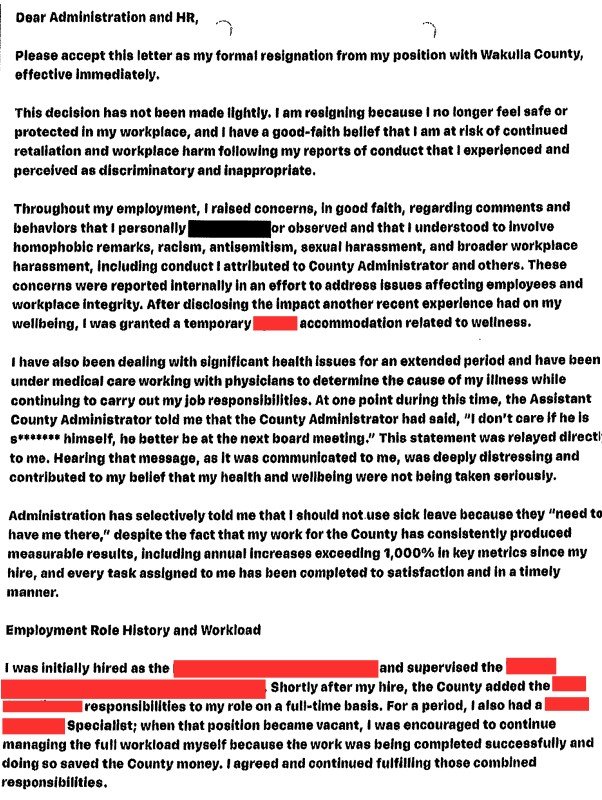
    Recently, Wakulla Reports obtained a resignation letter through a public records request that was initiated from multiple tips and citizen inquiry. The employee’s name and identifying details have been fully redacted to protect their privacy. What remains is a detailed account of workplace experiences that mirror the same issues the county has been settling for years.

    This is not about one employee. This is about a system that has not changed because it has never been required to.

    A Decade of Quiet Settlements

    Through the Florida Association of Counties Trust, Wakulla County has paid out numerous employment liability claims over the past decade. These include retaliation, discrimination, hostile work environment, wrongful termination, and whistleblower related disputes.

    These payouts are not rumors. They are documented in the Florida League of Cities (FACT) insurance records. A snippet of this record is below and can be obtained by emailing
    publicrecordsorl@flcities.com and asking for any public records provided to wakullareports@gmail.com since 06/01/2025.

    When you see the numbers lined up year after year, a clear truth emerges.

    The public was never told. The problems were never fixed. And the same issues keep resurfacing.

    Image from a public record or document discussed in this post: When Patterns Don’t Change: What a New Resignation Letter Reveals About Wakulla County’s Workplace Culture

    Updated from March 22, 2026 Public Records Request

    Image from a public record or document discussed in the section: Updated from March 22, 2026 Public Records Request

    What the New Resignation Letter Reveals

    The letter we received is redacted, as it should be. The goal is not to expose an individual. The goal is to expose a pattern.

    The employee describes raising discrimination and harassment concerns, then being placed back into situations involving the same individuals they had reported. They express fear that participating in employment related discussions under those conditions would not be fair or impartial. This echoes the same dynamics described in past cases the county quietly resolved.

    The letter also references discriminatory and inappropriate remarks, including homophobic comments, racist and antisemitic statements, sexual harassment, and unprofessional conduct by leadership. These concerns match the same types of allegations that have appeared in prior lawsuits the county resolved without explanation.

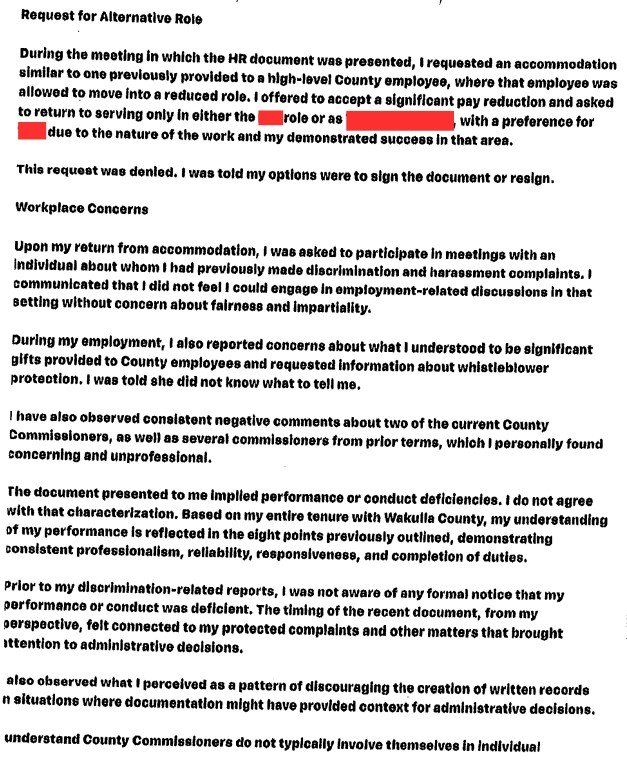
    Image from a public record or document discussed in the section: Updated from March 22, 2026 Public Records Request

    Another section describes being presented with an HR document implying performance issues, despite no prior notice of deficiencies. When the employee requested an alternative role, even offering to take a voluntary pay reduction, they were told their only options were to sign the document or resign. This mirrors past claims where sudden disciplinary actions followed protected complaints.

    The employee also reports concerns about what they understood to be significant gifts provided to certain county employees. They sought guidance about whistleblower protections and were told there was no clear answer. Questions about gifts, favoritism, and inconsistent standards have appeared in previous employment disputes, and the mention here reinforces a long running concern about ethics and fairness inside the administration.

    The letter includes a troubling account of comments made by the County Administrator that the employee found inappropriate and distressing. These comments contributed to an environment the employee describes as unprofessional and unsafe. Similar concerns about leadership behavior have surfaced in earlier cases that were settled quietly, and the repetition of this theme is significant.

    The employee also details selective enforcement of policies, including inconsistent application of sick leave rules. Selective enforcement is one of the most common indicators of retaliation, and it appears repeatedly in the county’s historical claims.

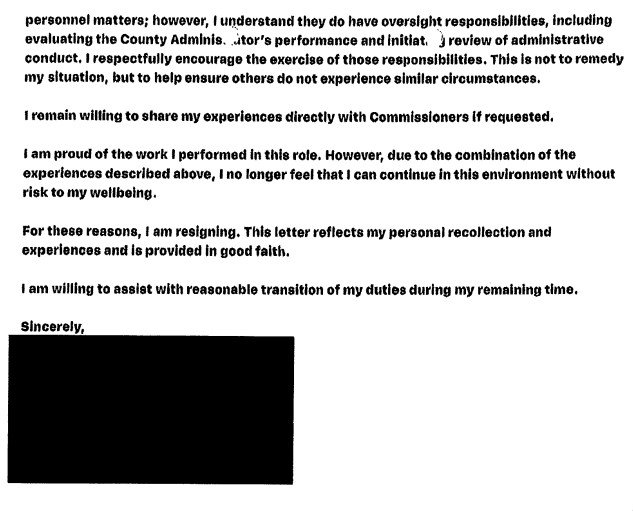
    One of the most concerning statements in the letter is the employee’s observation of a pattern of discouraging written records in situations where documentation would have provided context for administrative decisions. For a government agency, discouraging documentation is not just unprofessional. It undermines transparency, accountability, and public trust. And it helps explain why so many cases are settled quietly. The less that is written down, the less the public ever sees.

    Image from a public record or document discussed in the section: Updated from March 22, 2026 Public Records Request

    The letter ends with the employee stating they no longer felt they could continue working in the environment without risk to their wellbeing. This is not the language of someone leaving for a better opportunity. It is the language of someone who felt unsafe. And it is consistent with the emotional and psychological harm described in prior cases the county has settled.

    Image from a public record or document discussed in the section: Updated from March 22, 2026 Public Records Request

    A Pattern Confirmed by Sworn Testimony

    Some readers may find parts of this letter difficult to believe. That reaction is understandable. However, the concerns described here closely resemble statements made in sworn depositions from earlier employment law cases involving Wakulla County. Depositions are taken under oath, and employees testified to the same culture, the same communication style, and the same retaliatory dynamics. When you place this new letter alongside testimony that employees have already provided under oath, the pattern becomes impossible to ignore. Many of these depositions are available on the clerk of court website at https://www.civitekflorida.com/ocrs/county/65/ – you can search for Wakulla County or Wakulla County Board of County Commissioners. The records are voluminous and sometimes take some time to download.

    Why This Matters to the Public

    This is not about one employee’s experience. This is about taxpayer liability, administrative culture, oversight failures, and a decade of silence. When the same types of complaints appear again and again, and are resolved quietly, the public never gets the chance to demand change.

    Instead:

    • taxpayers pay the insurance premiums. The settlements increase risk for the insurance carrier and as such increases the insurance premiums that the taxpayers pay for.

    • employees pay with their health and careers

    • leadership remains unchanged

    The county has had more than ten years of opportunities to correct these issues. The documents show it has not.

    Oversight Is Not Interference. It Is a Responsibility.

    The letter ends with a reminder that County Commissioners have oversight duties, including evaluating the County Administrator’s performance and reviewing administrative conduct. The employee encourages commissioners to exercise those responsibilities, not to fix their situation, but to prevent others from experiencing the same. That alone speaks volumes.

    What Happens Next

    Wakulla Reports will continue to publish public records, document patterns, provide context, protect individuals, and shine light where it is needed. When you see the numbers next to the words in this letter, the pattern becomes impossible to ignore.

    Wakulla deserves a workplace culture rooted in professionalism, fairness, and accountability, not fear, retaliation, and silence.

    Sunlight is still the best disinfectant. And we intend to keep the lights on.

    We wish this former employee the best of luck in their future endeavors.

    Stay sharp, Wakulla!

  • Wakulla Left Behind: How FAC’s Lobbying Machine Dilutes Our Voice, With Outcomes from the 2026 Legislative Session

    Header image for the post: Wakulla Left Behind: How FAC’s Lobbying Machine Dilutes Our Voice, With Outcomes from the 2026 Legislative Session

    If you live in Wakulla and you are tired of watching growth swallow our rural character, septic‑to‑sewer costs climb, roads fill with traffic, and state laws override decisions made by our own commissioners, you have probably crossed paths with the Florida Association of Counties, known as FAC.

    FAC is the statewide lobbying group that claims to speak for all 67 counties, including ours. Each year they publish a Legislative Action Plan outlining what they want the Legislature to do. They often ask for more funding, rule changes that benefit counties, and occasionally a measure that protects local authority.

    Here is the part that matters for Wakulla. The way FAC decides what goes on that list is not nearly as democratic or representative as it sounds. Their process concentrates influence inside a small circle of insiders. That means rural counties like ours can end up tied to statewide lobbying positions we did not drive, did not fully debate, and sometimes do not agree with.

    How FAC Actually Chooses Its Priorities

    FAC describes its process as thoughtful and consensus‑based. In practice, it works like this:

    • Issues are divided into policy committees covering water, environmental rules, finance, taxation, community affairs, public safety, and more.

    • The FAC President for the year, currently Commissioner Michelle Lincoln of Monroe County for 2025 to 2026, appoints the Chair and Vice Chairs for each committee.

    • Those appointees, along with a small group of volunteer Policy Leaders, are the only people who vote on proposals.

    • County staff and non‑committee commissioners may attend and speak, but they do not vote.

    • Proposals are shaped and approved inside the committees, then sent to FAC’s annual Legislative Conference for a final vote.

    By the time that final vote happens, the direction is already set by the presidential appointees and the volunteer leaders.

    Why this creates problems for Wakulla

    • No Wakulla commissioner currently serves as a Chair or Vice Chair on any recent FAC committees.

    • We do have Policy Leaders. Commissioner Quincee Messersmith serves on the Community and Urban Affairs committee, and Commissioner Ralph Thomas serves on the Future Technology committee. Policy Leaders, however, do not control the agenda.

    • If our commissioners’ priorities, such as resisting forced density or strengthening biosolids protections, do not match the priorities of the appointees, our concerns can be softened or sidelined before most counties ever see the proposals.

    • Once FAC adopts a position, it speaks for all 67 counties, including Wakulla, whether our delegation supported that position or not.

    This centralized structure is the core issue. Instead of Wakulla advocating directly for Wakulla, our message is filtered through FAC’s inner circle and reshaped into a statewide compromise. That is how rural counties get boxed into policies that benefit larger or more urban counties. It is also how we end up defending positions we never asked for.

    How FAC’s 2026 Agenda Fared in Tallahassee

    The 2026 regular session adjourned on March 13 without a state budget. This is the second year in a row lawmakers failed to complete their most basic duty. Special sessions are scheduled for April to address the budget and congressional redistricting.

    FAC’s priorities saw mixed results:

    • Local opt‑outs for “missing middle” housing tax breaks:
      HB 1389 passed with adjustments. Opt‑out thresholds were raised, some prior projects were protected, mandates expanded on certain lands, and accessory dwelling unit requirements were removed.

    • Biosolids protections:
      Discussed, but not meaningfully strengthened for rural communities.

    • Fiscally constrained county funding:
      Possible minor tweaks, but nothing that offsets the loss of local control.

    The overall pattern is clear. FAC secured a few small revenue wins, but on issues tied to local authority, especially growth and housing, the session delivered compromises or setbacks. For residents who value Wakulla’s rural pace, springs protection, and community identity, that is not good news.

    Why This Matters for Wakulla

    The deeper issue is not the individual bills. It is the structure that allows a small group of FAC insiders to set the agenda for all 67 counties.

    When that agenda does not reflect Wakulla’s needs, we get pulled into statewide compromises that:

    • weaken our ability to manage growth

    • reduce protections for our springs

    • erode our rural character

    • limit our commissioners’ independence

    Future digging into FAC leadership patterns, committee appointments, and recurring influencers could reveal whether the process consistently favors urban priorities, revenue‑first strategies, or trade‑offs that cost rural counties more than they gain. Wakulla taxpayers deserve to see that clearly.

    What You Can Do Right Now

    Special sessions are approaching. Your voice still matters.

    Tell your representatives you want:

    • strong local opt‑outs for housing density mandates

    • tough biosolids restrictions near homes and recharge areas

    • no more state overrides that force growth we cannot support

    State Senator Corey Simon, District 3
    Email: simon.corey.web@flsenate.gov
    Capitol Phone: (850) 487‑5003
    Fax: (850) 487‑5086
    Address: 303 Senate Building, 404 South Monroe Street, Tallahassee, FL 32399‑1100

    State Representative Jason Shoaf, District 7
    Email: jason.shoaf@flhouse.gov
    Capitol Phone: (850) 717‑5007
    District Phone: (850) 295‑5680
    Address: 222 The Capitol, 402 South Monroe Street, Tallahassee, FL 32399‑1300

    A simple message works:

    “I am a Wakulla County resident. Please fight to keep local control over housing density and growth in any special sessions or future bills. Protect our rural way of life and our springs.”

    The regular session may be over, but the decisions that shape Wakulla’s future are still in motion. Your voice can still shift the outcome.

  • Wakulla County’s Facebook Comment Shutdown: Who Decided – and Was It Allowed? 📣

    Header image for the post: Wakulla County’s Facebook Comment Shutdown: Who Decided - and Was It Allowed? 📣

    In early January 2026, Wakulla County residents began noticing something strange on the county’s official Facebook pages: comments had quietly disappeared. Posts announcing Board of County Commissioners (BOCC) meetings, livestreams, and updates from departments like Library Services, Fire Rescue, and Recreation all shifted to one‑way communication overnight.

    A public records request has now revealed exactly how this happened.

    On January 6, 2026, Public Information Officer Kinsey Miller sent an internal email titled “URGENT FACEBOOK DIRECTIVE.” The message instructed every department to permanently disable comments on all county‑owned Facebook pages and livestreams. The email states plainly:

    “The County Administrator has directed departments… This is a permanent transition.”

    Departments were told to:

    • Turn off comments on every new post

    • Disable comments on all Facebook Live events

    • Unfollow all other accounts (including other county pages) to prevent cross‑commenting

    • Replace their pinned disclaimers with new language declaring the page “one‑way communication only”

    This wasn’t a technical adjustment. It was a county‑wide policy shift — implemented internally, without a BOCC vote, workshop, or public discussion.

    So the question becomes: Did the County Administrator actually have the authority to do this? 🧐

    To answer that, we look at the three governing sources: Florida Statute § 125.74, the Wakulla County Home Rule Charter, and Administrative Regulation (AR) 1.08.

    1. Florida Statute § 125.74: The Administrator Executes Policy — He Doesn’t Create It

    Florida law draws a bright line between policymaking and administration.

    • §125.74(1)(a): The administrator must “administer and carry out the directives and policies of the board.”
      That means implementing BOCC decisions — not inventing new ones.

    • §125.74(2): The Legislature’s intent is explicit:
      Policymaking stays with the BOCC.
      The administrator gets only administrative and executive powers.

    The statute lists duties like budgeting, personnel management, and property oversight.
    Nothing authorizes the administrator to restrict public speech or redefine how residents can interact with BOCC communications.

    A permanent, county‑wide comment ban — especially on BOCC meeting livestreams — is not “administration.” It is a policy decision.

    And under Florida Statutes, policy decisions belong to the elected board.

    2. Wakulla County Home Rule Charter: Separation of Powers by Design

    The Charter is even clearer.

    • Article 1, Sec. 1.6:
      “The establishment and adoption of policy shall be the responsibility of the board of county commissioners…”

    • Article 3, Sec. 3.3:
      The administrator manages operations and executes BOCC policy.
      No authority is granted to restrict public participation or alter communication channels.

    • Article 2, Sec. 2.7:
      The BOCC holds all legislative authority.

    • Article 2, Sec. 2.9:
      The BOCC adopts the Administrative Code — not the administrator.

    A permanent shift to one‑way communication on official platforms is a policy change, not an operational tweak.
    The Charter reserves that power for the BOCC alone.

    3. AR 1.08 (2017): Operational Guidance, Not a County‑Wide Mandate

    Administrative Regulation 1.08 governs social media use.

    • Sec. E.4:
      Page Administrators may allow two‑way communication at their discretion.
      This is per‑page flexibility – not a blanket rule.

    • Secs. C & D:
      Only authorized employees may manage pages, but their authority is operational, not legislative.

    • Purpose statement:
      Social media exists to “disseminate information and increase public awareness.”

    Nothing in AR 1.08 authorizes:

    • A county‑wide, permanent comment ban

    • Forced disclaimer changes

    • Prohibiting pages from following other accounts

    • A top‑down directive from the administrator

    The regulation gives limited operational discretion, not policymaking power.

    The Gray Area: “Act First, Ask Forgiveness Later” ⚠️

    Here’s the dynamic the email exposes:

    1. The administrator issues a directive internally.

    2. Departments implement it immediately.

    3. The public loses access overnight.

    4. The BOCC is never informed.

    5. The burden shifts to residents to notice, object, or challenge it.

    This is how de facto policy gets created without ever going through the proper channels.

    It’s not illegal because it’s forbidden.
    It’s questionable because it’s not authorized.

    Why This Matters – Especially for Residents Who Rely on Accessibility

    Turning off comments isn’t a minor change. For many residents, Facebook comments are:

    • The only accessible way to ask questions

    • A real‑time method to engage with BOCC meetings

    • A substitute for in‑person attendance

    • A way to participate without mobility, transportation, or verbal communication barriers

    Email and phone calls exist, but they lack visibility, immediacy, and community dialogue.

    When the county promotes Facebook as a tool for public awareness but then disables public input – especially on meeting livestreams – it raises serious concerns about transparency and accessibility.

    Where the BOCC Can Step In

    If commissioners choose to address this, they could:

    • Place the issue on a future agenda

    • Direct the administrator to restore comments on meeting‑related posts

    • Amend AR 1.08 to require BOCC approval for major changes to public engagement

    Local government works best when residents can see, speak, and participate.
    When communication tools change without public input — especially in ways that limit voices — it’s worth asking questions.

  • When Voters Choose Nonpartisan — and Still Lose the Choice: Wakulla’s Long Fight to Keep Politics Local

    Header image for the post: When Voters Choose Nonpartisan — and Still Lose the Choice: Wakulla’s Long Fight to Keep Politics Local

    For nearly two decades, Wakulla County voters have made one message unmistakably clear: local elections should be nonpartisan. Not because party labels are inherently bad, but because local governance works best when neighbors choose leaders based on qualifications, character, and community needs — not national political branding. While you may not agree with non-partisan elections (which is perfectly fine) the background story as to how Wakulla County (and the state) went to from non-partisan to partisan elections.

    Despite two voter approvals and a third vote rejecting repeal, Wakulla’s nonpartisan system was ultimately swept aside by forces far outside the county’s control. This is the story of how it happened, why it matters, and what it reveals about the tension between local choice and statewide preemption.

    A Voter‑Approved Tradition: 2008 and 2014

    Wakulla County adopted its Home Rule Charter on November 4, 2008. Included in that charter was a simple but powerful idea: key county offices should be elected without party labels. The goal was to keep local races focused on local issues.

    Voters reaffirmed this vision in 2014. Through a charter amendment (Ordinance No. 2014‑07), they expanded nonpartisan elections to all elected county officials:

    • County Commissioners

    • Clerk of Court

    • Property Appraiser

    • Sheriff

    • Supervisor of Elections

    • Tax Collector

    The ballot language emphasized elections “through nonpartisan elections instead of one indicating a political party affiliation.”

    Two separate elections. Two clear mandates.
    For more than a decade, Wakulla operated under a voter‑endorsed nonpartisan system.

    The 2016 FEC Complaint: A Warning Sign in the System

    The first cracks appeared in 2016.

    Commissioner Ralph Thomas — an incumbent and former chair of the local Republican Executive Committee — spoke at a WCREC‑hosted candidate forum. The event had Republican signage, but Thomas did not declare his party, distribute partisan materials, or campaign on party lines.

    Still, a complaint was filed: Florida Elections Commission Case No. 16‑350.
    It alleged that Thomas violated §106.143(3), F.S., which restricts nonpartisan candidates from using party affiliation in campaigning.

    Thomas defended himself by arguing:

    • The statute applied to advertisements, not spoken remarks.

    • No advertisement existed.

    • No Chapter 104 violation was alleged.

    • Precedent allowed attending partisan events, receiving endorsements, and accepting contributions.

    A probable cause hearing was scheduled for August 16, 2017.

    The public records received by Wakulla Reports did not include any final order, sanction, or documented resolution. It is possible additional materials exist elsewhere, but nothing provided to us showed a conclusive outcome.

    The case simply faded from the available record — a common fate for borderline complaints — but it revealed something important:

    Nonpartisan rules can create legal gray areas, defense costs, and opportunities for political weaponization, even when candidates follow the rules.

    Thomas is now in his fourth term and ran uncontested twice. Ironically, he later supported efforts to repeal the very nonpartisan provision that once entangled him.

    The Turning Point: Orange County v. Singh (2019) ⚖️

    The real shift came not from Wakulla voters, but from the Florida Supreme Court.

    In Orange County v. Singh (2019), the Court held that the Florida Election Code — especially §97.0115’s preemption clause — overrides charter‑mandated nonpartisan elections for constitutional officers. The ruling emphasized statewide uniformity in elections.

    Although the case focused on constitutional officers (like sheriff and clerk), counties across Florida, including Wakulla, applied the logic broadly. Because commissioners share many election statutes with constitutional officers, the ruling cast doubt on whether nonpartisan elections for commissioners could survive.

    This was not a legislative change.
    Not a statewide vote.
    Not a local vote.

    It was a judicial decision that effectively overrode local charters — including Wakulla’s — without direct voter input.

    2020: Voters Say No to Partisan Elections — But Partisan Elections Happen Anyway

    Citing Singh, the BOCC placed a referendum on the March 17, 2020 Presidential Preference Primary ballot:

    Should Wakulla repeal Section 7.6 and allow partisan elections for all county offices?

    Results (certified):

    • Yes: 2,627 (48.06%)

    • No: 2,839 (51.94%)

    • Undervotes: 339

    • Total votes: ~5,466 (out of ~21,600 registered voters)

    Voters rejected the repeal.
    The nonpartisan provision technically survived.

    But in practice:

    • Singh forced constitutional officers into partisan elections.

    • The Supervisor of Elections initially planned to keep commissioners nonpartisan.

    • The BOCC filed Case No. 2020‑CA‑43 against Supervisor Henry Wells, seeking a court order to force partisan commissioner races.

    No final order appears in the public records available to Wakulla Reports. The case likely became moot or resolved informally as the 2020 election cycle proceeded with partisan qualifying, primaries, and general elections.

    By the end of 2020, all Wakulla offices were effectively partisan, despite the voters’ decision.

    From “Pick a Seat” to “Pick a Side” 🎭

    Wakulla voters chose nonpartisan in 2008.
    They reaffirmed it in 2014.
    They rejected repeal in 2020.

    Yet the system shifted anyway — driven by judicial preemption and legal pressure rather than local will.

    This stands in contrast to 2024, when Florida voters statewide rejected Amendment 1, preserving nonpartisan school board elections.

    In Wakulla, the shift to partisan elections has had predictable effects:

    • Local races now mirror national political divides.

    • Incumbents gain structural advantages through party support.

    • Independent or cross‑aisle challengers face higher barriers.

    • Voters are nudged toward choosing a color, not a candidate.

    This is how communities get separated:
    Not by local issues, but by national labels that have little to do with county roads, land use, emergency services, or fiscal stewardship.

    Local government works best when residents evaluate people — not parties.
    That’s why Wakulla Reports encourages readers to leave partisan hats at the door. The future of your community depends on cooperation, not color‑coded teams.

    A Turning Point for Local Control

    When voters speak three times — and still lose the system they chose — it raises real questions about how much influence local communities retain over their own election structures.

    Wakulla’s story is not unique.
    But it is a powerful reminder:

    Local choices matter. And so does paying attention when those choices are overridden.

    Stay sharp, Wakulla. 👀

  • How the Florida Association of Counties (FAC) and the Small County Coalition (SCC) Are Funded

    Header image for the post: How the Florida Association of Counties (FAC) and the Small County Coalition (SCC) Are Funded
    a group of people walking down a sidewalk

    If you want to understand why county associations fight so aggressively against property tax reform, you have to understand how they are funded. These organizations present themselves as neutral, educational, or supportive bodies that “help counties serve residents.” But their financial structure tells a very different story.

    Here’s the short version:

    The Florida Association of Counties (FAC) and the Small County Coalition (SCC) are funded by taxpayers — indirectly, but unmistakably.

    And that funding is used to influence state policy in ways that often protect county revenue, not taxpayers.

    Below is a clear breakdown of how the system works.

    1. Counties Pay Membership Dues Using Public Money

    Every county in Florida pays annual dues to the Florida Association of Counties.

    These dues are not symbolic. They are:

    • budgeted

    • approved

    • paid out of county operating funds

    And those operating funds come from taxpayers.

    The same is true for the Small County Coalition.

    Small counties pay dues using public money, and participation is treated as a standard county expense – not an optional one.

    In other words:

    Taxpayers fund counties → counties fund FAC and SCC.

    2. Those Dues Fund Lobbyists

    FAC and SCC use membership dues to operate as full‑scale political advocacy organizations. Their activities include:

    • hiring lobbyists

    • running legislative advocacy programs

    • producing policy papers

    • organizing political strategy

    • influencing state legislation

    These lobbyists are not elected by the public.

    They are not accountable to voters.

    Yet they speak in Tallahassee as if they represent “local government.”

    In reality, they represent county governments, not residents.

    3. Counties Use Taxpayer Dollars to Lobby Against Taxpayer Interests

    This is the part most people never see.

    When FAC or SCC lobby against property tax elimination or other state‑level reforms, they are:

    • using taxpayer money

    • to lobby the Legislature

    • to protect county revenue

    • against the interests of taxpayers who want relief

    It creates a closed loop:

    1. Taxpayers fund counties

    2. Counties fund FAC and SCC

    3. FAC and SCC fund lobbyists

    4. Lobbyists fight to preserve county revenue

    5. Taxpayers have no direct say in any of it

    This is why county associations push “home rule” so aggressively.

    It’s not about local empowerment.

    It’s about protecting the revenue streams that fund their organizations.

    4. FAC and SCC Also Generate Revenue Through Conferences, Trainings, and Sponsorships

    Beyond dues, these associations run a lucrative ecosystem of:

    • conferences

    • trainings

    • workshops

    • vendor expos

    • sponsorship packages

    These events are:

    • attended by county officials

    • paid for with county funds

    • sponsored by vendors who want county contracts

    This creates a self‑reinforcing cycle:

    • counties pay associations

    • associations host events

    • vendors pay associations

    • vendors gain access to county officials

    • counties award contracts

    • the cycle repeats

    It is not illegal.

    But it is absolutely political.

    And it blurs the line between public service and institutional self‑preservation.

    5. The Public Is Not Told Any of This

    County associations present themselves as:

    • educational

    • supportive

    • collaborative

    • non‑political

    But their core function is political advocacy.

    And their funding comes from the very taxpayers whose interests they sometimes lobby against.

    Most residents have no idea that:

    • their county pays dues

    • those dues fund lobbyists

    • those lobbyists influence state tax policy

    • and those positions may conflict with taxpayer priorities

    The result is a system where county governments — through their associations — can exert significant influence in Tallahassee without direct voter oversight.

    Why This Matters

    When FAC or SCC oppose property tax elimination, they are not necessarily speaking for residents.

    They are speaking for county governments — and for the revenue streams that sustain their organizations.

    Understanding how these associations are funded is the first step in understanding why they take the positions they do.

    Sunlight is the second step — and this is where things get muddy.

    Despite being funded with public dollars, the Florida Association of Counties is not subject to Florida’s public records laws. FAC is structured as a private nonprofit, which means residents cannot request:

    • financial records

    • lobbying expenditures

    • communications with legislators

    • internal strategy documents

    • vendor sponsorship agreements

    • conference revenue details

    In other words, taxpayers fund the organization, but taxpayers cannot see how the organization uses that money.

    This lack of transparency makes it nearly impossible for the public to fully understand how much influence FAC and SCC exert in Tallahassee, or how taxpayer‑funded dues are being deployed to shape state policy.

    Share with your friends all across the state and, as always, stay sharp, Wakulla!

  • A Sheriff’s Office Exposed? Major Dale Evans Questions Newsome’s Arrest and a Reserve Deputy Twist

    Header image for the post: A Sheriff’s Office Exposed? Major Dale Evans Questions Newsome’s Arrest and a Reserve Deputy Twist

    Author Note: for the public records surrounding this article, please reach out to the Wakulla County Sheriff’s Office Public Records Custodian. Wakulla Reports has reviewed the records provided by Major Evans but due to potential pending claims, we are unable to share those at this time. All information used for this article, and part 1 are available to the general public upon request. Please use the referenced dates of emails and report ID numbers to narrow your search for the custodian.

    In Part 1, Wakulla Reports introduced Major Dale Evans’ allegations of misconduct and retaliation within the Wakulla County Sheriff’s Office (WCSO), spotlighting the 2024 arrests of Commissioner Mike Kemp, Deputy Newsome, and R. Whaley for a doxxing scandal tied to “Thunder Lightening.” Now, in Part 2, we dive deeper into Evans’ claims, exposing a questionable investigation against him, a bombshell revelation that Kemp was a WCSO Reserve Deputy during the incident, and serious question about Newsome’s arrest for sharing information. We ask again: Why was Commissioner Ralph Thomas, who provided key data for the doxxing, never questioned? Wakulla Reports does not endorse the views of Evans or the WCSO; we’re giving this veteran deputy a voice to demand accountability. Backed by emails and a 2017 DOJ report, this story challenges our county’s leadership. Let’s finish unraveling the details.

    A “Witch Hunt” Against Evans

    In August 2024, Evans faced a WCSO investigation, detailed in report WCSO24OFF002379. On August 25, Captain Surace directed Detective Ormerod to investigate allegations that Evans was improperly sharing information about an Internal Affairs probe into a deputy’s firing for misusing NCIC/FCIC, citing Florida Statute 815 (Florida Computer Crimes Act). Ormerod’s report notes that FS 815, which covers unauthorized computer access or fraud, didn’t apply, as WiFi use alone isn’t a violation. Assistant State Attorney Deneen found no criminal violations, deeming issues administrative. The probe also cited Florida Statute 112.533, ruled unconstitutional in Cooper v. Dillon (2005) for restricting officer speech, undermining its basis.

    Evans argues this seemingly frivolous investigation was meant to intimidate him for his 2023 complaints. The report focused on potential HR or legal consequences, not internal affairs details, suggesting a pretext to discipline him. He received a written verbal counseling, which he says damaged his reputation, violating his First Amendment rights (Cooper v. Dillon), Fourth Amendment rights (unlawful subpoenas), and Fourteenth Amendment rights (no due process).

    Link to Council of the Inspectors General Quality Standards for Investigations

    Ormerod’s Troubled History

    Evans questions Ormerod’s credibility, pointing to his time at the Tallahassee Police Department. In 2013, TPD investigated a DUI arrest involving excessive force, as reported by WFSU. The incident led to a 2014 settlement where the City of Tallahassee paid the victim, Christina West, $475,000 to avoid trial. Evans claims this reflects Ormerod’s pattern of producing inaccurate reports, a concern echoed in the 2024 doxxing case and his own investigation, where he believes Ormerod falsified details to target him.

    The Reserve Deputy Surprise and Newsome’s Arrest

    A critical twist emerged in the 2024 doxxing case. An October 22, 2024, email from Major Deal to Deputy Newsome confirms that Mike Kemp was a WCSO Reserve Deputy during the incident, as verified by HR. Newsome was charged under Florida Statute 815.06(2)(a) for exceeding database authority by providing Kemp with a complainant’s name from a March 28, 2024, traffic incident. Newsome told Deal he believed he was doing a “low-end favor” for Kemp, a fellow law enforcement officer, not violating policy. He also raised concerns that Ormerod’s report falsely claimed “text messages and phone calls” between him and Kemp, which he says don’t exist, suggesting a deliberate effort to mislead the State Attorney and judge.

    This raises a burning question: Was Newsome wrongly arrested for sharing information with Kemp, a Reserve Deputy, as part of his job? Reserve Deputies in Wakulla County, per the WCSO website, are sworn officers who meet the same qualifications as full-time deputies, including background checks and training. It’s not uncommon in rural counties for community members, even elected officials, to serve in such roles to bolster resources. However, a commissioner holding this position raises potential conflicts, especially when accessing law enforcement resources for personal or political purposes. If Kemp was authorized to receive the information, Newsome’s actions may have been routine. Why, then, was Newsome charged, and why was Kemp’s Reserve Deputy status not scrutinized? The failure to question Ralph Thomas, who provided the WebElect data that fueled the doxxing, only deepens the suspicion of selective enforcement.

    Intimidation Tactics

    By 2025, Evans’ fears intensified. On July 16, 2025, he emailed Lamarche, reporting that Ormerod and Sauls drove slowly by his house at 12:45 PM, with no active calls, unsettling his wife. He called it “gangster moves” and sought documentation, receiving only an EAP (employee assistance program) referral. Colonel Johnson responded on July 18, dismissing the complaint, citing Ormerod’s nearby residence. Evans countered that Ormerod’s travel pattern was abnormal and no GPS checks or interviews were conducted, calling the response biased. On August 8, he requested swapping Whaley and Johnson’s positions, citing Whaley’s “vendetta” for exposing his “negligence and criminal misconduct” and closed-door meetings with Ormerod and Surace. On August 10, he reported Ormerod’s parents taking photos of his home, labeling it stalking. HR never responded, deepening his distrust.

    Whaley’s Checkered Past

    Evans ties Whaley’s actions to a 2017 DOJ OIG report, which criticized Whaley, then DEA Acting Chief Inspector, for improperly overruling a security clearance suspension for an agent who committed serious misconduct. The OIG found Whaley lacked authority and expertise, showing “poor judgment and leadership.” Evans alleges Whaley’s WCSO tenure mirrors this, citing a 2018 incident where Whaley asked the DEA to overlook excessive overtime by two detectives and a 2024 threat: “Be careful, you’re on DROP now.” Evans also claims Whaley dismissed a colleague’s transfer with, “FDLE can’t bail you out this time.”

    A Personal Toll

    Evans says the stress of retaliation, compounded by a Parkinson’s diagnosis, forced him into the DROP program on July 1, 2024, costing him over $1 million in retirement benefits. He required medication and an ADA accommodation for fatigue. He alleges a coworker suggested he be fired as a “liability” due to his condition, deepening his sense of persecution. Evans claims Miller and Whaley lead a “personal hit squad” with several others joining forces, targeting critics like Kemp, Newsome, and himself. He’s reported issues to FDLE, the Florida Ethics Commission, and the State Attorney’s Office, but no public action has yet emerged.

    Link to Part 2

  • A Sheriff’s Office Under Fire? Major Dale Evans Exposes Alleged Misconduct and Retaliation

    Header image for the post: A Sheriff’s Office Under Fire? Major Dale Evans Exposes Alleged Misconduct and Retaliation

    Wakulla Reports is a voice on the Forgotten Coast, shining a light on stories that demand to be heard. Today, we stand with Major Dale Evans, a veteran of the Wakulla County Sheriff’s Office (WCSO), who alleges a shocking pattern of misconduct, retaliation, and abuse of power by Sheriff Miller, Colonel Whaley, and several other WCSO staff members. Wakulla Reports does not endorse the views of Evans or the WCSO; we’re giving this dedicated deputy a platform to demand accountability. Backed by emails, a 2017 DOJ report, and a 2024 arrest scandal involving Commissioner Mike Kemp and Deputy Newsome, Evans’ claims expose a Sheriff’s Office in crisis. This is Part 1 of a two-part series, tying Evans’ fight to a broader web of dissent in Wakulla County. Stay with us as we unravel the details—and ask why Commissioner Ralph Thomas was never questioned in a high-profile case.

    A Veteran’s Stand Against a Toxic System

    Major Dale Evans, a decades-long WCSO veteran in the Special Operations Division, has come forward with allegations of a hostile workplace, retaliation, and systemic misconduct from 2023 to 2025, forcing him into early retirement and costing him over $1 million in benefits. His claims, detailed in letters and emails, accuse Sheriff Miller and his inner circle of targeting critics and protecting selective insiders. A 2017 DOJ report on Whaley’s past and a 2024 arrest scandal fuel Evans’ narrative, set against Wakulla County’s growing unrest over governance. This first part dives into Evans’ allegations and the arrests that shook our community.

    2023: A Toxic Workplace Under Sheriff Miller

    In 2023, while working in the WCSO Administration building, Evans claims Sheriff Miller verbally abused employees and made inappropriate comments to female staff. One alleged incident involved Miller instructing an assistant to wear a revealing outfit for a public event, leaving her humiliated. Another saw Miller berating an employee with derogatory insults about their family, threatening financial ruin. Evans says these outbursts were so severe that senior officers locked administration doors to hide them. Multiple employees, including senior staff, reportedly witnessed or experienced this behavior.

    On February 7, 2023, Evans filed a formal complaint with HR Director Lamarche, claiming whistleblower status under WCSO policy. He says Miller met with him, promised to stop, and committed to a harassment-free workplace. But Evans alleges this was a facade, setting the stage for retaliation.

    Retaliation Begins: A Second Complaint

    By March 3, 2023, Evans claims Miller turned on him. In an email to Lamarche, cc’d to Undersheriff Jones, he wrote: “Since that meeting, [Miller] has personally started retaliating towards me, telling employees and non-employees he has not forgot and he is going to get me (which is documented and already have sworn statements from several individuals).” He alleges Miller told Major Johnson, an African American officer with over 20 years of shared history with Evans, that Evans was a “racist” and untrustworthy. Evans called this “tortious interference with employment,” saying it damaged his reputation and created a hostile environment where he felt like he was “walking on eggshells.” He filed a federal EEOC complaint and added this as a second complaint to his original.

    Evans says an internal investigation “sustained” his accusations, with Jones approving the findings. Miller apologized, claiming the complaints made him a “better person,” but Evans says the retaliation only grew.

    2024: A Political Vendetta and Arrests

    In 2024, Evans alleges the retaliation targeted his allies, particularly former WCSO Major Mike Kemp, then a County Commissioner. Evans claims Miller stated that “he had something for him (Kemp) and that corrupt ass David Edwards”, with several other officers discussing plans to purge the “old Wakulla” guard, including Evans and Kemp. When Evans solved a vandalism case tied to Kemp’s campaign signs in August 2024, he says these officers were furious, accusing Kemp of “weaponizing” the WCSO.

    On August 30, 2024, WCTV reported the arrests of Mike Kemp, Deputy Newsome, and R. Whaley, a citizen and then admin of a well-known community page (not to be confused with Colonel Whaley) for a doxxing incident targeting an innocent resident mistaken for “Thunder Lightening,” an anonymous Facebook critic, who criticized Kemp, Commissioner Ralph Thomas, and R. Whaley’s political and community stances. On May 6, 2024, R. Whaley posted a WebElect voter printout (name, DOB, address, voter ID, party affiliation) on the “Wakulla Citizens” page, sourced from Kemp via Commissioner Ralph Thomas. A text from R. Whaley to Kemp read, “Tell me that Thunder guy’s real name about to bust him out.” Newsome allegedly misused a law enforcement database to tip Kemp off about a complaint. Charges included criminal use of personal identification to harass (Kemp, R. Whaley), witness tampering (Kemp), and database misuse (Newsome). Body cam footage captured Kemp driving by the victim’s home during the complaint response. Arraignments were delayed to January 9, 2025, with State Attorney Jack Campbell citing election timing concerns. Kemp lost his re-election bid to Valerie Russell, in August 2024.

    Evans accuses Ormerod of falsifying the arrest report and deliberately bypassing an interview with Ralph Thomas—a figure who could have shed critical light on the case. Despite being the source of the voter data that fueled the doxxing, Thomas was never questioned. His absence from the investigation raises a glaring question: Why was a central player (page 70 of the report) left untouched? The silence speaks volumes, hinting at selective scrutiny in a case that rattled Wakulla County.

    What’s Next?

    Evans’ story is only half-told. In Part 2, we’ll dive into a questionable 2024 investigation targeting Evans, a shocking revelation about Kemp’s Reserve Deputy status, and the troubling arrest of Newsome for actions that may have been part of his job. We’ll ask again: Why was Ralph Thomas never questioned despite being listed as a principal person of interest (page 70 in the final report) in the investigation? Stay tuned as we unravel the rest of this saga.

    Link to Part 2

    Author’s note: Wakulla Reports has reviewed the emails and documentation provided by Major Evans. To protect the integrity of any potential pending legal claims we are not publishing the records. You may request the records from WCSO using the dates and other information provided in Parts 1 and 2 of this blog.

  • Wakulla County Worker Bees: We See You, We Hear You

    Header image for the post: Wakulla County Worker Bees: We See You, We Hear You

    To the dedicated county employees of Wakulla County: our community sees you. You’re the ones keeping our coastal home thriving—processing permits at the clerk’s office, staffing our libraries, maintaining our parks, and ensuring our elections run smoothly. You’re the heartbeat of Wakulla, preserving our springs, beaches, and small-town charm with quiet pride. From all of us—taxpayers, residents, and neighbors—thank you. Your hard work is the foundation of our community, and it deserves to be celebrated.

    But your efforts are being overshadowed by the Wakulla County Board of County Commissioners (BOCC) and top administrators, whose self-interest and mismanagement drain our trust and resources. This isn’t about you, the workers who serve with heart. It’s about a leadership culture that wastes taxpayer dollars, rewards insiders, and settles countless employee lawsuits without a fight—only to carry on with the same old song and dance.

    County Employees: Wakulla’s True Strength
    You, the county workers, are the backbone of our community. Whether you’re helping a resident navigate a government process, clearing roads after a storm, or safeguarding our votes, your work matters. These aren’t just jobs—they’re the threads that hold Wakulla together. You live here, raise families here, and understand what makes our county special. Every time you go above and beyond, you build trust and strengthen our community’s spirit. Your local knowledge and commitment are Wakulla’s greatest assets.

    The Top Brass: Wasting Taxpayer Dollars, Dodging Accountability
    So why does Wakulla County government often feel like it’s falling short? The answer lies with the BOCC and top administrators, who prioritize their own agendas over the community’s needs. Instead of empowering the workers who know Wakulla best, they waste taxpayer money on outside consultants—often from beyond our county—ignoring the expertise right here at home. Your voices, the ones that could guide smarter decisions, are sidelined in favor of outsiders with no stake in our future.

    Then there’s the cronyism. It’s not always outright illegal—carefully skirting Florida’s statutes—but it’s felt across the county. Family ties and insider connections too often influence hiring and promotions, leaving hardworking employees questioning whether merit matters as much as who you know. This undermines morale and erodes trust, a direct result of leadership that values loyalty to the inner circle over loyalty to Wakulla.

    Most troubling is the BOCC’s habit of settling employee civil suits with taxpayer money (if you want to know how that works, check out this blog: . Over the past 15 years, Wakulla County has faced numerous lawsuits tied to workplace disputes—claims of unfair treatment, retaliation, and other grievances. These cases point to a pattern: a leadership culture that fails to support its workers, fostering environments where employees feel undervalued or silenced. Instead of addressing these issues or defending their practices, the county quietly settles, shelling out millions in taxpayer dollars without a fight. Then it’s business as usual—no changes, no accountability, just the same processes and the same leadership failures. Our community isn’t interested in the day-to-day grind of county operations; we want to know how the top dogs spend our bucks—and why they keep paying for their mistakes with our money.

    The idea of DOGE—smart, efficient government—could transform Wakulla. Not as a buzzword, but as a practical solution: a county that cuts waste, trusts its workers, and spends taxpayer money wisely. Imagine a Wakulla where your expertise is valued, your departments are fully staffed, and your leaders listen to you instead of hiring outsiders. That’s the government our community deserves, but it’s out of reach when the BOCC and administrators cling to wasteful habits and protect their own interests.

    The Problem Is Leadership, Not Workers
    Let’s be clear: Wakulla’s challenges aren’t because of county employees. You’re the solution, not the problem. The issue lies with the top brass—leaders who waste taxpayer money on consultants, let cronyism fester, and settle lawsuits without fixing the root causes. When the BOCC and administrators fail to lead with integrity, you’re left picking up the pieces—handling frustrated residents, understaffed offices, and the fallout of their mismanagement. Our community’s frustration isn’t with your work; it’s with a leadership culture that puts itself first and pushes you aside.

    A Call to Celebrate Wakulla’s Workers
    This message is for you, the Wakulla County employees who make our community better every day. Our community stands with you, celebrating your dedication and calling out the BOCC for failing you. It’s time for the BOCC and administrators to stop wasting our tax dollars on outside consultants and lawsuit settlements. End the cronyism that undermines fairness. Invest in our workers—value their expertise, hire enough staff, and create a workplace where speaking up is welcomed, not punished.

    To county employees: Keep shining. Your work keeps Wakulla’s springs clear, our beaches inviting, and our community proud. You’re the heart of this county, and your efforts outshine the failures of those above you.

    To taxpayers: Next time you interact with a county worker, say thank you. They’re doing the real work, often despite leadership’s shortcomings. Hold the BOCC accountable—demand elected officials who trust local workers, spend our money wisely, and stop settling lawsuits without change. Together, our community can build a Wakulla County government that works for all of us.

  • Florida’s Two-Party Consent Law and Why It Needs a Rethink

    Header image for the post: Florida’s Two-Party Consent Law and Why It Needs a Rethink
    two phones on white table

    At Wakulla Reports, we’re committed to keeping our community in the know and sparking tough conversations. A reader recently nudged us to take a hard look at Florida’s two-party consent law—especially after our coverage of the alleged witness intimidation involving a county attorney and local lawyers. Under Fla. Stat. § 934.03, recording a private conversation without everyone’s consent is a felony, and those recordings are often inadmissible in court. This blog digs into the law, connects it to Wakulla County’s latest drama reveal, compares it to other states, and makes the case for switching to one-party consent—or at least amending the law to allow recordings of crimes or public interest.

    Florida’s Two-Party Consent Law: The Basics

    In Florida, if you’re in a private conversation with a reasonable expectation of privacy, everyone involved has to greenlight being recorded. Step over that line, and it’s a third-degree felony—up to five years in prison and a $5,000 fine. That’s stricter than the 38 states and Washington, D.C., where one-party consent rules: if you’re part of the talk, you can record without telling a soul, per federal law (18 U.S.C. § 2511). States like Texas and Georgia roll with this flexibility, while Florida hangs with a tougher crowd—California, Maryland, and a few others—putting privacy on a pedestal.

    Wakulla County: Witness Intimidation and Government Cameras

    Our recent piece, “Another Conspiracy: Wakulla County Attorney and Lawyers Accused of Witness Intimidation,” lit this fuse. A whistleblower claims they recorded a county attorney pressuring them to tweak testimony in a legal dispute—a potential felony. Florida’s two-party law throws a wrench in: without the attorney’s consent, that recording’s likely dead in court, even if it nails the crime. Here’s the gut punch—after the whistleblower handed over the recordings to authorities, their house got searched. You cooperate, and they rummage through your life? That’s a bitter pill.

    Meanwhile, Wakulla County’s new surveillance cameras are up in government buildings, snagging crime in public spaces where privacy’s off the table. The county says it’s for safety, and legally, they’re golden. So, the government can watch us, but a citizen recording to call out misconduct risks jail—and a home search? That double standard’s glaring.

    Florida vs. Other States

    In one-party states like New York, the whistleblower’s recording could hit the courtroom, no consent required, as long as they were in the conversation. Florida’s law might bury it, letting the accused skate. California carves out exceptions for felonies like extortion, but Florida’s are tight—law enforcement, child abuse, public settings.

    Why We Need Change

    Florida’s law can protect the wrong people, and Wakulla’s mess shows it. Here’s why one-party consent—or an amendment—makes sense:

    1. Nailing Criminals: If the whistleblower’s recording proves tampering, it should count. In one-party states like Virginia, it would. Allowing “damning criminal information” (e.g., felonies) in court could nab the guilty.

    2. Holding Power Accountable: This involves a public official. Recordings in the “public interest”—like government misconduct—should be fair game. One-party states like New Jersey nail this.

    3. Matching Government Power: County cameras watch us for safety. Why can’t we record back when it matters, especially when cooperation gets your house searched? One-party consent fits the smartphone era.

    4. Keeping It Honest: Privacy concerns—recordings twisted—are real, but courts can sift truth. An amendment could add judicial oversight, limiting use to serious crimes or public good, with penalties for abuse.

    A Reader’s Push, Our Take

    Big thanks to the reader who flagged this—it’s a wake-up call. Our witness intimidation story shows a law meant to guard privacy can shield wrongdoers. If the county can use cameras, why can’t we use our phones to demand accountability? And when a whistleblower steps up, only to face a home search, the system’s skewed. One-party states don’t tie citizens’ hands like this—Florida needs to catch up.

    What Do You Think?

    Changing this law is a state-level fight. We’re skipping comments here—our topics spark enough fire—but we want your voice out there. Talk to your neighbors, hit up elected officials, even reach out to your state senators and representatives. Should Florida stick with two-party consent, or is it time for reform? Let’s get this on their desks—Wakulla, and all Floridians, deserve a system that puts justice over technicalities.

    Extra Reading: Florida Cases Where the Law Blocked Justice

    Florida’s two-party consent law has left some brutal scars—cases where evidence of heinous crimes got tossed because of a technicality. Here’s a deeper look at two that hit hard:

    • McDade v. State (2014): A stepdaughter endured six years of sexual abuse from her stepfather, an ice cream truck operator. She secretly recorded him with her MP3 player, capturing undeniable proof of his assaults—evidence that backed her testimony and led to a life sentence in lower courts. But the Florida Supreme Court stepped in and flipped it. The stepfather didn’t consent to being recorded in his home, where he had a “reasonable expectation of privacy.” The recordings were ruled inadmissible, despite her being a minor and the abuse being crystal clear. Without that audio, the case weakened, and he got a new trial. Privacy won, but a child’s justice lost—leaving a sour taste and fueling calls for change that haven’t yet stuck.

    • Panama City Beach Domestic Violence Case (2020): This one’s not a high-profile ruling but a real-world nightmare, detailed by attorney Albert J. Sauline III. A woman in a messy divorce secretly recorded her husband threatening her—chilling audio that proved he meant harm. She handed it over, hoping for a restraining order or prosecution, but Florida’s law said no dice. He didn’t consent, so the evidence was useless in court. Then it got worse—she faced felony charges for making the recording, turning her from victim to defendant. Her husband walked free, while she fought legal blowback. It’s a stark example of how the law can flip the script, punishing the person trying to protect themselves.

    These cases sting because they show victims fighting to be heard, only to have the law slam the door. In one-party states like Texas or New York, those recordings could’ve locked up the offenders. Here, they’re trash—proof sidelined by a rule that sometimes feels more like a shield for the guilty. Think about these as you talk this over with your reps—real people, real pain, real reasons to rethink this law.